
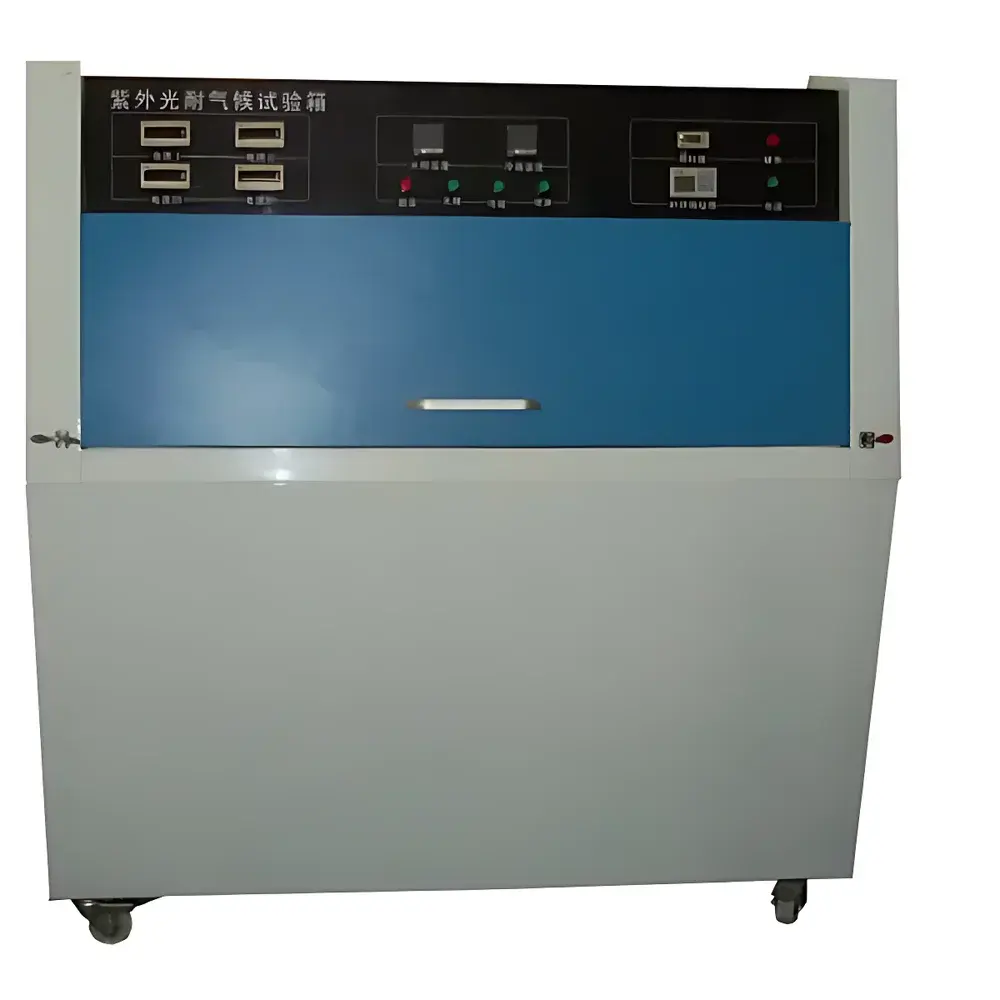
JianHu JH-Series UV Aging Test Chamber
| Brand | JianHu |
|---|---|
| Origin | Shanghai, China |
| Model | JH-Series UV Aging Test Chamber |
| Humidity Range | ≥95% RH (in-chamber actual value) |
| UV Lamp Power | 40 W per lamp |
| Irradiance Range | 0.72 W/m² (at 340 nm) |
| Exposure Time Control | 1–9999 hours (adjustable) |
| Operating Temperature Range | Consult technical support for application-specific configuration |
Overview
The JianHu JH-Series UV Aging Test Chamber is an engineered environmental simulation system designed to accelerate material degradation through controlled ultraviolet radiation exposure under regulated temperature and humidity conditions. Based on the principles of photochemical degradation kinetics, the chamber replicates the most damaging portion of solar UV spectrum—primarily UVA (315–400 nm) and UVB (280–315 nm)—to induce polymer chain scission, oxidation, and surface embrittlement in a reproducible laboratory setting. Unlike natural outdoor exposure—which may require months or years to yield measurable deterioration—the JH-Series enables predictive lifetime assessment within days or weeks. Its architecture conforms to core photostability testing paradigms defined in ASTM G154 (Standard Practice for Operating Fluorescent Ultraviolet (UV) Lamp Apparatus for Exposure of Non-Metallic Materials) and ISO 4892-3 (Plastics — Methods of exposure to laboratory light sources — Part 3: Fluorescent UV lamps). The system is not intended for sterilization or germicidal applications; its purpose is strictly materials performance qualification under accelerated weathering protocols.
Key Features
- High-stability fluorescent UV lamps (UVA-340 or UVB-313 selectable per test standard requirements), each rated at 40 W nominal power, with calibrated spectral output traceable to NIST-traceable reference spectroradiometers
- Precision humidity control system maintaining ≥95% RH within the working chamber volume, achieved via integrated steam generator and condensation management circuitry
- Programmable exposure timer supporting continuous or cyclic operation from 1 to 9999 hours, with non-volatile memory retention during power interruption
- Robust stainless-steel interior chamber construction (SUS304) resistant to UV-induced corrosion and ozone accumulation
- Front-access viewing window with multi-layer UV-blocking glass (≥99.9% attenuation below 400 nm) and integrated safety interlock
- Compliance-ready design incorporating hardware-level irradiance monitoring ports and optional data logging interfaces for audit trail generation
Sample Compatibility & Compliance
The JH-Series accommodates flat-panel specimens up to 600 mm × 600 mm × 50 mm (W × D × H), with standardized sample racks permitting uniform irradiance distribution across the test plane (per ASTM G154 Section 6.2). Compatible substrates include thermoplastics (e.g., ABS, PC, PP), coatings (automotive clearcoats, architectural paints), elastomers (EPDM, silicone), textiles, and laminated composites. The system supports test methodologies aligned with ISO 4892-3, ASTM D4329 (Plastic Testing in Fluorescent UV and Condensation Apparatus), and GB/T 14522 (Chinese national standard for mechanical property evaluation after UV exposure). While not certified to IEC 60068-2-5 or MIL-STD-810H by default, the chamber’s operational envelope permits adaptation to those protocols via firmware-defined cycling profiles and third-party calibration validation.
Software & Data Management
The JH-Series operates via embedded microcontroller-based logic with local LCD interface; no proprietary PC software is required for basic operation. However, optional RS-485/Modbus RTU or Ethernet TCP/IP communication modules enable integration into centralized lab management systems (LIMS) or MES platforms. All exposure parameters—including elapsed time, lamp-on duration, and chamber humidity—are logged with timestamped records stored internally for ≥30 days. For GLP/GMP-regulated environments, optional 21 CFR Part 11-compliant add-ons provide electronic signature capability, audit trail export (CSV/Excel), and role-based access control—validated through third-party verification reports upon request. Raw irradiance data (if equipped with optional calibrated sensor) is recorded at 1-minute intervals and referenced to ISO/CIE spectral weighting functions.
Applications
This chamber serves as a primary qualification tool in R&D laboratories and QC departments across industries where long-term outdoor durability is mission-critical. In automotive supply chains, it validates pigment stability in exterior trim and headlamp lenses per SAE J2020. In architectural product development, it verifies colorfastness and gloss retention of facade sealants and PVC cladding under simulated subtropical conditions. Electronics manufacturers use it to assess UV resistance of conformal coatings on PCB assemblies prior to field deployment in equatorial regions. Academic research groups apply it in polymer degradation studies—correlating carbonyl index growth (via FTIR) with irradiance dose—and in photocatalytic nanomaterial screening where TiO₂-coated surfaces undergo controlled UV activation. It is also routinely deployed in third-party testing labs accredited to ISO/IEC 17025 for issuing certified weathering reports.
FAQ
What UV spectral bands does the JH-Series simulate?
The standard configuration uses UVA-340 lamps, which closely match terrestrial sunlight down to 295 nm. UVB-313 lamps are available as an option for more aggressive, non-sunlight-simulating stress testing.
Is condensation cycling supported?
Yes—condensation cycles can be programmed via timed humidity saturation phases, enabling ASTM G154 Cycle 1 (UV only) and Cycle 4 (UV + condensation) execution.
Can irradiance be adjusted during a test?
Irradiance is fixed per lamp type and aging state; real-time adjustment is not implemented. However, lamp replacement schedules and output decay compensation tables are provided in the user manual.
Does the chamber meet FDA or EU regulatory requirements for medical device packaging validation?
While not pre-certified, the system’s repeatability (±3% irradiance uniformity across test plane) and traceable calibration path support validation per ISO 11607-1 Annex C when paired with documented IQ/OQ/PQ protocols.
What maintenance intervals are recommended?
UV lamps require replacement every 1600–2000 hours of operation; humidity sensors should be verified quarterly using saturated salt solutions; chamber seals inspected biannually for compression set.



