
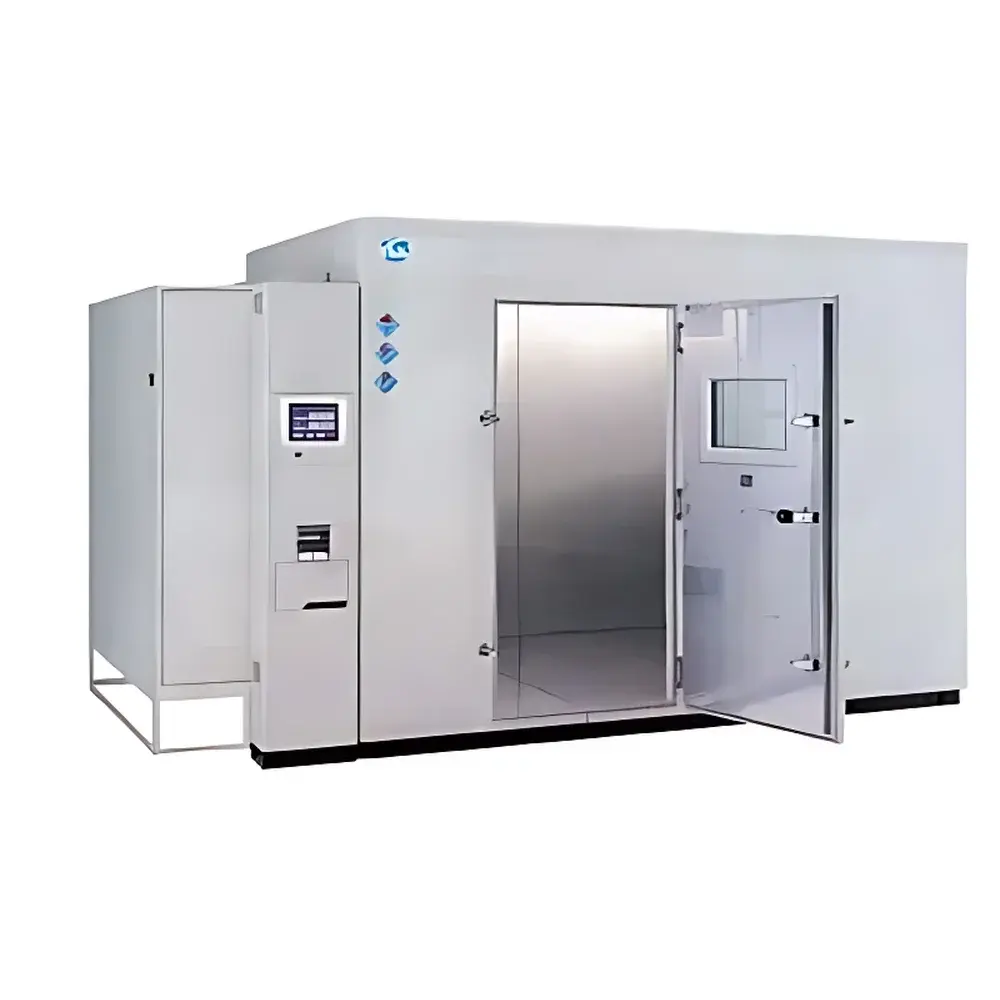
Jianhu JH Walk-in Environmental Test Chamber (Burn-in Room / Climate Stress Screening Room)
| Brand | Jianhu |
|---|---|
| Origin | Shanghai, China |
| Model | JH |
| Type | Walk-in Environmental Test Chamber |
| Compliance | GB/T 5170.2–5170.6–1995 (IEC 60068-3 series equivalent) |
| Construction | Modular insulated chamber with SUS#304 interior and color-coated steel exterior |
| Refrigeration | Semi-hermetic German-made compressor |
| Humidity System | Steam-based humidification with RO-purified water supply |
| Control Interface | Color TFT touchscreen with programmable logic controller (PLC), multi-segment ramp-soak profiles, real-time fault logging, and timer-based auto-start/stop |
| Humidity Sensing | Capacitive polymer sensor (no wick maintenance, water-free measurement) |
| Control Method | Water vapor partial pressure (WVPP) feedback for stable RH regulation |
| Power Management | Staggered heating/humidification output to limit inrush current |
| Defrost | Hot-gas defrost circuit for uninterrupted low-temperature operation |
| Optional Refrigerant | HFC-based (R404A/R507 compliant |
| Safety | Integrated leakage circuit breaker, emergency egress door latch, dual-channel power interlock for DUT supply, and over-temperature/over-humidity cut-off |
| Standard Accessories | Built-in chart recorder, distilled water generator, and ESS (Environmental Stress Screening) mode preset |
Overview
The Jianhu JH Walk-in Environmental Test Chamber is an industrial-grade, large-volume climate-controlled enclosure engineered for reliability validation, burn-in screening, and environmental stress testing of electronic systems, automotive components, aerospace subassemblies, and other high-value physical products. Designed to meet the metrological requirements of GB/T 5170.2–5170.6–1995 — which aligns with IEC 60068-3-1 through -3-6 for temperature and humidity test equipment calibration — this chamber delivers traceable thermal and hygrometric performance across extended operational ranges. Its core architecture integrates a semi-hermetic German-manufactured compressor, steam-based humidification with reverse-osmosis (RO)-purified water feed, and capacitive polymer humidity sensing that eliminates wick-dependent calibration drift. Unlike conventional chambers relying on relative humidity (RH) setpoint control alone, the JH system employs water vapor partial pressure (WVPP) as the primary feedback parameter, minimizing overshoot during rapid transitions and preventing thermal runaway under high-load conditions. The chamber supports continuous operation from −40 °C to +85 °C and 20 %RH to 98 %RH, with typical stability of ±0.5 °C and ±2 %RH under steady-state conditions.
Key Features
- Modular walk-in construction using 100 mm thick polyurethane-insulated panels, with SUS#304 stainless steel interior and color-coated steel exterior for corrosion resistance and cleanroom compatibility.
- Intelligent PLC-based control system featuring a 10.4″ color TFT touchscreen interface, supporting up to 99 programmable segments with ramp/soak logic, user-defined alarm thresholds, and real-time data trending.
- Capacitive humidity sensor with factory-calibrated accuracy traceable to NIM (National Institute of Metrology, China); requires no distilled water replenishment or textile wick maintenance.
- Dual-circuit hot-gas defrost system enabling uninterrupted operation at sub-zero temperatures — critical for long-duration cold soak and thermal cycling applications.
- Staggered electrical output management: heating and humidification circuits are sequenced to reduce peak current draw, ensuring compatibility with standard industrial 3-phase 380 V/50 Hz power infrastructure.
- Integrated safety architecture including Class II leakage protection, emergency exit latching mechanism, dual-channel DUT power interlock, and independent over-temperature/over-humidity cut-off relays.
Sample Compatibility & Compliance
The JH chamber accommodates full-system validation of large-format devices such as server racks, automotive ECUs, avionics enclosures, medical imaging subsystems, and printed circuit board assemblies undergoing ESS (Environmental Stress Screening). Its internal dimensions are fully customizable to support footprint requirements from 2 m³ to over 50 m³. All units comply with GB/T 5170.2–5170.6–1995 for verification of temperature uniformity (±2 °C), temperature fluctuation (±0.5 °C), humidity uniformity (±3 %RH), and humidity fluctuation (±2 %RH) across the working volume. The system supports GLP/GMP-aligned audit trails when paired with optional data logger modules compliant with FDA 21 CFR Part 11 requirements (electronic signature, change control, and secure archive functions). It is routinely deployed in ISO/IEC 17025-accredited laboratories performing qualification per MIL-STD-810G, JEDEC JESD22-A108, and IEC 60068-2-14 (thermal shock) and -2-30 (damp heat cyclic) standards.
Software & Data Management
The embedded control firmware provides native support for CSV export of time-stamped temperature, humidity, and alarm event logs via USB or Ethernet. Optional PC-based software (Jianhu TestLink Pro) enables remote monitoring, multi-chamber synchronization, statistical process control (SPC) charting, and automated report generation in PDF or Excel format. All recorded data include timestamp, sensor ID, operator login, and configuration version — satisfying traceability requirements for ISO 9001:2015 Clause 8.5.2 and IATF 16949 Section 8.5.1.2. Firmware updates are performed via signed binary packages to prevent unauthorized modification, and all parameter changes are logged with user ID and timestamp for regulatory review.
Applications
- Burn-in screening of semiconductor devices, power modules, and embedded controllers at elevated temperatures (45 °C–85 °C) under powered conditions to accelerate infant mortality failure modes.
- Environmental Stress Screening (ESS) per MIL-HDBK-344 and JEDEC J-STD-020 for identifying latent defects prior to field deployment.
- Thermal aging studies for polymer-based enclosures, battery packs, and conformal coatings under combined temperature-humidity stress.
- Dynamic functional testing — e.g., printer paper-feed reliability, robotic actuator repeatability, or HVAC controller response — within controlled climatic boundaries.
- Pre-compliance verification for IEC 60068-2 series, UL 1577, and AEC-Q200 component qualification protocols.
FAQ
What is the difference between a standard environmental chamber and a Burn-in Room?
A Burn-in Room is specifically configured for powered-in operation at elevated temperatures (typically 45 °C–85 °C), with integrated DUT power distribution and safety interlocks. It prioritizes thermal load capacity and electrical isolation over fine-grained humidity resolution.
Does the JH chamber support low-GWP refrigerants?
Yes — while R404A and R507 are standard, the refrigeration circuit can be recharged with EPA SNAP-approved alternatives (e.g., R449A, R452A) upon request and subject to local regulatory approval.
Can the chamber operate continuously at −40 °C?
Yes — the hot-gas defrost system and reinforced insulation allow uninterrupted operation down to −40 °C without manual intervention or cycle interruption.
Is humidity control based on RH or WVPP?
Primary humidity regulation uses water vapor partial pressure (WVPP) feedback, ensuring thermodynamic consistency across wide temperature ranges and eliminating RH setpoint ambiguity near dew point.
What documentation is provided for compliance verification?
Each unit ships with a Factory Calibration Certificate (traceable to NIM), GB/T 5170 verification report, CE Declaration of Conformity, and electrical safety test records per GB 4793.1.



