
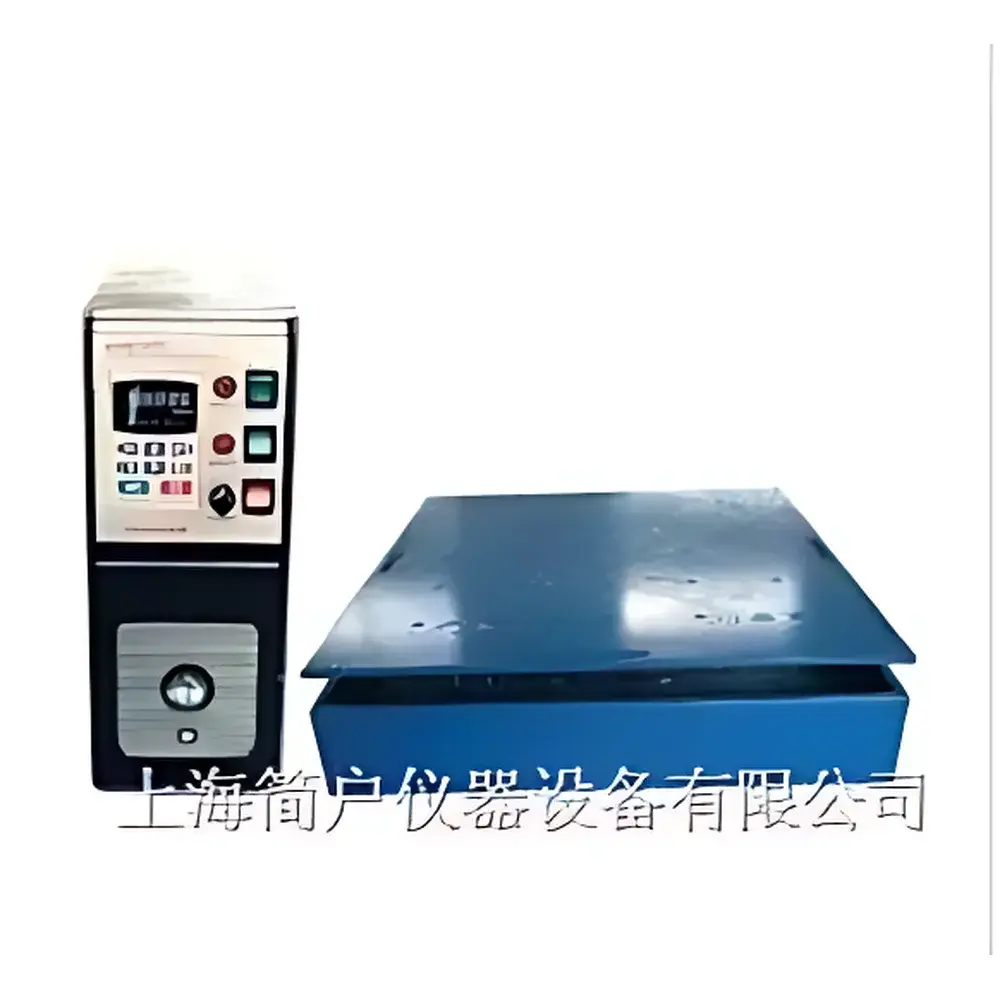
Jianhu JDZD-F Combined Temperature-Humidity-Vibration Test System
| Brand | Jianhu |
|---|---|
| Origin | Fujian, China |
| Manufacturer Type | Authorized Distributor |
| Country of Origin | China |
| Model | JDZD-F |
| Quotation | Available Upon Request |
| Frequency Range | 1–400 Hz |
| Sweep Range | 1–400 Hz |
| Maximum Load Capacity | 100 kg |
| Peak-to-Peak Amplitude | 0–5 mm |
| Maximum Acceleration | 20 g |
| Vibration Axes | Vertical, Horizontal, or Dual-Axis (Vertical + Horizontal) |
| Vibration Waveform | Sinusoidal |
| Control Modes | Programmable, Sine, Amplitude Modulation, Linear/Logarithmic Sweep, Octave Sweep |
| Time Control Capability | Full programmable timing for sweep, modulation, dwell, and step functions |
| Drive Power | 2.2 kW |
| Table Dimensions | 500 mm × 500 mm |
| Supply Voltage | 220 V ±20% |
Overview
The Jianhu JDZD-F Combined Temperature-Humidity-Vibration Test System is an integrated environmental stress screening platform engineered for rigorous reliability validation of electronic components, automotive modules, aerospace subsystems, and industrial packaging under synchronized thermal, hygrothermal, and mechanical dynamic loads. Unlike standalone vibration shakers or climatic chambers, the JDZD-F implements a tightly coupled triaxial (temperature–humidity–vibration) control architecture compliant with IEC 60068-2-52, MIL-STD-810H Method 514.7, and ISO 16750-3 test protocols. Its core vibration actuator employs electromagnetic force generation based on Lorentz principle, delivering high-fidelity sinusoidal excitation across 1–400 Hz with closed-loop acceleration feedback via integrated piezoelectric accelerometers. The system’s dual-axis capability—supporting independent or simultaneous vertical/horizontal excitation—enables realistic simulation of multi-directional road-induced fatigue, aircraft cabin resonance, or shipping container dynamics.
Key Features
- Triple-stress integration: Precisely coordinated control of temperature (−70°C to +180°C), relative humidity (10–98% RH), and mechanical vibration within a single test chamber
- High-dynamic electromagnetic shaker with 20 g peak acceleration capability and 0–5 mm peak-to-peak displacement range
- Programmable waveform synthesis: Supports fixed-frequency sine, amplitude-modulated (AM) sine, linear/logarithmic sweeps, octave sweeps, and user-defined time-history profiles
- Real-time closed-loop control: Acceleration, velocity, and displacement feedback channels ensure traceable compliance with test spectra per ASTM D4728 and GR-63-CORE
- Robust structural design: Reinforced stainless-steel worktable (500 mm × 500 mm) rated for 100 kg payload with minimal modal interference up to 400 Hz
- Integrated 2.2 kW Class-D amplifier with thermal overload protection and EMI-filtered power conditioning
- Comprehensive data logging: Synchronized acquisition of chamber parameters (T/RH), shaker output (g, mm, Hz), and DUT response signals at ≥1 kHz sampling rate
Sample Compatibility & Compliance
The JDZD-F accommodates test specimens up to 100 kg mass and 500 mm × 500 mm footprint, with optional fixture adapters for PCB assemblies, ECUs, battery packs, and sealed enclosures. Its environmental chamber meets ISO 16750-4 (automotive), IPC-9701A (printed board reliability), and JEDEC JESD22-B103E (mechanical shock) dimensional and sealing requirements. All control firmware adheres to IEC 61508 SIL2 functional safety principles for test sequence integrity. Calibration documentation supports traceability to NIST-traceable standards via accredited third-party labs; routine verification follows ISO/IEC 17025 procedures. The system is designed to operate within GLP-compliant laboratories and supports audit-ready event logs required under FDA 21 CFR Part 11 for regulated medical device validation.
Software & Data Management
Control and analysis are managed through Jianhu’s proprietary TestMaster Pro v4.x software, a Windows-based application supporting hierarchical test definition, real-time spectrum monitoring, and post-test FFT/PSD analysis. The software enforces role-based access control (RBAC), electronic signatures, and immutable audit trails—including operator ID, timestamped parameter changes, and automatic backup of raw waveform files in IEEE 1558-compliant .tdms format. Export options include CSV, MATLAB .mat, and PDF-certified reports with embedded digital signatures. Remote monitoring via HTTPS-enabled web interface allows secure off-site supervision without compromising firewall integrity. Data archival complies with ISO 27001 encryption standards and integrates with enterprise LIMS platforms via OPC UA 1.04 interface.
Applications
- Accelerated life testing of automotive infotainment systems under combined thermal cycling and road-spectrum vibration
- Qualification of avionics enclosures per DO-160G Section 8 (vibration) and Section 4/5 (temperature/humidity)
- Reliability assessment of lithium-ion battery modules subjected to transport-simulated random+sinusoidal profiles
- Failure mode identification in consumer electronics during HALT/HASS routines with controlled humidity ramping
- Validation of military-grade connectors and cable harnesses per MIL-DTL-55302 and MIL-STD-202G
- Package integrity evaluation of pharmaceutical primary containers under ISTA 3A and ASTM D4169-22 distribution profiles
FAQ
What standards does the JDZD-F support out-of-the-box?
The system includes preloaded test templates for IEC 60068-2-64 (random vibration), IEC 60068-2-6 (sinusoidal vibration), ISO 16750-3 (road vehicle vibration), and MIL-STD-810H Method 514.7. Custom profile import via Sine, Random, Shock, and Transient formats is fully supported.
Is remote operation and data export compliant with FDA 21 CFR Part 11?
Yes. TestMaster Pro implements electronic signatures, audit trail archiving, and role-based permissions meeting Part 11 requirements for electronic records and signatures in regulated environments.
Can the system perform simultaneous vertical and horizontal vibration?
Yes—the JDZD-F offers true dual-axis excitation with independent drive amplifiers and phase-synchronized control, enabling correlated or uncorrelated motion profiles per ISO 10816-4 Annex B.
What is the calibration interval recommendation?
Annual full-system calibration is recommended, with quarterly verification of accelerometer sensitivity and chamber sensor linearity using NIST-traceable reference standards.
Does the system support third-party hardware integration?
Yes—via analog I/O (±10 V, 16-bit), digital TTL triggers, and Ethernet-based TCP/IP commands, allowing synchronization with external DAQ systems, power supplies, or optical measurement tools.
Related Products



