
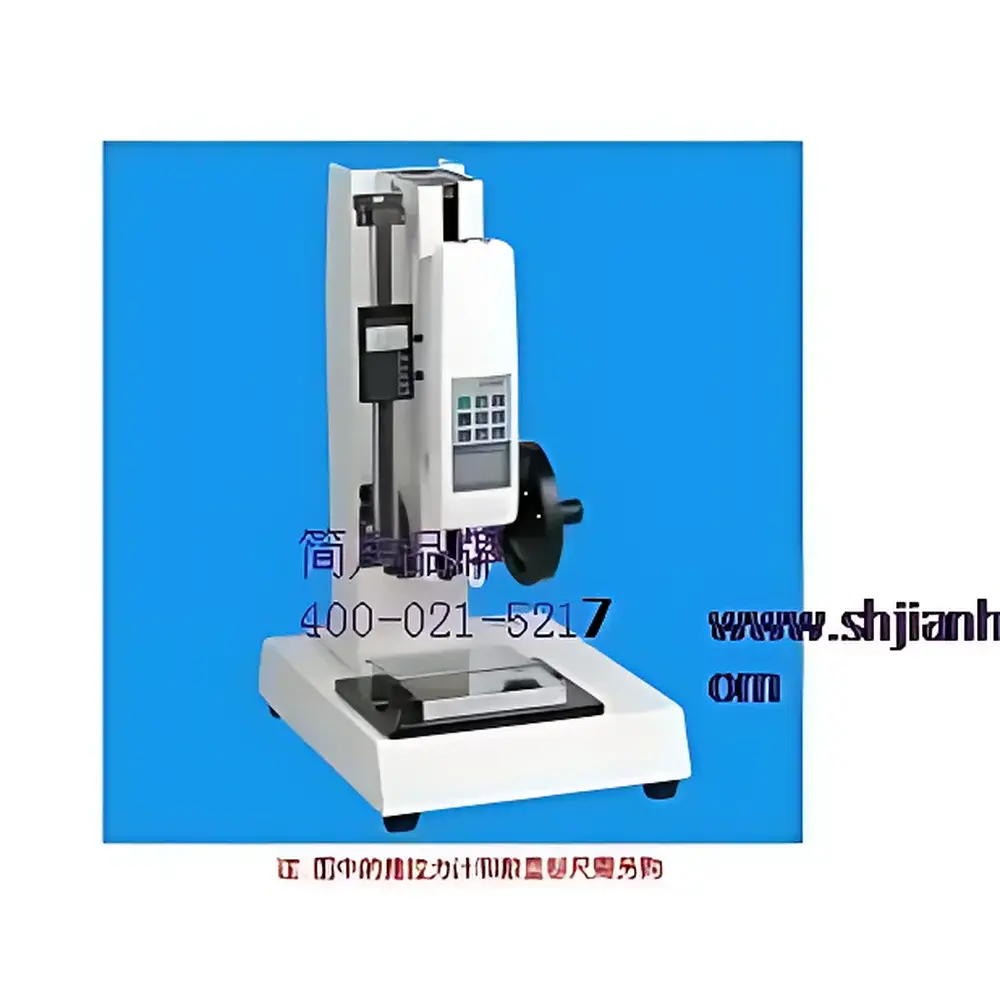
Jianhu Manual Vertical Side-Crank Testing Stand
| Origin | Shanghai, China |
|---|---|
| Manufacturer Type | Distributor |
| Origin Category | Domestic (China) |
| Model | Jianhu |
| Pricing | Available Upon Request |
Overview
The Jianhu Manual Vertical Side-Crank Testing Stand is a precision-engineered mechanical test platform designed for integration with digital and analog push-pull force gauges (e.g., HF-series digital gauges and NK-series analog gauges). It operates on a manual mechanical principle—utilizing a trapezoidal lead screw driven by a side-mounted handwheel—to deliver controlled, repeatable axial loading in vertical orientation. Unlike motorized or servo-driven systems, this stand relies on human-operated torque input, eliminating electrical dependencies and enabling use in environments where EMI sensitivity, power constraints, or cost-effectiveness are critical. Its primary function is to support static and quasi-static mechanical property evaluation—including insertion/extraction force, button actuation force, snap-fit engagement/disengagement, and controlled destructive testing—under defined displacement or load conditions. The stand’s rigid base and low center of gravity ensure minimal deflection during measurement, supporting high reproducibility in benchtop laboratory and QC environments.
Key Features
- Stable vertical frame with reinforced 350 mm × 260 mm × 500/700 mm footprint (two height options), optimized for desktop deployment and calibrated force measurement.
- Trapezoidal-thread lead screw mechanism with side-mounted ergonomic handwheel—ensuring smooth, backlash-minimized linear motion and precise manual control over test speed and loading rate.
- Integrated XY translation stage (standard on base plate) enabling fine lateral and longitudinal positioning of test specimens relative to the force gauge axis—critical for alignment-sensitive applications such as connector mating or micro-switch actuation.
- Modular mounting interface compatible with both M3- and M4-threaded force gauges; includes dedicated adapter plates and hardware kits for HF (digital) and NK (analog) series gauges per ISO 7500-1 mounting standards.
- Optional ASC-S digital displacement sensor mount—supports synchronized acquisition of force vs. displacement data at 0.01 mm resolution when paired with compatible digital gauges or external data loggers.
- Fixed-load capacity variants: 500 N (standard) and 3000 N (heavy-duty)—each rated per ISO 376 calibration traceability requirements for class 1 force measurement systems.
Sample Compatibility & Compliance
The stand accommodates a broad range of small- to medium-scale components requiring mechanical integrity verification—such as PCB edge connectors, USB/Audio jacks, membrane switches, medical device latches, and consumer electronics housings. Its open-frame geometry permits unobstructed access for fixturing custom jigs or vacuum chucks. All structural components comply with GB/T 2611–2007 (Chinese national standard for testing machine general requirements) and align with mechanical safety provisions of ISO 12100. When used with certified force gauges meeting ISO 376:2019 (metallic load cells) or ASTM E4 (force verification of testing machines), the integrated system supports GLP-compliant documentation workflows. Displacement data from ASC-S sensors meet resolution thresholds required for ASTM F1874 (connector insertion force) and IEC 60512-2-1 (electromechanical component testing).
Software & Data Management
As a manually operated mechanical platform, the stand itself does not include embedded firmware or onboard software. However, it is fully interoperable with third-party data acquisition ecosystems. When paired with HF-series digital force gauges (which output RS-232/USB serial data), users may log synchronized force–displacement profiles using vendor-provided PC software or generic DAQ platforms (e.g., LabVIEW, MATLAB Data Acquisition Toolbox). All ASC-S digital calipers support Modbus RTU or TTL-level quadrature output, enabling direct integration into SCADA or MES environments. Audit trails, user permissions, and electronic signatures can be implemented at the host software layer to satisfy FDA 21 CFR Part 11 requirements where applicable.
Applications
- Insertion and extraction force testing of electrical connectors per IEC 60512-2-1 and MIL-STD-883 Method 2011.
- Actuation force validation of tactile feedback mechanisms in automotive HMI interfaces and industrial control panels.
- Controlled compression testing of elastomeric gaskets, O-rings, and soft-touch buttons under fixed-displacement protocols.
- Destructive pull-off testing of adhesively bonded assemblies (e.g., display modules, sensor housings) with real-time load monitoring.
- Educational demonstration of Hooke’s law, yield point identification, and load–deflection hysteresis in materials science laboratories.
FAQ
What is the maximum allowable load for routine non-destructive testing?
For sustained operational reliability and metrological integrity, the 500 N variant is rated for continuous use up to 400 N; the 3000 N version is rated up to 2400 N.
Can this stand be bolted directly to an optical table or vibration-isolated surface?
Yes—the base plate features four countersunk M6 threaded holes (20 mm pitch) conforming to ISO 2768-mK general tolerances, allowing secure anchoring without modification.
Is lubrication required during regular operation?
A single drop of ISO VG 32 mineral oil applied biannually to each side bearing grease port maintains optimal screw efficiency and minimizes wear-induced hysteresis.
Does the stand support automated test sequencing?
No—it is strictly manual. For programmable stroke control or cyclic loading, consider coupling it with an external stepper-motor actuator and motion controller.
How is traceable calibration maintained across the force–displacement chain?
Force calibration must be performed on the gauge separately per ISO 376; displacement calibration of the ASC-S sensor follows ISO 13028. The stand itself requires no periodic recalibration but should undergo visual inspection for thread wear and bearing play every 6 months.



