
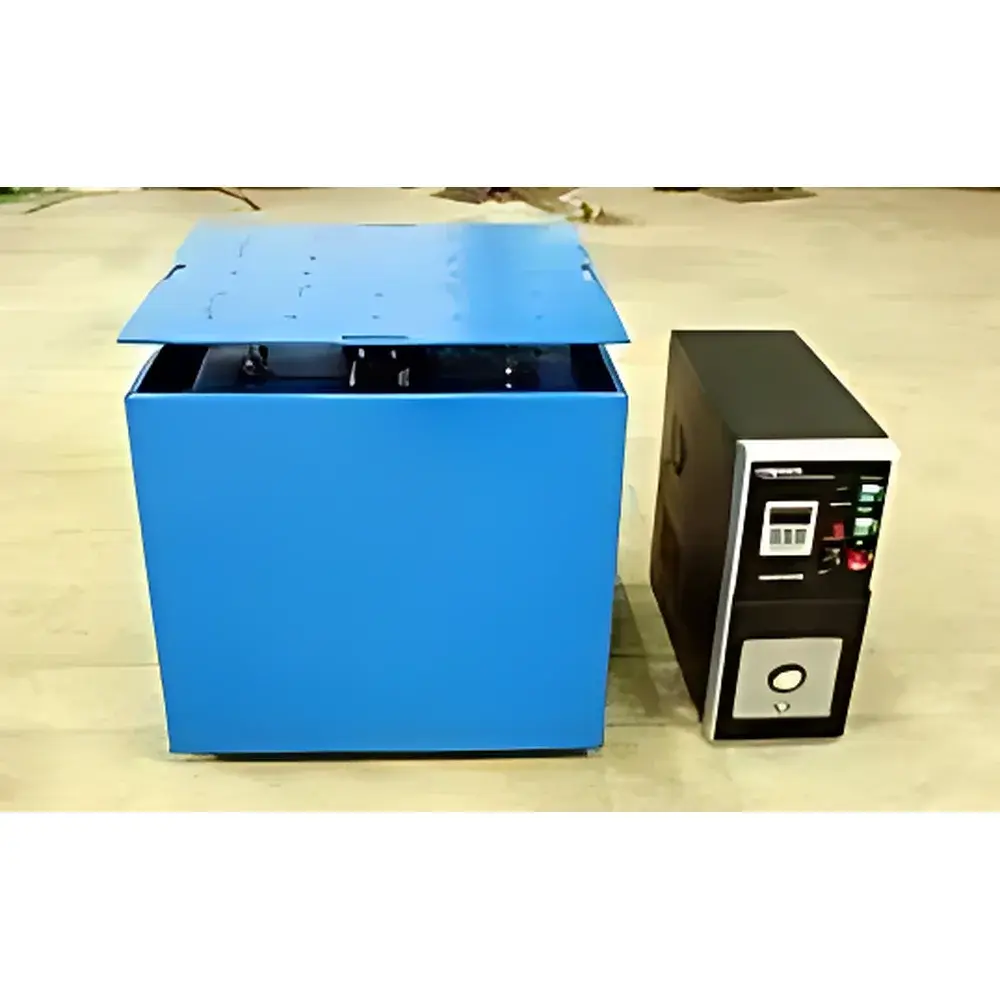
Jianhu JDZD-XPTP 6-DOF Electrodynamic Vibration Shaker System with Integrated PC Control
| Brand | Jianhu |
|---|---|
| Origin | Shanghai, China |
| Type | Electrodynamically Driven 6-Axis Vibration Shaker |
| Rated Thrust | 0–900 kgf |
| Frequency Range | 1–600 Hz (display resolution: 0.01 Hz, accuracy: ±0.1 Hz) |
| Max. Test Load | 100 kg |
| Table Dimensions | 500 mm × 500 mm × 10 mm (L×W×H) |
| Peak Acceleration | 20 g (rms up to 14.1 g) |
| Displacement (p-p) | 0–5 mm |
| Power Consumption | 3.3 kW |
| Input Voltage | 220 V ±20% |
| Communication Interface | RS-485 |
| Compliance | Designed per ISO 5344, IEC 60068-2-6, and ASTM D999 test standards |
Overview
The Jianhu JDZD-XPTP is a fully integrated 6-degree-of-freedom (6-DOF) electrodynamic vibration shaker system engineered for high-fidelity mechanical stress testing across aerospace, automotive, electronics, and packaging industries. Unlike conventional single- or dual-axis shakers, this platform delivers synchronized, programmable motion along all three translational axes (X, Y, Z) and their coupled combinations—enabling true six-axis excitation in a single test plane. Its core actuation relies on a robust electromagnetic force generation architecture, delivering precise control over acceleration, displacement, and velocity profiles under closed-loop feedback. The system operates within a validated frequency bandwidth of 1–600 Hz, supporting both deterministic (sine, swept-sine, stepped-sine) and stochastic (random, pseudo-random) excitation modes. All motion parameters are traceable to SI units and calibrated per ISO/IEC 17025-accredited procedures. The integrated PC interface provides real-time waveform visualization, data logging, and audit-ready reporting—essential for GLP/GMP-compliant validation environments.
Key Features
- True 6-DOF synchronized motion: simultaneous independent or coupled control of X (left-right), Y (up-down), and Z (front-back) axes—configurable for discrete axis operation, dual-axis combinations (e.g., XY, YZ, XZ), sequential axis cycling, or full 6-axis coordinated vibration.
- Multi-mode excitation capability: supports sine (full/half-wave), frequency modulation (FM), linear/logarithmic sweep, programmable multi-segment profiles (up to 15 segments), octave-based frequency doubling, and Gaussian random vibration with user-defined PSD profiles.
- High-force electrodynamic actuator: rated thrust up to 900 kgf (≈8.8 kN), enabling rigorous qualification testing of mid-size assemblies (up to 100 kg payload) at peak accelerations of 20 g and peak-to-peak displacements up to 5 mm.
- Industrial-grade test table: 500 mm × 500 mm stainless steel surface with 25 × M10 threaded mounting holes (grid spacing: 50 mm) and four reinforced hook-mounting slots (175 mm length) for fixture anchoring and load restraint.
- Real-time parameter monitoring: onboard digital signal processing enables continuous display of instantaneous frequency (0.01 Hz resolution), acceleration (g), displacement (mm p-p), and velocity (mm/s)—with optional external metrology integration via analog/digital I/O expansion.
- RS-485 communication interface standard; compatible with third-party control software (e.g., VibrationVIEW, m+p VibControl) when paired with an external interface card and host PC.
Sample Compatibility & Compliance
The JDZD-XPTP accommodates rigid and semi-rigid test specimens up to 100 kg, including printed circuit board assemblies (PCBAs), automotive ECUs, consumer electronics enclosures, medical device housings, and military-grade avionics modules. Fixture design must ensure center-of-gravity alignment within ±25 mm of the table’s geometric center to maintain motion fidelity and avoid torque-induced resonance artifacts. The system complies with key international environmental test standards, including ISO 5344 (vibration test machines — specification and verification), IEC 60068-2-6 (sinusoidal vibration testing), and ASTM D999 (vibration testing of shipping containers). While not certified for FDA 21 CFR Part 11 out-of-the-box, its data export architecture supports CSV/TXT log formats suitable for post-processing in 21 CFR Part 11–compliant LIMS or ELN platforms.
Software & Data Management
The system operates via a dedicated Windows-based host application accessible through the integrated PC. Core functionalities include waveform synthesis, real-time spectrum monitoring (FFT up to 16,384 lines), time-history recording (sample rate up to 51.2 kHz), and automated report generation (PDF/Excel). All test sessions are timestamped and logged with operator ID, configuration parameters, and pass/fail criteria. Audit trails record configuration changes, start/stop events, and calibration status—supporting internal quality audits and ISO 9001 documentation requirements. Raw binary data (.bin) files are stored with embedded metadata (frequency range, segment count, dwell times, loop iterations), ensuring full reproducibility. Optional add-ons include remote access via secure RDP, API-driven automation (COM/ActiveX), and integration with PLC-based factory MES systems.
Applications
- Aerospace component qualification: fatigue life assessment of satellite mounting brackets under combined-axis launch vibration spectra (e.g., MIL-STD-810H Method 514.8).
- Automotive ECU durability: accelerated aging tests simulating road-induced multi-axis excitations per ISO 16750-3.
- Consumer electronics reliability: drop-and-vibration synergy testing of smartphones and wearables using hybrid sine-random profiles.
- Packaging integrity validation: ISTA 3A/3E-compliant transport simulation with programmable dwell, sweep, and random phases.
- Research-grade modal analysis: experimental determination of structural natural frequencies and damping ratios via controlled broadband excitation.
FAQ
Does the system support real-time closed-loop control with external accelerometers?
Yes—when equipped with an optional analog input module and calibrated triaxial accelerometers, the system performs real-time feedback control using PID or adaptive algorithms to maintain target PSD or sine amplitude within ±0.5 dB tolerance.
Is the 20 g acceleration rating achievable across the full 1–600 Hz range?
No—the 20 g peak is specified at frequencies ≥20 Hz; below 20 Hz, displacement limits (5 mm p-p) govern performance. A dynamic constraint envelope ensures compliance with both acceleration and displacement boundaries simultaneously.
Can the shaker perform simultaneous random + sine-on-random (SoR) testing?
Not natively—the base configuration supports pure random or pure sine modes. SoR functionality requires firmware upgrade and external signal synthesis hardware (sold separately).
What is the recommended maintenance interval for the voice coil and bearing assembly?
Jianhu specifies 2,000 hours of cumulative operational time or 12 months—whichever occurs first—for preventive inspection of suspension components, thermal sensors, and cooling duct integrity.
Is third-party calibration certification available?
Yes—Jianhu partners with CNAS-accredited metrology labs in Shanghai to provide ISO/IEC 17025 calibration certificates (traceable to NIM), including thrust linearity, frequency response, and transverse motion suppression verification.



