
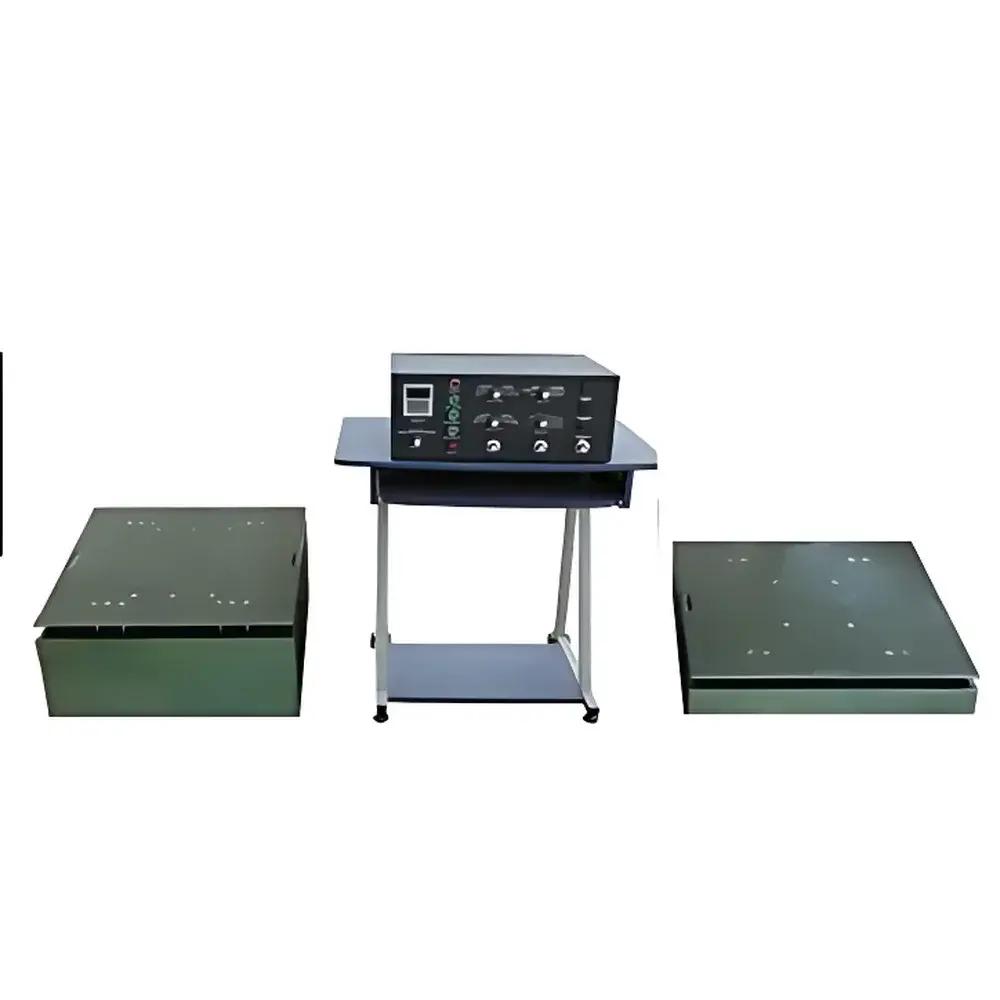
Jianhu JDZD-TF Electromagnetic Vibration Shaker System
| Brand | Jianhu |
|---|---|
| Origin | Shanghai, China |
| Model | JDZD-TF |
| Vibration Mode | Vertical Only |
| Frequency Range | 1–400 Hz |
| Max. Load Capacity | 100 kg |
| Peak-to-Peak Amplitude | 0–5 mm |
| Acceleration Capability | Up to 20 g (peak) |
| Waveform | Sinusoidal |
| Control Mode | Programmable Sine, Sweep (Linear/Logarithmic), Amplitude Modulation, Time-Based Test Sequencing |
| Drive Power | 2.2 kW |
| Table Size | 50 cm × 50 cm |
| Input Voltage | 220 V ±20% |
| Compliance | GB/T 2423.10, IEC 60068-2-6 (Fc), JJG 189–1997, GB/T 13309–1991 |
| Software Interface | PC-based control with data logging and test report generation |
Overview
The Jianhu JDZD-TF Electromagnetic Vibration Shaker System is a precision-engineered electrodynamic vibration test platform designed for laboratory-grade environmental simulation of mechanical shock and sinusoidal vibration stress. Operating on electromagnetic excitation principles, it delivers controlled, repeatable acceleration profiles across a broad frequency spectrum (1–400 Hz) to replicate real-world transport, handling, and operational vibratory environments. This system is purpose-built for reliability validation in R&D, quality assurance, and production-line testing workflows—particularly where compliance with international vibration test standards is mandatory. Its robust voice-coil actuator architecture ensures high force-to-mass ratio, low harmonic distortion, and thermal stability during extended duty cycles. Unlike hydraulic or servo-hydraulic shakers, the JDZD-TF offers rapid start-up, minimal maintenance, and precise low-frequency resolution—making it ideal for electronics packaging integrity assessment, PCB solder joint fatigue analysis, automotive component durability screening, and medical device drop-and-vibration qualification.
Key Features
- Electrodynamic shaker design with 2.2 kW linear power amplifier and high-efficiency moving coil assembly
- Programmable sine vibration capability with user-defined amplitude, frequency, dwell time, and sweep rate (linear or logarithmic)
- Real-time digital monitoring of acceleration (g), displacement (mm p-p), and velocity (mm/s) via integrated feedback sensors
- Dedicated vertical-axis configuration optimized for ISO/IEC standard-compliant mounting—no cross-axis coupling or rotational instability
- 50 cm × 50 cm rigid aluminum test table with threaded mounting patterns (M6/M8) and T-slots for fixture adaptability
- Integrated safety interlocks including over-temperature cutoff, over-acceleration limiter, and emergency stop circuit per IEC 61508 SIL2 requirements
- Front-panel LCD interface with intuitive menu navigation plus optional Ethernet/USB PC connectivity for remote operation
Sample Compatibility & Compliance
The JDZD-TF accommodates test specimens up to 100 kg gross mass, with dynamic response validated for rigidly mounted units ranging from small PCB assemblies (<0.5 kg) to mid-size enclosures (e.g., automotive ECUs, industrial HMIs). Fixture design must ensure center-of-gravity alignment within ±15 mm of table centerline to maintain waveform fidelity. The system meets the mechanical and metrological requirements of GB/T 2423.10–2019 (equivalent to IEC 60068-2-6:2019), JJG 189–1997 (national verification regulation for vibration calibrators), and GB/T 13309–1991 (vibration testing methods for mechanical products). It supports full traceability documentation for GLP/GMP-regulated environments, with audit-ready calibration records aligned to ISO/IEC 17025-accredited reference standards.
Software & Data Management
The optional PC-based control software provides ISO 17025-aligned test sequence definition, real-time waveform visualization, and automated pass/fail evaluation against user-specified tolerance bands. All test parameters—including drive signal FFT spectra, acceleration time histories, and thermal sensor logs—are timestamped and stored in CSV and binary formats compliant with FDA 21 CFR Part 11 requirements (electronic signatures, audit trails, data integrity controls). Export modules support direct integration with LIMS platforms and statistical process control (SPC) dashboards. Firmware updates are delivered via signed package files with SHA-256 checksum verification.
Applications
- Electronics: Solder joint fatigue life prediction under resonant vibration; connector retention force degradation analysis
- Automotive: ECU housing resonance mapping; sensor mount stiffness validation per LV-124 and GMW14872
- Packaging: Corrugated box compression–vibration interaction modeling per ASTM D999 and ISTA 3A
- Medical Devices: ISO 13485-compliant vibration stress screening of infusion pumps and handheld diagnostics
- Aerospace Components: Pre-qualification of avionics enclosures per DO-160 Section 8 (Vibration)
- Quality Labs: Third-party certification testing for CE marking, CCC, and KC mark submissions
FAQ
What standards does the JDZD-TF explicitly support for test execution and reporting?
It natively executes test profiles defined in GB/T 2423.10, IEC 60068-2-6 (Fc), and JJG 189–1997, with report templates pre-formatted for regulatory submission.
Can the system perform random vibration testing?
No—the JDZD-TF is configured exclusively for deterministic sinusoidal and swept-sine vibration per its hardware architecture and firmware scope.
Is calibration certification included with delivery?
Yes—a factory calibration certificate traceable to NIM (National Institute of Metrology, China) is provided, valid for 12 months from shipment date.
What is the maximum allowable off-center load mass before performance derating occurs?
For amplitudes >3 mm p-p or frequencies >100 Hz, the center-of-gravity offset must not exceed ±10 mm to maintain ≤5% waveform distortion.
Does the system support external trigger synchronization with oscilloscopes or DAQ systems?
Yes—via TTL-compatible BNC sync output (1 PPS and frame-start signals) and analog voltage output (±10 V) proportional to drive current.
Related Products



