
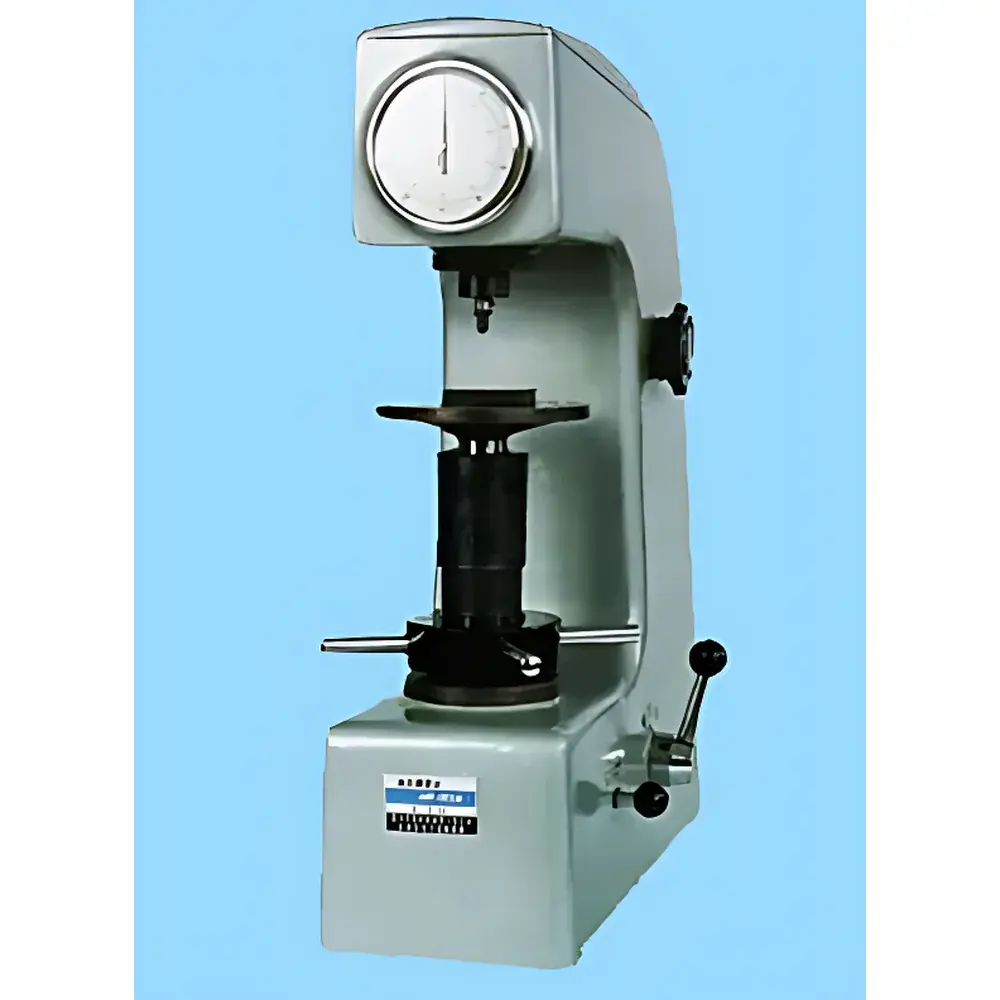
Jinhoo JH Manual Rockwell Hardness Tester
| Brand | Jinhoo |
|---|---|
| Origin | Shanghai, China |
| Manufacturer Type | Authorized Distributor |
| Country of Origin | China |
| Model | JH |
| Pricing | Available Upon Request |
| Rockwell Scales | HRA, HRB, HRC, HRD, HRE, HRF, HRG, HRH, HRK |
| Initial Test Force | 98.07 N (10 kgf) |
| Total Test Forces | 588 N (60 kgf), 980 N (100 kgf), 1471 N (150 kgf) |
| Hardness Range | HRC 20–70, HRB 25–100, HRA 70–88 |
| Indication Method | Analog Dial Gauge |
| Max Specimen Height | 170 mm |
| Dimensions (L×W×H) | 520 × 240 × 700 mm |
| Net Weight | 80 kg |
| Compliance | GB/T 230.2, JJG 112 |
| Standard Accessories | Diamond cone indenter (120° apex angle, 0.2 mm tip radius), 1.5875 mm tungsten carbide ball indenter, large flat anvil, medium flat anvil, V-anvil, certified HRC & HRB reference hardness blocks |
Overview
The Jinhoo JH Manual Rockwell Hardness Tester is a mechanically actuated, non-electronic hardness testing instrument engineered for precision and repeatability in industrial quality control and metallurgical laboratories. It operates on the fundamental Rockwell principle—measuring the depth of permanent indentation under two sequential loads: a minor (initial) force to establish a zero reference, followed by a major (total) test force applied for a specified dwell time. The difference in indentation depth between these two load states is converted directly into a Rockwell hardness number via calibrated mechanical amplification and analog dial readout. Designed for routine verification of heat-treated steels, cast irons, non-ferrous alloys, and bearing materials, this tester delivers high reproducibility without dependency on power supply or digital electronics—making it ideal for environments where electromagnetic interference, operational simplicity, or long-term calibration stability are critical.
Key Features
- Fully mechanical lever-and-gear loading system ensures consistent force application without electronic drift or sensor calibration dependencies.
- Triple-test-force capability (588 N, 980 N, 1471 N) supports all standard Rockwell scales—including HRA (diamond indenter, thin/hard materials), HRB (1.5875 mm ball, softer non-ferrous metals), and HRC (diamond indenter, hardened steels)—as well as HRD, HRE, HRF, HRG, HRH, and HRK for specialized applications.
- Robust cast-iron frame with vibration-dampening base minimizes external influence on indentation depth measurement, enhancing inter-operator consistency.
- Analog dial gauge with 0.5 HR resolution provides immediate, unambiguous hardness reading without software interpretation or display latency.
- Three interchangeable anvils—large flat, medium flat, and V-shaped—accommodate diverse specimen geometries including rods, plates, and irregularly shaped forgings up to 170 mm in height.
- Complies with GB/T 230.2 (equivalent to ISO 6508-2) for verification procedures and JJG 112 national metrological verification regulation, ensuring traceability to Chinese national standards.
Sample Compatibility & Compliance
The JH tester accommodates a broad spectrum of metallic materials commonly encountered in manufacturing QA/QC workflows: quenched and tempered steels, annealed carbon steels, chilled cast iron, malleable iron, aluminum alloys (e.g., 2024, 6061), copper and brass, and case-hardened bearing steels (e.g., GCr15). Specimens must present a stable, flat, or cylindrically supported surface perpendicular to the indenter axis. Minimum thickness requirements follow ISO 6508-1: ≥10× indentation depth (typically ≥1.5 mm for HRC tests). Surface finish should be ≤0.8 µm Ra to avoid false low readings. All hardness blocks supplied are certified per GB/T 230.3 and traceable to NIM (National Institute of Metrology, China). While not FDA 21 CFR Part 11 compliant (as it lacks digital audit trail functionality), its mechanical design satisfies GLP-aligned manual recordkeeping practices when paired with standardized logbooks and technician sign-offs.
Software & Data Management
This is a purely mechanical instrument with no embedded electronics, firmware, or data output interface. Hardness values are recorded manually in laboratory notebooks or LIMS-compatible spreadsheets. For traceable documentation, users are advised to log: date/time, operator ID, specimen ID, scale used, test force applied, anvil type, hardness value(s), and environmental conditions (temperature, humidity). Optional third-party digital calipers or USB microscopes may be used to photograph dial readings for archival purposes, though such additions fall outside the scope of factory calibration.
Applications
- Final inspection of heat-treated components in automotive and aerospace supply chains (e.g., gear teeth, shafts, valve seats).
- In-process verification of annealing or tempering cycles in metalworking facilities.
- Incoming material inspection for raw stock compliance against ASTM A370 or EN 10002-1 specifications.
- Educational use in metallurgy labs for teaching indentation mechanics and scale selection logic.
- Maintenance workshops verifying hardness of repair welds or refurbished tooling prior to service reintegration.
FAQ
Is this tester suitable for testing thin sheet metal?
Yes—provided minimum thickness and surface preparation requirements per GB/T 230.1 are met; use HRA or superficial Rockwell scales (not supported on this model) for thicknesses below 1 mm.
Does it require periodic recalibration by an accredited lab?
Per JJG 112, verification of force accuracy and dial linearity must be performed annually by a metrology institute holding CNAS accreditation.
Can I use non-standard indenters (e.g., 3.175 mm ball)?
No—the mechanical loading train is calibrated exclusively for the supplied 120° diamond cone and 1.5875 mm tungsten carbide ball indenters; substitution invalidates traceability.
What maintenance does the instrument require?
Monthly cleaning of the indenter holder and anvil surfaces with isopropyl alcohol; annual lubrication of pivot points with light machine oil per the maintenance manual.
Is it compatible with international hardness standards like ASTM E18?
While calibrated to GB/T 230.2 (technically equivalent to ISO 6508), direct conformance to ASTM E18 requires validation per Section 8.2 of that standard using certified reference blocks traceable to NIST.



