
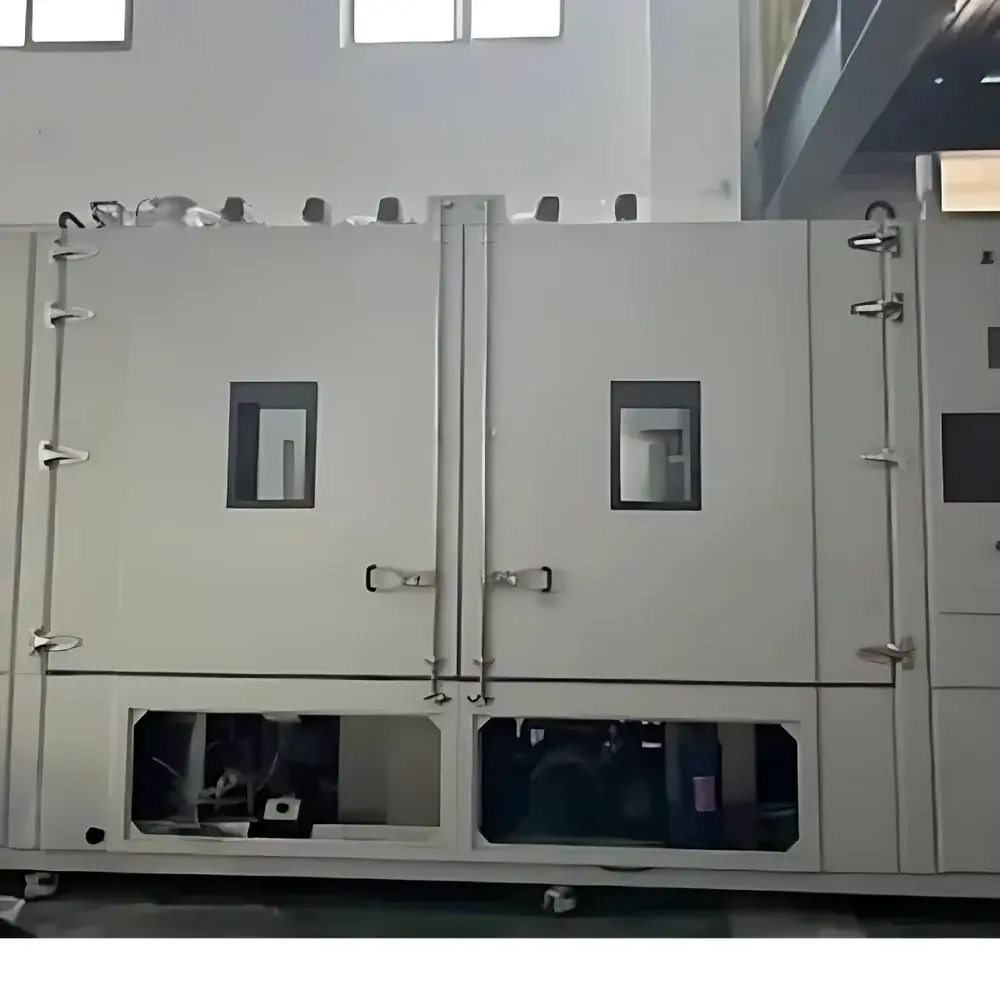
Jianhu JH-Battery Multi-Environment Composite Test Chamber (Salt Spray + High-Low Temperature + Humidity Cycling)
| Brand | Jianhu |
|---|---|
| Origin | Shanghai, China |
| Manufacturer Type | Authorized Distributor |
| Product Category | Domestic |
| Model | JH-Battery Multi-Environment Composite Test Chamber |
| Temperature Range | -70 °C to +150 °C |
| Refrigeration Method | Compressor-based |
| Explosion-Proof Rating | ATEX Ex d IIB T4 certified |
| Temperature Fluctuation | ±0.5 °C |
| Temperature Uniformity | ±2.0 °C |
| Temperature Deviation | ±2.0 °C |
| Heating Rate | ≤60 min (from -40 °C to +85 °C) |
| Cooling Rate | ≤45–80 min (depending on configuration) |
| Chamber Dimensions | Customizable (Small / Medium / Large) |
Overview
The Jianhu JH-Battery Multi-Environment Composite Test Chamber is an engineered environmental simulation platform designed specifically for the accelerated reliability validation of lithium-ion and next-generation electrochemical energy storage systems. Unlike conventional single-stress test chambers, this system integrates three physically distinct environmental stressors—salt spray corrosion, high-low temperature cycling, and humidity conditioning—within a single, tightly controlled chamber volume. It operates on the principle of multi-field coupling: simultaneous or sequential application of thermal gradients (−70 °C to +150 °C), relative humidity (20–98% RH), and controlled NaCl aerosol generation (1–2 mL/80 cm²/h, compliant with ISO 9227) enables realistic replication of complex real-world service conditions encountered by battery packs in electric vehicles, grid-scale energy storage, aerospace platforms, and marine applications. The chamber’s architecture supports dynamic parameter synchronization via embedded PID control loops, ensuring traceable, repeatable, and auditable environmental profiles aligned with international testing standards.
Key Features
- Triple-Mode Environmental Simulation: Seamless integration of salt spray (NSS/AASS modes), temperature extremes (−70 °C to +150 °C), and humidity (20–98% RH) within one chamber—eliminating cross-test transfer errors and enabling true multi-stress acceleration.
- ATEX-Certified Explosion-Proof Design: Structural compliance with Ex d IIB T4 classification, including flame-arresting ventilation ducts, pressure-relief safety valves, and intrinsically safe internal cabling—critical for testing thermally unstable battery cells under fault conditions.
- Multi-Parameter Coupling Control: Real-time coordinated regulation of temperature, humidity, and salt fog deposition using adaptive PID algorithms; achieves temperature uniformity ≤ ±2.0 °C and humidity stability ≤ ±3% RH across working volume.
- Anti-Crystallization Salt Fog System: Dual-stage filtration and automated backflush mechanism prevents nozzle clogging during extended tests; adjustable NaCl concentration (5–20%) with gravimetric calibration traceability.
- Independent Thermal-Humidity Management: Segregated heating/humidification and cooling/dehumidification pathways prevent condensation interference during rapid thermal transients—essential for simulating desert heat soak or alpine freeze-thaw cycles.
- Integrated Battery Monitoring Interface: Standard RS485/Modbus and optional CAN bus connectivity for synchronized acquisition of voltage, current, surface temperature, and internal resistance data from DUTs during environmental exposure.
Sample Compatibility & Compliance
The JH chamber accommodates battery modules up to 1.2 m × 0.8 m × 0.6 m (L×W×H) in large configuration, with customizable mounting fixtures and cable feedthroughs rated to IP65. It supports testing per multiple international standards, including but not limited to: IEC 62660-2 (performance testing of traction batteries), UN 38.3 Section 38.3.4 (altitude, thermal, vibration, and shock), ISO 16750-4 (road vehicle environmental conditions), and MIL-STD-810H Method 509.6 (salt fog). Its explosion-proof construction meets EU Directive 2014/34/EU (ATEX), while its data logging architecture supports audit-ready records required under GLP and ISO/IEC 17025-accredited laboratories. Calibration certificates are provided traceable to NIM (China National Institute of Metrology).
Software & Data Management
Equipped with a 10.1-inch industrial-grade touchscreen HMI and programmable logic controller (PLC), the system stores up to 200 multi-step test programs with variable ramp rates, dwell times, and conditional branching logic. All operational parameters—including chamber setpoints, actual sensor readings, alarm logs, and external battery telemetry—are timestamped and saved in CSV format on internal SSD or network-attached storage. Optional software modules enable remote monitoring via Ethernet/Wi-Fi, automated report generation (PDF/Excel), and integration with LIMS or MES platforms. Audit trail functionality complies with FDA 21 CFR Part 11 requirements for electronic records and signatures when configured with user role management and digital signature authentication.
Applications
- EV Battery Validation: Simulating coastal tropical environments (45 °C / 95% RH + 5% NaCl fog) to assess pack-level sealing integrity and long-term corrosion resistance.
- Energy Storage Systems: Replicating underground salt mine conditions (+50 °C / 95% RH + continuous salt mist) to evaluate electrolyte degradation kinetics in stationary LiFePO₄ stacks.
- Aerospace Batteries: Combining −55 °C cold soak with intermittent salt particle impingement and thermal cycling (−55 °C ↔ +70 °C at 5 °C/min) to model stratospheric deployment scenarios.
- Material Screening: Accelerated aging of battery housing polymers, busbar coatings, and gasket elastomers under combined hygrothermal and chloride exposure.
- Failure Mode Analysis: Triggering and observing thermal runaway propagation in multi-cell modules under controlled salt-contaminated thermal stress—supporting FMEA development and BMS algorithm refinement.
FAQ
Does the chamber support automated transition between salt spray and dry heat phases?
Yes—the control system executes pre-programmed phase transitions without manual intervention, including purge cycles, chamber drying, and reconditioning to next setpoint.
Can third-party battery cyclers be synchronized with environmental profiles?
Yes—via Modbus TCP or CANopen, the chamber can accept external trigger signals and relay status flags to coordinate charge/discharge sequencing with thermal-humidity-salt events.
Is calibration documentation included with shipment?
Each unit ships with factory calibration reports for temperature, humidity, and salt fog deposition rate, traceable to national metrology institutes.
What maintenance intervals are recommended for the salt fog system?
Filter replacement every 200 operational hours; full nozzle inspection and cleaning every 500 hours; annual verification of pH and conductivity of collected fog solution.
Are custom chamber dimensions available for OEM integration?
Yes—Jianhu offers engineering consultation and mechanical customization, including non-standard footprints, reinforced structural frames, and auxiliary gas purge interfaces (N₂, dry air).



