
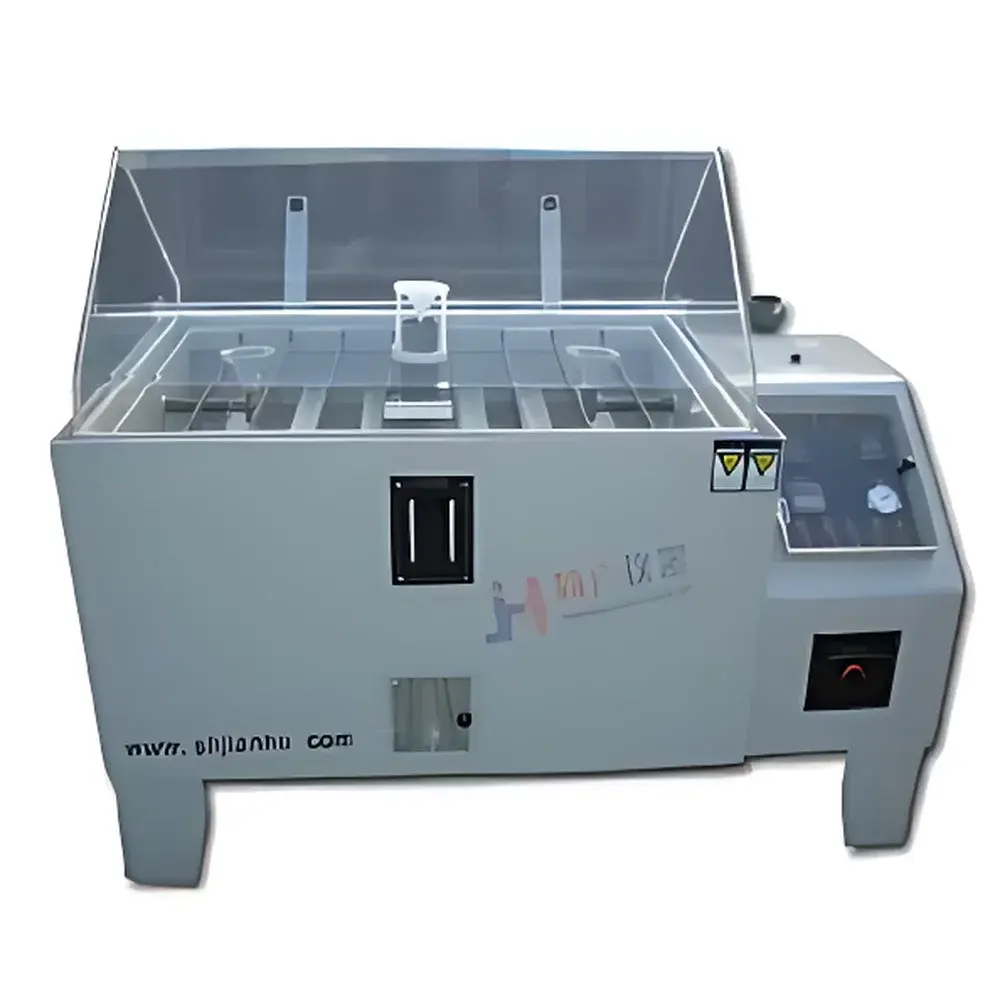
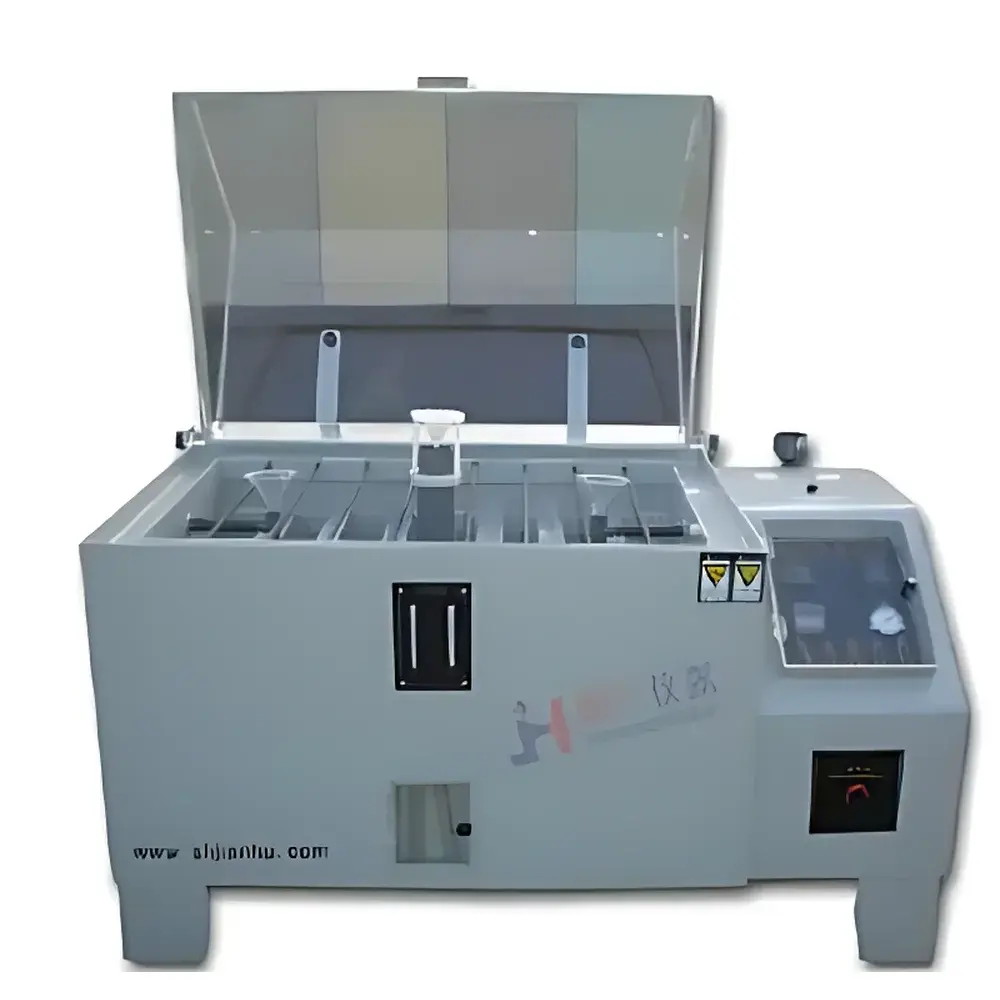
Jianhu JST-060 Salt Spray Test Chamber
| Brand | Jianhu |
|---|---|
| Origin | Shanghai, China |
| Model | JST-060 |
| Chamber Dimensions (L×W×H) | 60×40×45 cm |
| Internal Volume | 108 L |
| Test Temperature Range | 35±1°C (NSS/ASS), 50±1°C (CASS) |
| Saturated Air Chamber Temperature | 37±1°C (NSS/ASS), 63±1°C (CASS) |
| Fog Collection Rate | 1.0–2.0 mL / 80 cm² / hr |
| pH of Collected Fog | 6.5–7.2 (NSS/ASS), 3.0–3.2 (CASS) |
| Construction Material | Imported PVC & PP板材 |
| Power Supply | AC 1-phase 220 V, 10 A |
| Compliance Standards | ASTM B117, ISO 9227, JIS Z2371, GB/T 2423.17, CNS 3627, GJB 150.11A |
Overview
The Jianhu JST-060 Salt Spray Test Chamber is an engineered environmental test system designed for standardized accelerated corrosion evaluation of metallic and coated components under controlled saline fog conditions. It operates on the principle of continuous atomization of a precisely formulated salt solution—either neutral (NSS), acetic acid (ASS), or copper-accelerated acetic acid (CASS)—into a temperature- and humidity-regulated test chamber. The chamber replicates aggressive atmospheric corrosion mechanisms by exposing specimens to a dense, uniform fog of chloride-rich aerosol at elevated temperatures, enabling quantitative assessment of coating integrity, galvanic protection performance, and base material resistance to electrochemical degradation. Its design adheres to internationally recognized test methodologies including ASTM B117, ISO 9227, and JIS Z2371, making it suitable for quality assurance in automotive, aerospace, electronics, and marine hardware manufacturing where long-term field reliability depends on validated corrosion resistance.
Key Features
- Chamber constructed from imported high-purity PVC and polypropylene (PP) panels—chemically inert, non-reactive to acidic or saline environments, and resistant to thermal aging up to 60°C.
- Precision-machined borosilicate glass nozzle ensures consistent droplet size distribution and laminar, gravity-fed fog deposition—eliminating nozzle clogging and salt crystal accumulation on test specimens.
- Dual-zone temperature control: independent regulation of test chamber (±1°C accuracy) and saturated air chamber (±1°C), both managed via PID-controlled digital thermostats with 0.1°C resolution and maximum setpoint duration of 999 hours.
- Steam-based direct heating system enables rapid, uniform chamber temperature stabilization—reducing pre-conditioning time and improving inter-test reproducibility.
- Integrated automatic water replenishment system with low-water-level optical sensor and visual alarm—ensures uninterrupted operation during extended test cycles.
- Pressure-saturated air supply governed by Henry’s Law principles, delivering stable relative humidity and precise fog generation pressure (0.07–0.17 MPa adjustable via calibrated regulator).
- Dual over-temperature protection circuitry and real-time water level monitoring provide fail-safe operational safety compliant with IEC 61000-6-2 and EN 61000-6-4 EMC requirements.
- Conical fog disperser mounted atop the spray tower directs aerosol flow, modulates fog density, and promotes even spatial distribution across specimen racks.
- Optional automatic de-fogging function clears chamber visibility post-test without opening the lid—minimizing operator exposure and preserving test integrity.
Sample Compatibility & Compliance
The JST-060 accommodates flat and three-dimensional samples up to 60 × 40 × 45 cm (L×W×H), with adjustable specimen racks supporting standard inclination angles (15° or 30°) per ASTM B117 and ISO 9227. It supports all major salt spray test protocols: Neutral Salt Spray (NSS), Acetic Acid Salt Spray (ASS), and Copper-Accelerated Acetic Acid Salt Spray (CASS). Each protocol requires strict adherence to solution chemistry—including NaCl concentration (5.0 ± 0.1 wt% for NSS; 50 ± 5 g/L for CASS), pH (6.5–7.2 for NSS/ASS; 3.0–3.2 for CASS), and collection rate (1.0–2.0 mL/80 cm²/hr)—all verifiable using traceable calibrated pH meters and volumetric funnels per ISO 9227 Annex A. The chamber meets full technical alignment with ASTM B117 (2023), ISO 9227:2022, JIS Z2371:2019, GB/T 2423.17–2022, and CNS 3627, and is routinely used in laboratories undergoing ISO/IEC 17025 accreditation audits.
Software & Data Management
While the JST-060 operates via embedded digital controller (no PC interface included by default), its PID-based firmware logs critical parameters—including chamber temperature, saturation temperature, elapsed test time, and fault codes—with timestamped event memory. All settings are password-protected and retain configuration after power cycling. For regulated environments requiring audit trails, optional RS-485 communication module (JST-COM485) enables integration with LabVIEW™, custom SCADA systems, or LIMS platforms. When configured with 21 CFR Part 11-compliant software add-ons, the system supports electronic signatures, user access tiers, and immutable data archiving—meeting GLP and GMP documentation requirements for QC labs in medical device and automotive Tier-1 supplier facilities.
Applications
This chamber serves as a core tool in corrosion validation workflows across multiple industries: evaluating electroplated zinc/nickel coatings on fasteners per ASTM B633; verifying passivation efficacy of stainless steel surgical instruments (ASTM A967); assessing anti-corrosion pretreatment on aluminum auto body panels (SAE J2334); qualifying conformal coatings on PCBs under IPC-CC-830B; and validating marine-grade anodized finishes per MIL-A-8625 Type II/III. It is also employed in R&D for comparative lifecycle modeling—correlating salt spray hours to real-world service exposure using statistical Weibull analysis and failure mode mapping.
FAQ
What standards does the JST-060 comply with?
ASTM B117, ISO 9227, JIS Z2371, GB/T 2423.17, CNS 3627, and GJB 150.11A.
Can the chamber perform cyclic corrosion testing (CCT)?
The base JST-060 model supports only continuous salt spray modes. Cyclic testing (e.g., salt/freeze/dry) requires the optional JST-CCT upgrade kit with programmable multi-stage controller.
Is distilled water mandatory for operation?
Yes—only deionized or distilled water must be used in the humidification reservoir and salt solution preparation to prevent mineral deposits and nozzle blockage.
How often should the fog nozzle be cleaned?
Daily visual inspection is recommended; ultrasonic cleaning with 5% nitric acid solution is advised every 72 operational hours or after each CASS test cycle.
Does the unit include calibration certification?
Factory calibration certificate (traceable to NIM, China) is provided with shipment; ISO/IEC 17025-certified third-party calibration services are available upon request.



