
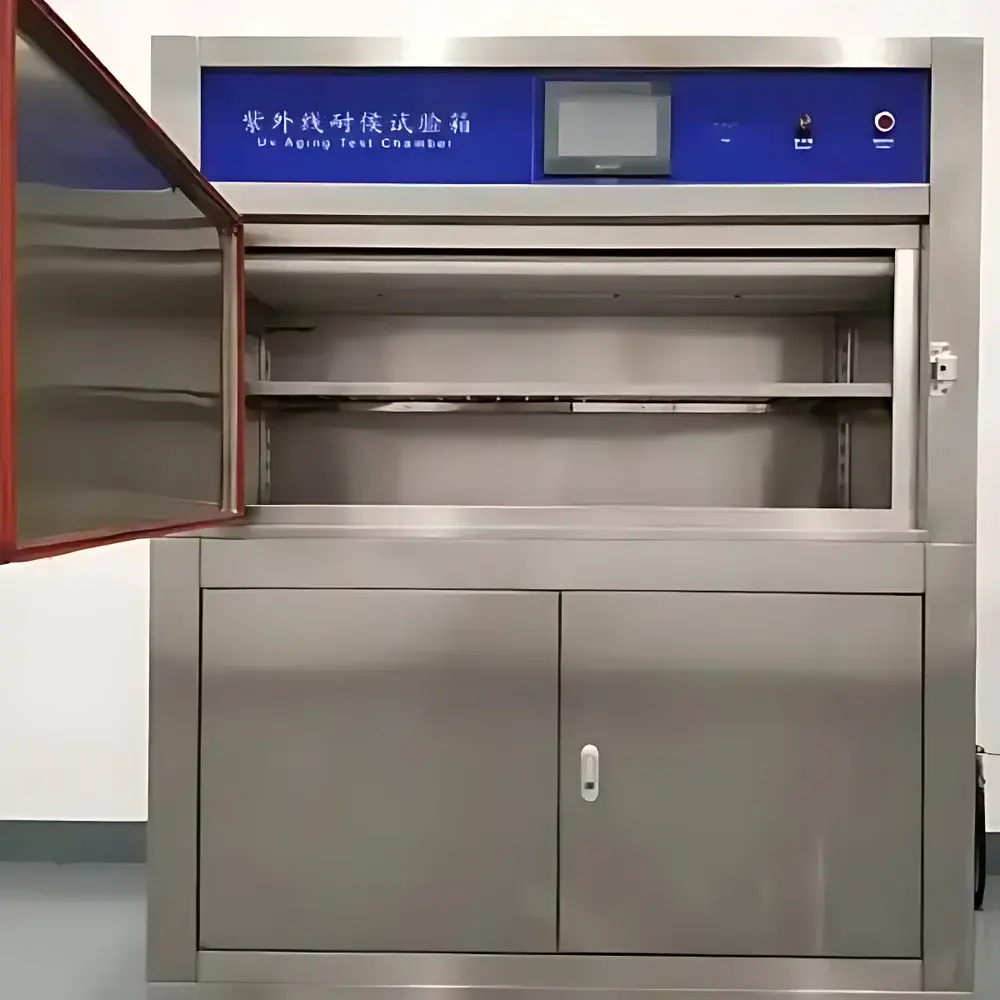
Jianhu UV Aging Test Chamber DV-340 Series
| Brand | Jianhu |
|---|---|
| Origin | Shanghai, China |
| Manufacturer Type | Authorized Distributor |
| Product Category | Domestic |
| Model | Jianhu UV Aging Test Chamber DV-340 Series |
| Price Range | USD 750 – 75,000 |
| Humidity Range | ≥95% RH |
| Lamp Power | 40 W per lamp |
| Irradiance Range | 0.72 W/m² (at 340 nm) |
| Exposure Time | 1–9999 hours (adjustable) |
Overview
The Jianhu UV Aging Test Chamber DV-340 Series is an engineered environmental test system designed to accelerate and quantify the photodegradation behavior of organic coatings, polymers, and composite materials under controlled ultraviolet radiation, temperature, and humidity conditions. Based on the fundamental principles of photochemical aging—where UVA photons (primarily 320–365 nm) induce bond scission, crosslinking, and oxidation in polymer matrices—the chamber replicates the most damaging segment of terrestrial solar spectrum using calibrated UVA-340 fluorescent lamps. Unlike broad-spectrum UV sources, UVA-340 lamps emit spectral power distribution closely matching natural sunlight below 365 nm, enabling high-fidelity simulation of long-term outdoor exposure in compressed laboratory timeframes. This capability is critical for automotive OEMs, Tier-1 suppliers, and R&D laboratories seeking to predict coating durability, validate formulation robustness, and support material qualification against industry-specific aging protocols.
Key Features
- UVA-340 lamp array with stable spectral output at 340 nm ± 2 nm, traceable to NIST-calibrated reference standards
- Programmable irradiance control (0.72 W/m² nominal, adjustable via feedback-regulated ballast)
- Condensation cycle system simulating dew formation through controlled surface cooling (cold junction method), compliant with ASTM G154 Cycle 1 and ISO 4892-3 requirements
- Temperature control range: 40–70°C (black panel thermometer), with ±1.5°C uniformity across test area
- Humidity maintenance up to ≥95% RH during condensation phases, achieved via integrated water reservoir and saturated steam injection
- Digital touchscreen controller with multi-segment time/temperature/irradiance programming and real-time data logging
- Test chamber constructed from SUS304 stainless steel interior and insulated double-wall housing for thermal stability and corrosion resistance
- Compliance-ready architecture supporting audit trails, user access levels, and electronic signature options per FDA 21 CFR Part 11 (when paired with optional software module)
Sample Compatibility & Compliance
The DV-340 Series accommodates flat-panel specimens up to 150 mm × 300 mm × 10 mm (standard rack configuration), with optional custom fixtures for curved automotive body panels or multi-layer cross-sections. It supports standardized test methods including ASTM D4329 (plastics), ASTM D4587 (coatings), ISO 4892-3 (general exposure), and SAE J2020 (automotive exterior materials). The system enables comparative evaluation of interfacial degradation mechanisms—e.g., delamination between basecoat and clearcoat layers—by integrating sequential exposure cycles with post-test metrology (gloss, colorimetry, FTIR, SEM). All operational parameters adhere to GLP-compliant documentation practices; calibration certificates for irradiance sensors and temperature/humidity probes are provided with each unit shipment.
Software & Data Management
Built-in firmware supports automatic data capture of irradiance, chamber temperature, black panel temperature, relative humidity, and elapsed exposure time at user-defined intervals (1–60 min). Exportable CSV files include timestamped metadata for traceability. Optional Jianhu TestSuite™ software extends functionality with statistical analysis tools (Weibull lifetime modeling, Arrhenius extrapolation), report generation templates aligned with IATF 16949 documentation requirements, and integration with LIMS platforms via OPC UA protocol. Audit trail logs record all parameter modifications, user logins, and calibration events—enabling full compliance with ISO/IEC 17025 and internal quality management systems.
Applications
- Accelerated weathering validation of automotive topcoats, clearcoats, and primer systems
- Screening of UV absorbers, HALS stabilizers, and pigment dispersion stability in OEM paint formulations
- Failure mode analysis of gloss loss, chalking, microcracking, and interlayer adhesion loss
- Correlation studies between lab-aged samples and real-world field exposure (e.g., Arizona desert, Florida subtropics)
- Support for PPAP submissions and material release sign-off in Tier-1 supplier workflows
- Research into synergistic effects of UV + thermal cycling + moisture on polymer nanocomposites and bio-based resins
FAQ
What spectral output does the UVA-340 lamp provide, and how is it validated?
UVA-340 lamps emit peak irradiance at 340 nm with a half-bandwidth of ~10 nm, conforming to the spectral irradiance distribution specified in ASTM G154 Annex A1 and ISO 4892-3 Table 1. Each lamp batch undergoes spectroradiometric verification prior to installation.
Can the chamber replicate both dry UV exposure and wet/dry cycling?
Yes. The system supports three core exposure modes: pure UV irradiation (dry), UV + condensation (wet/dry), and UV + spray (optional add-on). Condensation cycles follow ASTM G154 Cycle 1 specifications with programmable duration and frequency.
Is black panel temperature monitoring included as standard?
Yes. A calibrated black panel thermometer (BPT) is mounted inside the test chamber adjacent to specimen holders, providing direct measurement of surface heating effect per ASTM D4329 Section 7.3.
How is irradiance uniformity ensured across the test area?
Irradiance mapping is performed during factory acceptance testing (FAT) using a traceable spectroradiometer. Uniformity across the standard test area is maintained within ±15% of nominal value at 340 nm, meeting ISO 4892-3 Clause 6.2 requirements.
Does the system support compliance with automotive OEM-specific test standards such as VW PV 3929 or GMW 14124?
Yes. Preconfigured test profiles for major OEM protocols—including exposure duration, irradiance setpoints, temperature ramps, and condensation timing—are available in the controller library and can be modified per project requirements.
Related Products



