
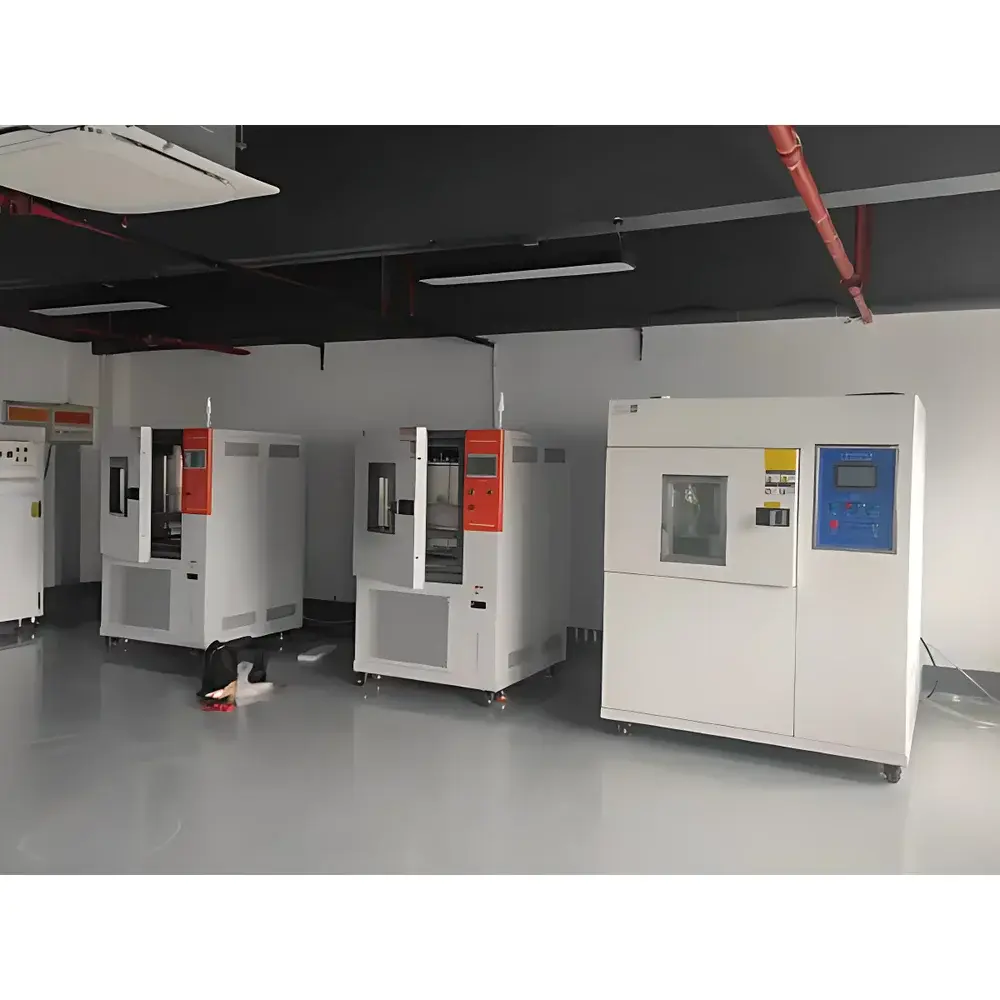
Jianhu JH-TC Series High-Low Temperature Environmental Test Chamber for EV Battery Pack Cycling and Charge/Discharge Testing
| Brand | Jianhu |
|---|---|
| Origin | Shanghai, China |
| Manufacturer Type | Authorized Distributor & System Integrator |
| Product Origin | Domestic (China) |
| Model | JH-TC Series |
| Price Range | USD 4,200 – 420,000 |
| Temperature Range | −70 °C to +150 °C |
| Cooling Method | Mechanical Compression Refrigeration |
| Explosion-Proof Configuration | Available (ATEX / IECEx-compliant variants) |
| Temperature Fluctuation | ±0.5 °C |
| Temperature Uniformity | ±2.0 °C (at working volume center) |
| Temperature Deviation | ±2.0 °C (vs. setpoint, per IEC 60068-3-5) |
| Ramp-Up Time | ≤60 min (−70 °C to +150 °C) |
| Ramp-Down Time | ≤45–80 min (depending on chamber volume and configuration) |
Overview
The Jianhu JH-TC Series High-Low Temperature Environmental Test Chamber is an engineered platform designed specifically for the thermal validation and electrochemical cycling of electric vehicle (EV) battery packs under controlled, reproducible ambient conditions. Unlike general-purpose temperature chambers, the JH-TC integrates structural reinforcement, explosion-proof engineering, and real-time electrical feedthrough compatibility to support simultaneous thermal conditioning and in-situ charge/discharge testing per ISO 12405-4, GB/T 31467.3, and UN ECE R100 requirements. Its core operation relies on dual-refrigerant cascade compression cooling and precision PID-controlled forced-air convection, enabling stable thermal profiles across wide dynamic ranges while maintaining mechanical integrity during repeated thermal transients. The chamber is not intended for environmental simulation alone; rather, it functions as a thermally anchored subsystem within integrated battery test rigs—serving as the environmental boundary condition for accelerated life testing, safety abuse evaluation (e.g., thermal runaway propagation), and low-temperature power delivery characterization.
Key Features
- Explosion-proof design compliant with IEC 60079-0 and GB 3836.1, with optional ATEX Zone 1/21 certification for volatile electrolyte environments
- Dual-stage cascade refrigeration system enabling continuous operation at −70 °C without liquid nitrogen supplementation
- Integrated high-current electrical feedthroughs (up to 500 A, 1000 V DC) with IP65-rated sealing and thermal decoupling to prevent condensation ingress
- Real-time temperature mapping via 9-point calibrated PT100 sensor array, traceable to NIST standards
- Robust stainless-steel interior with non-outgassing insulation and corrosion-resistant airflow ducting for long-term battery off-gas exposure
- Modular control architecture supporting third-party integration with battery cyclers (e.g., Keysight, Bitrode, Arbin) via Ethernet/IP or Modbus TCP
Sample Compatibility & Compliance
The JH-TC accommodates EV battery modules (up to 1.2 m × 0.8 m × 0.3 m) and full-pack assemblies (up to 2.0 m × 1.5 m × 0.5 m) with configurable internal mounting rails and cable management pathways. It meets essential regulatory and industry-specific compliance requirements including: IEC 60068-2-1 (cold), IEC 60068-2-2 (dry heat), ISO 16750-4 (road vehicles—electrical loads), and UL 2580 Annex B (battery thermal shock). All units undergo factory calibration per ISO/IEC 17025-accredited procedures, with documented uncertainty budgets for temperature uniformity and stability. Optional configurations include gas sampling ports (for CO, H₂, HF monitoring), fire suppression interfaces (FM-200 ready), and vibration isolation mounts compatible with concurrent mechanical stress testing.
Software & Data Management
Chamber operation is managed through Jianhu’s TC-OS v4.2 embedded controller, featuring a 10.1″ touchscreen HMI with multi-user role-based access (Operator, Engineer, Auditor). The system logs all thermal parameters at 1 Hz resolution, stores raw data in CSV and SQLite formats, and supports automated report generation aligned with GLP/GMP audit trails (21 CFR Part 11 compliant when deployed with optional electronic signature module). Remote monitoring and alarm escalation are enabled via MQTT and HTTPS APIs, allowing synchronization with enterprise LIMS platforms or battery test data management systems. Historical calibration records, maintenance logs, and deviation reports are retained for ≥10 years and exportable in PDF/A-1b format for regulatory submission.
Applications
- Low-temperature discharge capacity retention testing of NMC, LFP, and solid-state battery cells per SAE J2464 and GB/T 31486
- Thermal runaway propagation studies using calibrated thermal imaging and gas chromatography coupling
- Charge acceptance validation at −30 °C and +55 °C under constant-current/constant-voltage protocols
- Environmental stress screening (ESS) of battery management systems (BMS) and junction box assemblies
- Pre-conditioning of battery packs prior to mechanical shock, vibration, or crush testing per ISO 12405-2
- Long-term calendar aging experiments with programmable temperature hold sequences and humidity co-modulation (optional)
FAQ
Does the JH-TC Series support simultaneous temperature control and live battery cycling?
Yes—via integrated high-isolation feedthroughs and synchronized communication protocols with commercial battery testers.
What is the standard calibration interval and traceability basis?
Factory calibration is performed pre-shipment against NIST-traceable references; recommended recalibration every 12 months or after 2000 thermal cycles.
Can the chamber be validated for GMP-compliant battery qualification studies?
Yes—when equipped with 21 CFR Part 11 software options, full audit trail logging, and IQ/OQ documentation packages.
Is remote firmware update capability available?
Yes—secure over-the-air (OTA) updates are supported via TLS 1.2 encrypted connections with signed firmware binaries.
How is condensation managed during rapid cooldown of high-humidity battery samples?
Optional dry-air purge system (dew point ≤ −40 °C) and heated observation windows mitigate internal condensation without compromising thermal ramp rates.



