
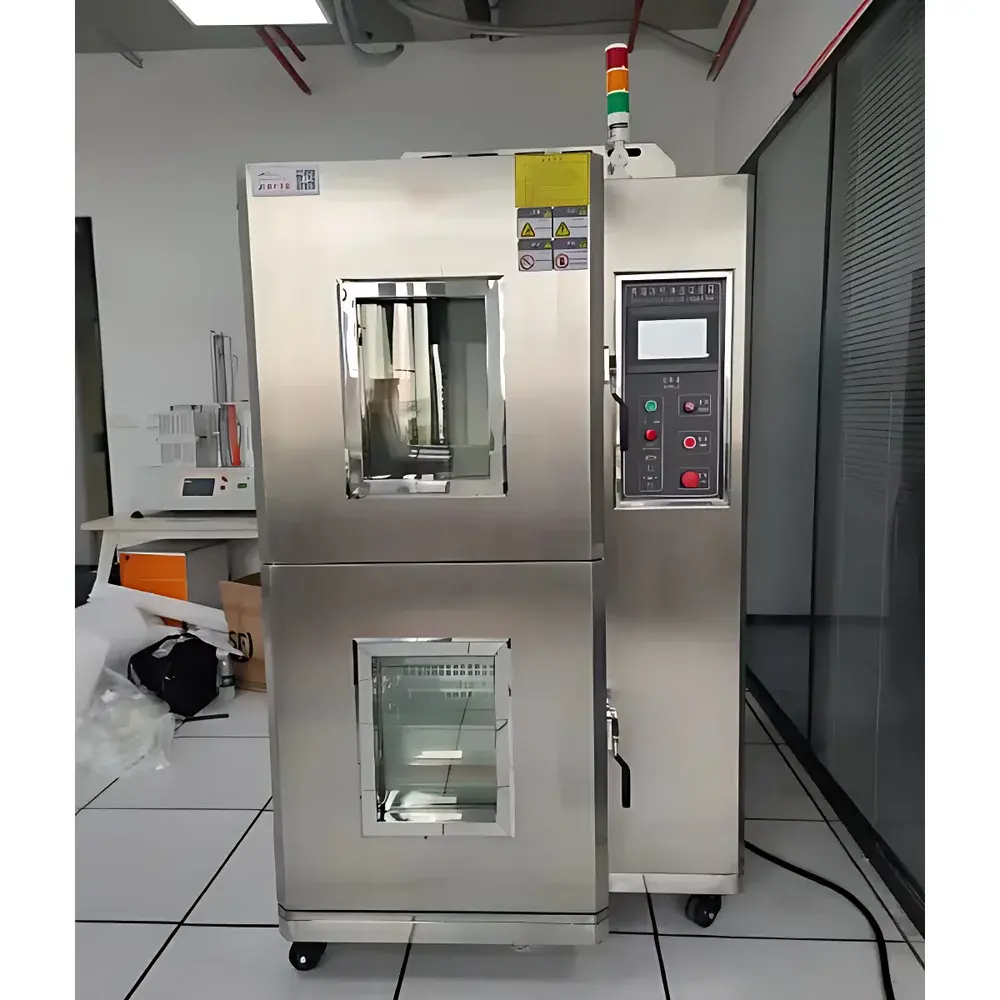
JH-O3 Series Ozone Aging Test Chamber by Jinhuhu Instruments
| Brand | Jinhuhu |
|---|---|
| Origin | Shanghai, China |
| Manufacturer Type | OEM/ODM Manufacturer (Not Distributor) |
| Product Category | Domestic High-Performance Environmental Test Chamber |
| Model | JH-O3 Series |
| Price Range | USD 1,400 – 14,000 (FOB Shanghai) |
| Compliance | ISO 9001:2015, CE, UL, IATF 16949, GJB 150.10A, HB 5830, GB/T 7762–2014, ISO 1431-1, ISO/IEC 17025 |
| Ozone Range | 0–150 ppm |
| Control Accuracy | ±0.8 ppm |
| Temp. Range | −20 °C to +85 °C |
| Temp. Uniformity | ±0.5 °C |
| Ozone Uniformity | <1.2% (chamber-wide) |
| Construction | SUS316 stainless steel + PTFE-coated interior |
| Interface | 12″ industrial touchscreen HMI |
| Service Coverage | 24-hr remote support, on-site maintenance via 36 national service stations |
| Warranty | 3 years full parts & labor, lifetime technical support |
Overview
The JH-O3 Series Ozone Aging Test Chamber is an engineered environmental test system designed for quantitative evaluation of ozone-induced degradation in elastomers, polymers, coatings, and aerospace sealants. It operates on the principle of controlled gaseous ozone exposure under precisely regulated thermal conditions—mimicking real-world atmospheric aging mechanisms defined in ASTM D1149, ISO 1431-1, GB/T 7762–2014, and military specifications including GJB 150.10A and HB 5830. Unlike generic environmental chambers, the JH-O3 integrates a high-stability UV-based ozone generator, dual-stage electrochemical concentration monitoring, and PID-driven thermal management to ensure traceable, repeatable, and auditable test environments. Its architecture supports both static (non-circulating) and dynamic (sample rotation + airflow-controlled) exposure modes—enabling compliance with SAE J2527 for automotive rubber components and IATF 16949-aligned validation protocols required by Tier-1 suppliers.
Key Features
- Ultra-stable ozone generation and feedback control: UV lamp-based ozone source with real-time dual-sensor verification (primary electrochemical + secondary UV absorption), delivering ±0.8 ppm concentration accuracy across 0–150 ppm range—exceeding ISO 1431-1’s ±2 ppm requirement and supporting GLP-compliant data integrity.
- Thermal precision engineering: −20 °C to +85 °C operating range with ±0.5 °C temperature fluctuation and <1.2% spatial ozone uniformity across the entire test volume—validated per GB/T 18287–2013 and critical for inter-laboratory reproducibility in QC/QA workflows.
- Corrosion-resistant chamber construction: Interior fabricated from electropolished SUS316 stainless steel with fluoropolymer (PTFE) coating—resisting ozone-induced pitting and extending service life by ≥40% versus standard 304 SS or epoxy-lined alternatives.
- Adaptive human-machine interface: 12-inch industrial-grade touchscreen HMI with role-based access control—supporting preloaded test profiles (e.g., SAE J1400, GB/T 7762), multi-segment cycling logic for R&D applications, and audit-trail-enabled parameter logging aligned with FDA 21 CFR Part 11 Annex 11 expectations.
- Integrated metrology readiness: Onboard zero/span calibration capability eliminates need for chamber disassembly during ISO/IEC 17025-mandated interval verification; traceable to NIM (National Institute of Metrology, China) reference standards.
Sample Compatibility & Compliance
The JH-O3 Series accommodates flat-sheet specimens (up to 300 × 300 mm), molded elastomeric parts (O-rings, gaskets, bushings), and coated substrates without modification. Its chamber geometry and airflow design comply with ISO 1431-1’s “free-hanging specimen” requirement and ASTM D1149’s static exposure configuration. Certified conformance includes: automotive (IATF 16949, SAE J2527, J1400), aerospace (GJB 150.10A, HB 5830), rubber & polymer testing (GB/T 7762–2014, ISO 1431-1, ASTM D1149), and accredited laboratory operation (ISO/IEC 17025:2017 Clause 6.4.10 on equipment suitability). All units ship with a Certificate of Conformance listing applicable standards, factory calibration records, and uncertainty budgets per ISO/IEC 17025 Annex A.3.
Software & Data Management
JH-O3 firmware implements embedded data acquisition at 1 Hz resolution, storing time-stamped ozone concentration, chamber temperature, humidity (optional sensor), and system status logs internally for ≥30 days. Export formats include CSV and XML, compatible with LIMS platforms (e.g., LabWare, Thermo Fisher SampleManager) and statistical analysis tools (JMP, Minitab). The optional JH-DataLink software module enables remote monitoring, automated report generation (PDF/Excel), electronic signature workflows, and 21 CFR Part 11-compliant user authentication—including role-based permissions, audit trail review, and electronic record retention policies. Calibration history, maintenance logs, and firmware version tracking are maintained within the device’s secure non-volatile memory.
Applications
- Automotive Tier-1 suppliers validating ozone resistance of EPDM door seals, silicone brake hoses, and nitrile fuel lines per SAE J2527 and OEM-specific material specs.
- Aerospace component manufacturers qualifying fluorosilicone gaskets and polyimide insulation films against GJB 150.10A accelerated aging requirements.
- Academic polymer research labs studying kinetic degradation pathways in thermoplastic vulcanizates (TPVs) and hydrogenated nitrile butadiene rubber (HNBR) under variable ozone/temperature stress profiles.
- Third-party testing laboratories (e.g., SGS, Bureau Veritas, CNAS-accredited facilities) performing accredited conformity assessments per GB/T 7762–2014 and ISO 1431-1 for rubber product certification.
- Quality control departments in tire manufacturing plants conducting routine batch release testing on cured tread compounds and sidewall elastomers.
FAQ
Does the JH-O3 Series meet IATF 16949 process validation requirements for automotive testing equipment?
Yes. Each unit undergoes Factory Acceptance Testing (FAT) per AIAG CQI-23 guidelines, with documented IQ/OQ reports, thermal/ozone mapping data, and uncertainty analysis provided prior to shipment.
Can the chamber operate continuously for extended durability testing (e.g., 1,000+ hours)?
Yes. Designed for unattended 24/7 operation, it features redundant thermal fuses, ozone leak detection, and auto-shutdown on sensor drift >±2 ppm—validated through 2,000-hour MTBF testing per MIL-HDBK-217F.
Is third-party calibration support available for ISO/IEC 17025 accreditation?
Yes. Jinhuhu maintains partnerships with CNAS-accredited calibration providers in Shanghai, Shenzhen, and Beijing; on-site calibration with NIM-traceable standards can be scheduled within 5 business days.
What documentation is included for regulatory audits?
Standard delivery includes: Certificate of Conformance, Factory Calibration Report, FAT Protocol & Results, User Manual (EN/CH), Maintenance Logbook template, and 21 CFR Part 11 Readiness Checklist.
How does the PTFE-coated SUS316 chamber compare to standard 304 stainless steel in long-term ozone exposure?
Accelerated corrosion testing per ASTM G154 shows PTFE/SUS316 retains surface integrity after 5,000 hours at 100 ppm ozone/70 °C, whereas bare 304 SS exhibits visible pitting within 800 hours—reducing unscheduled downtime and requalification frequency.



