
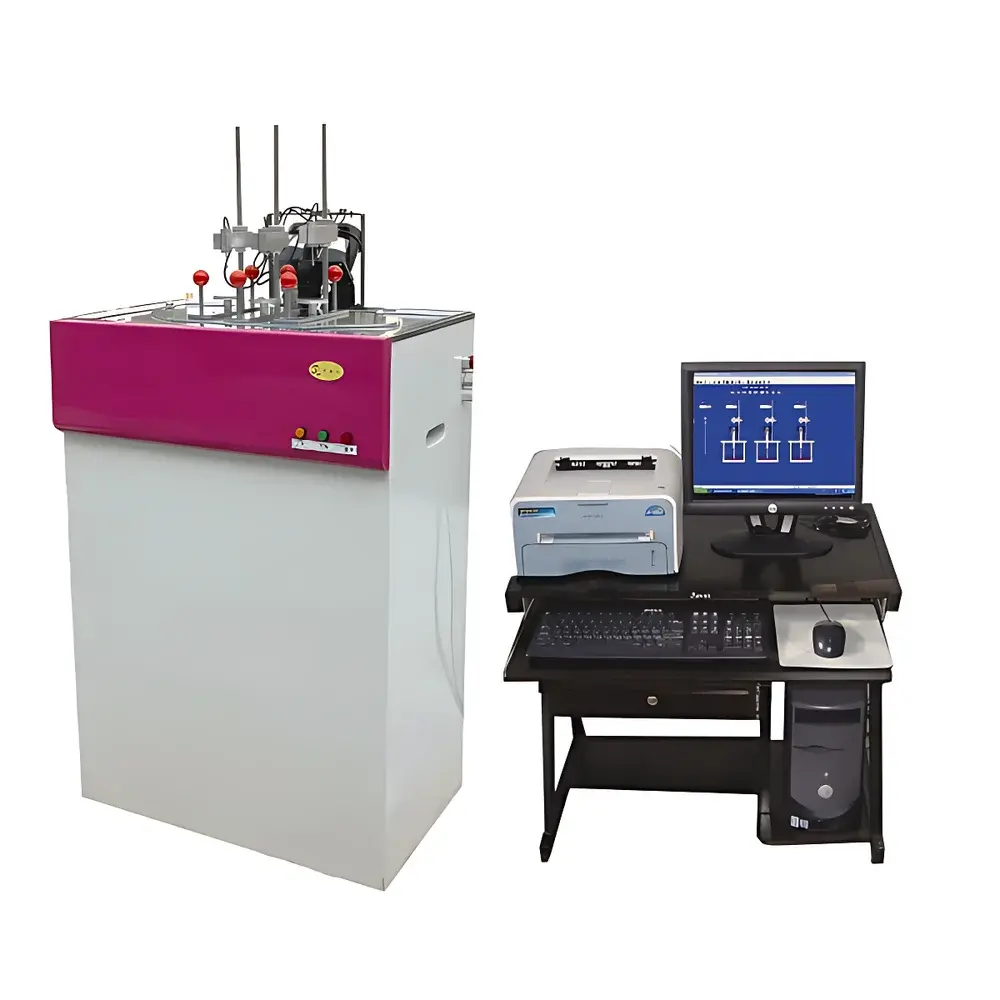
Jinhoo JH-6020B Heat Deflection Temperature (HDT) & Vicat Softening Temperature (VST) Tester
| Brand | Jinhoo |
|---|---|
| Origin | Shanghai, China |
| Model | JH-6020B |
| Temperature Range | Ambient to 300 °C |
| Heating Rate Options | 120 °C/h or 50 °C/h |
| Temperature Control Accuracy | ±1 °C (VST), ±2 °C/6 min (HDT) |
| Temperature Measurement Accuracy | ±0.5 °C |
| Deflection Measurement Resolution | 0.001 mm |
| Max Deflection Error | ±0.005 mm |
| Vicat Penetration Depth | 1.00 mm ±0.01 mm |
| Standard Test Loads | 10 N, 50 N (VST) |
| Bending Stresses | 0.45 MPa (Method B), 1.80 MPa (Method A), 8.00 MPa (Method C) (HDT) |
| Sample Supports | 3 independent test frames with selectable spans (64 mm for flatwise placement |
| Heating Medium | Methyl silicone oil (kinematic viscosity ≤200 cSt |
| Max Heating Power | 3 kW |
| Cooling Method | Natural convection |
| Power Supply | 220 V ±10%, 50 Hz, 15 A |
| Compliant Standards | GB/T 1633–2000 (ISO 306:1994), GB/T 1634.1–2004 (ISO 75-2:2003), GB/T 1634.2–2004, GB/T 1634.3–2004, GB/T 8802–2001 (ISO 2507:1995), ASTM D1525, ASTM D648 |
Overview
The Jinhoo JH-6020B Heat Deflection Temperature (HDT) & Vicat Softening Temperature (VST) Tester is a dual-function thermal characterization instrument engineered for precise determination of thermomechanical transition temperatures in rigid polymeric materials. It operates on two standardized principles: the Vicat Softening Temperature test—where a needle of 1 mm² cross-sectional area penetrates a specimen under a defined axial load (typically 10 N or 50 N) at a controlled heating rate until 1.00 mm of penetration is achieved—and the Heat Deflection Temperature test—where a rectangular specimen is subjected to three-point bending under constant flexural stress (0.45 MPa, 1.80 MPa, or 8.00 MPa) while heated at a uniform rate, with HDT recorded as the temperature at which a predefined deflection (e.g., 0.34 mm for 4.0 mm-thick flatwise specimens) is attained. The system employs a vertical cabinet architecture with a thermally stabilized oil bath, featuring a 45° dual-helix automatic stirring mechanism and silicon oil as the heat-transfer medium—ensuring exceptional thermal homogeneity (<±0.5 °C gradient across the bath volume) and long-term stability during extended ramp cycles up to 300 °C.
Key Features
- Integrated dual-mode operation supporting both ISO/ASTM-compliant Vicat softening point (VST) and heat deflection temperature (HDT) determinations within a single platform
- Precision temperature control via silicon-controlled rectifier (SCR) circuitry, enabling selectable ramp rates of 50 °C/h or 120 °C/h with real-time feedback from calibrated Pt100 sensors (±0.5 °C accuracy)
- Three independent test stations with mechanically indexed span selection: 64 mm (for flatwise placement per GB/T 1634.1–2004) and 100 mm (for edgewise configuration), each equipped with hardened steel supports and low-hysteresis loading columns
- High-resolution linear displacement transducers (±0.005 mm full-scale error) with coarse/fine mechanical adjustment capability for accurate deflection tracking during dynamic thermal loading
- Thermally optimized oil bath design incorporating vortex-free dual-spiral agitation, minimizing localized hot spots and ensuring uniform heat distribution across all sample positions
- Dedicated Windows-based control software with real-time plotting of temperature–deflection curves, automated endpoint detection, audit-trail-enabled data logging, and export-compatible report generation (PDF, CSV)
- Safety-integrated architecture including emergency stop button, lockable rear service panel, noise-dampened lift mechanism, and overtemperature cutoff at user-defined upper limits
Sample Compatibility & Compliance
The JH-6020B accommodates standard test specimens per international regulatory frameworks governing thermoplastic and thermosetting polymers—including unreinforced plastics, fiber-reinforced composites, rigid elastomers, and electrically insulating materials. Specimen dimensions follow strict tolerances defined in ISO 306 (VST) and ISO 75-2 (HDT): flatwise specimens measure 80 mm × 10 mm × (3.8–4.2) mm; edgewise configurations range from 120 mm × (9.8–15.0) mm × (3.0–4.2) mm. The instrument fully satisfies mandatory requirements of GB/T 1633–2000 (identical to ISO 306:1994), GB/T 1634.1–2004 (ISO 75-2:2003), GB/T 8802–2001 (equivalent to ISO 2507:1995), ASTM D1525, and ASTM D648. Its calibration traceability aligns with national metrological standards, supporting GLP-compliant laboratories in pharmaceutical packaging validation, automotive polymer qualification, and electrical insulation certification workflows.
Software & Data Management
The embedded Windows application provides full IEC 62304-aligned control logic with deterministic timing resolution (<100 ms loop cycle). During testing, it continuously acquires synchronized temperature and displacement data at ≥10 Hz sampling rate, generating time-stamped .dat files with embedded metadata (operator ID, sample ID, method parameters, environmental conditions). All curve interactions are logged—including manual cursor-based interrogation of any point on the temperature–deflection plot, returning instantaneous values for both axes with four-decimal precision. Data archives support version-controlled backups, role-based access permissions, and 21 CFR Part 11–ready electronic signatures when deployed on validated IT infrastructure. Export functions include batch-report compilation, comparative overlay analysis of historical datasets, and direct integration with LIMS via ODBC-compliant drivers.
Applications
This instrument serves critical quality assurance and R&D functions across polymer supply chains. In materials development, it quantifies the effect of plasticizer content, filler dispersion, or copolymer composition on thermal resistance thresholds. For manufacturing process validation, it verifies batch-to-batch consistency of injection-molded housings, extruded pipe segments, and compression-molded insulators against contractual HDT/VST specifications. Regulatory submissions for medical device components (ISO 10993-12), automotive interior trim (SAE J2334), and flame-retardant cable jackets (UL 94, IEC 60695) routinely require documented HDT/VST data generated on instruments meeting the dimensional, thermal, and metrological criteria embodied in the JH-6020B design. Academic research applications include structure–property correlation studies in biodegradable polyesters, nanocomposite reinforcement efficiency assessment, and aging-induced embrittlement modeling.
FAQ
What standards does the JH-6020B comply with?
It conforms to GB/T 1633–2000 (ISO 306:1994), GB/T 1634.1–2004 (ISO 75-2:2003), GB/T 8802–2001 (ISO 2507:1995), ASTM D1525, and ASTM D648.
Can the instrument perform both HDT and VST tests without hardware reconfiguration?
Yes—switching between modes is fully software-directed; only the appropriate test probe (Vicat needle or HDT loading nose) and weight set need manual installation.
Is the temperature uniformity verified across all three test stations?
Yes—the dual-helix agitation system and optimized bath geometry ensure ≤±0.5 °C spatial deviation at steady state, confirmed by NIST-traceable multi-point probe mapping.
Does the software support audit trail and electronic signature functionality?
The control application includes configurable audit logging and integrates with external PKI systems for 21 CFR Part 11–compliant digital signing when deployed on validated Windows environments.
What is the recommended heating medium and its service life?
Methyl silicone oil (≤200 cSt, flash point ≥300 °C) is specified; typical replacement interval is 18–24 months under continuous laboratory use with periodic viscosity checks.




