
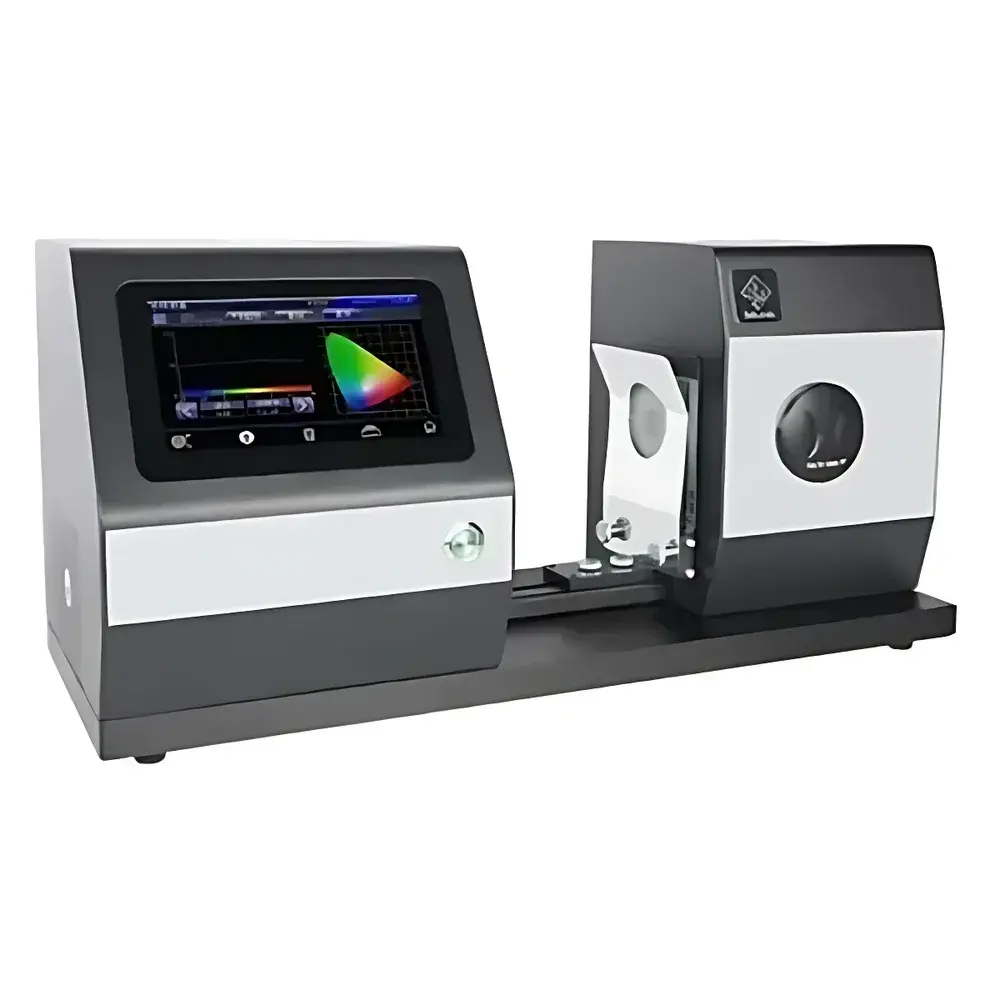
JianHu JH-Series Film Transmittance Analyzer
| Brand | JianHu |
|---|---|
| Origin | Shanghai, China |
| Model | JH-Series Film Transmittance Analyzer |
| Measurement Range | 0–100% transmittance |
| Spectral Range | 380–780 nm (visible spectrum) |
| Light Source | Tungsten-halogen lamp with stabilized output |
| Detector | Silicon photodiode with linear response |
| Repeatability | ±0.2% T |
| Sample Thickness Capacity | Up to 5 mm |
| Interface | 7-inch capacitive touchscreen with embedded OS |
| Data Output | USB, RS-232, optional Ethernet |
| Compliance | ISO 9050, ASTM D1003, GB/T 2410 |
Overview
The JianHu JH-Series Film Transmittance Analyzer is an optical instrumentation system engineered for precise, repeatable quantification of visible-light transmittance through thin-film materials. It operates on the fundamental principle of spectrophotometric transmittance measurement—comparing incident radiant flux (via a stabilized tungsten-halogen source) against transmitted flux detected by a calibrated silicon photodiode. The instrument is optimized for the 380–780 nm visible spectrum, aligning with human photopic vision and international standards for optical clarity assessment. Unlike broadband integrator-based systems lacking spectral discrimination, the JH-Series employs fixed-wavelength illumination and detector geometry that ensures high angular and spatial uniformity—critical for minimizing edge effects and scattering artifacts in low-thickness, high-refractive-index films. Its architecture supports rapid single-point acquisition (<1 s per reading) with traceable linearity across the full 0–100% transmittance range, making it suitable for both R&D screening and routine QC verification in regulated environments.
Key Features
- Stabilized tungsten-halogen light source with thermal regulation, ensuring consistent spectral irradiance over extended operation cycles
- High-linearity silicon photodiode detector, factory-calibrated against NIST-traceable reference standards
- Fixed 0°/0° collimated beam geometry compliant with ASTM D1003 Annex A1 for haze-corrected transmittance
- 7-inch industrial-grade capacitive touchscreen interface with embedded real-time OS—no external PC required
- On-device data logging (up to 10,000 records), timestamped with operator ID and environmental metadata (optional ambient sensor input)
- Modular sample stage accommodating flat films up to 100 × 100 mm, with adjustable clamping force to prevent deformation-induced measurement drift
- Integrated self-diagnostic routines including lamp intensity monitoring, dark-current compensation, and optical path validation
Sample Compatibility & Compliance
The JH-Series accommodates rigid and flexible polymeric films (PET, PC, PMMA, PI), coated glass substrates, anti-reflective laminates, touch sensor overlays, and thin-film photovoltaic encapsulants. Samples must be optically homogeneous within the 10 mm illuminated area; surface roughness < 0.1 µm Ra is recommended for sub-0.5% repeatability. The analyzer conforms to ISO 9050:2003 (glass in building — determination of light transmittance), ASTM D1003-22 (standard test method for haze and luminous transmittance of transparent plastics), and Chinese national standard GB/T 2410-2008. While not a GLP/GMP-certified platform out-of-the-box, its audit-ready data structure—including immutable timestamps, user authentication logs, and calibration history—supports integration into FDA 21 CFR Part 11-compliant workflows when paired with validated third-party LIMS or ELN systems.
Software & Data Management
Firmware v3.2 includes embedded analysis tools: batch statistical reporting (mean, SD, min/max, CPK), pass/fail threshold configuration per material grade, and automatic outlier detection via Grubbs’ test. Raw transmittance values are stored in CSV format with UTF-8 encoding and ISO 8601 timestamps. USB export enables direct import into Excel, MATLAB, or JMP for multivariate correlation studies (e.g., transmittance vs. thickness, coating density, or curing temperature). Optional Ethernet module supports Modbus TCP protocol for integration into factory SCADA systems. All firmware updates are signed and verified; no cloud connectivity or remote telemetry is implemented—data sovereignty remains fully under end-user control.
Applications
- Display Manufacturing: Verification of cover lens transmittance uniformity across OLED/LCD stack interfaces; validation of AR/AG coating efficacy pre- and post-abrasion testing
- Photovoltaics: Quantification of encapsulant clarity impact on photon capture efficiency; correlation of yellowing index (YI) with long-term UV exposure
- Architectural Glazing: Certification of electrochromic and PDLC film switching performance—measuring dynamic ΔT between bleached and colored states
- Medical Packaging: Compliance checking of sterile barrier transparency for visual inspection protocols per ISO 11607-1
- Academic Research: In-situ transmittance tracking during solvent annealing of conjugated polymer films; interfacial scattering analysis in multilayer dielectric stacks
FAQ
Does the JH-Series measure haze in addition to transmittance?
No. It measures total luminous transmittance only. Haze requires a separate integrating sphere configuration per ASTM D1003 Annex A2—this model uses direct-beam geometry.
Can it measure curved or textured films?
Only flat, planar samples are supported. Curvature or surface texture introduces unquantifiable scattering deviations beyond ±1.5% T error.
Is NIST-traceable calibration included with purchase?
Yes—a certified reference standard (certified transmittance filter set: 10%, 50%, 90% @ 550 nm) is supplied with initial calibration certificate valid for 12 months.
What maintenance is required?
Annual lamp replacement and optical path cleaning with spectroscopic-grade methanol; no alignment tools or service technician visit needed.
Is software validation support available for regulated industries?
Yes—IQ/OQ documentation templates and protocol execution services are offered as a paid add-on, aligned with ASTM E2500 and ICH Q9 principles.



