
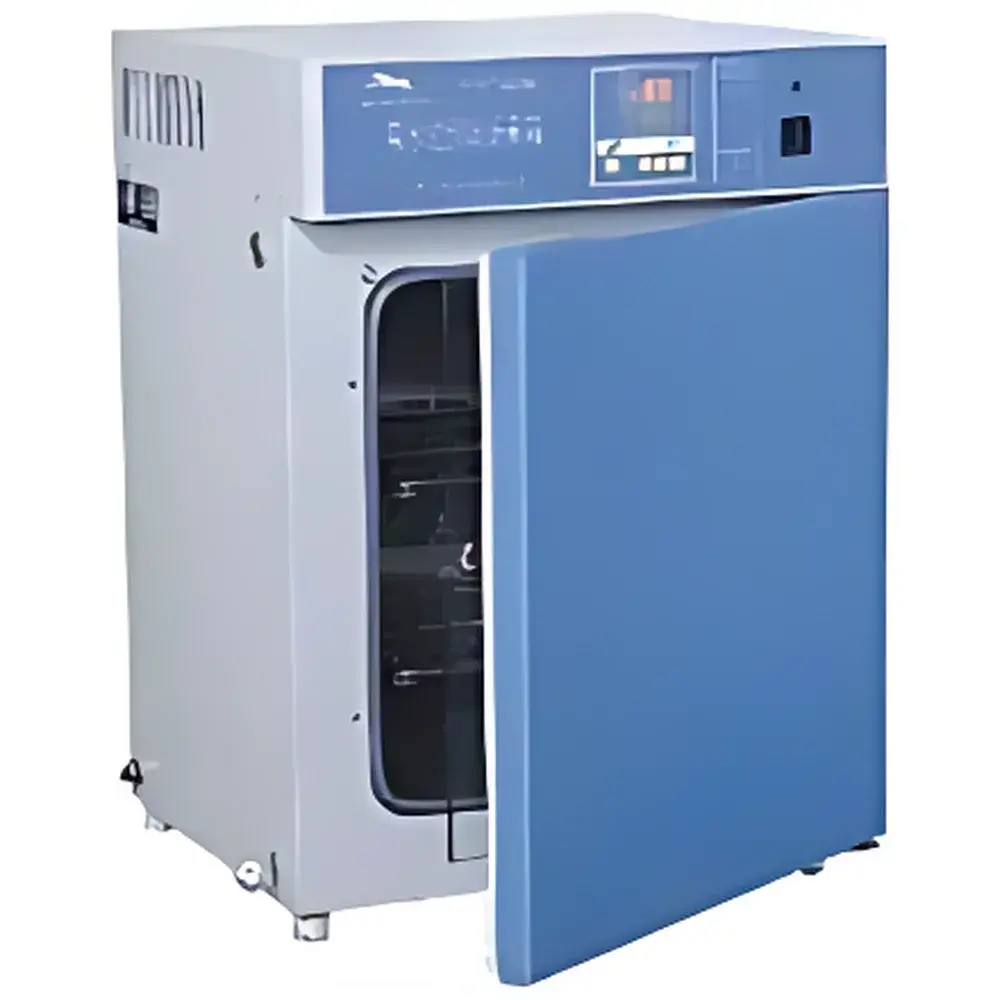
Jinhoo JH Series Water-Jacketed Incubator
| Brand | Jinhoo |
|---|---|
| Origin | Shanghai, China |
| Model | JHP-9050 / JHP-9080 / JHP-9160 / JHP-9270 |
| Power Supply | 220 V, 50 Hz |
| Heating Method | Water-jacketed |
| Temperature Range | RT + 5 to 65 °C |
| Temperature Resolution | 0.1 °C |
| Ambient Operating Temperature | +5 to 35 °C |
| Chamber Volume | 50 L / 80 L / 178 L / 270 L |
| Internal Dimensions (W×D×H, mm) | 350×350×410 / 400×400×500 / 500×500×650 / 600×600×750 |
| External Dimensions (W×D×H, mm) | 500×500×700 / 550×550×800 / 650×640×950 / 750×740×1050 |
| Standard Shelving | 2 / 3 / 3 / 3 stainless steel trays |
| Timer Range | 1–9999 min |
| Input Power | 450 W / 650 W / 850 W / 1350 W |
| Output Signal | 4–20 mA analog output & RS-485 interface (optional) |
| Safety Features | Dual-limit temperature alarm system (independent over-temperature cut-off, optional), low-water-level auto-shutoff, door-open interlock halting heating and circulation |
Overview
The Jinhoo JH Series Water-Jacketed Incubator is a precision-controlled, laboratory-grade thermal environment system engineered for stable, uniform, and reproducible incubation of biological samples, cell cultures, microbiological specimens, and temperature-sensitive reagents. Unlike forced-air (oven-type) incubators, this series employs a water-jacketed heating architecture—where a sealed outer chamber filled with deionized water surrounds the inner stainless-steel working chamber. Heat transfer occurs via conduction and natural convection through the water medium, resulting in exceptional thermal inertia, minimal temperature fluctuation (< ±0.3 °C typical stability), and negligible overshoot during setpoint transitions. This design ensures long-term thermal stability even during brief power interruptions—retaining usable incubation conditions for up to 60–90 minutes post-power-loss. The unit operates within a controlled ambient range of +5 to +35 °C and delivers precise setpoint control from ambient +5 °C up to 65 °C, with 0.1 °C resolution and PID-driven microprocessor regulation.
Key Features
- Double-layer insulated water jacket with integrated water-level monitoring: automatic optical alarm and heater cutoff upon low- or high-level detection
- Intelligent microprocessor PID controller with real-time deviation compensation, adaptive tuning, and digital display of actual vs. set temperature
- Tempered double-glazed observation window with magnetic door seal—equipped with door-open interlock that immediately suspends heating and fan circulation to prevent thermal shock and energy waste
- Electropolished 304 stainless-steel inner chamber and shelving—corrosion-resistant, non-porous, and compliant with ISO 14644-1 Class 7 cleanroom-compatible surface finish standards
- Optional independent over-temperature safety cut-off system (UL/IEC 61010-1 certified), physically isolated from main control circuitry for fail-safe operation
- Standard 4–20 mA analog output and RS-485 serial interface (Modbus RTU protocol) for integration into centralized lab monitoring systems, SCADA platforms, or electronic lab notebooks (ELN)
- Programmable timer (1–9999 minutes) supporting delayed start, cycle termination, and auto-restart functions
Sample Compatibility & Compliance
This incubator supports a broad spectrum of sample types—including Petri dishes, multi-well plates (6–96-well), culture flasks (T25–T225), glass vials, and serum bottles—without risk of desiccation or condensation-induced contamination. The water-jacketed thermal mass minimizes internal air velocity, eliminating convective drying effects common in fan-assisted units. All models comply with IEC 61010-1:2010 for electrical safety in laboratory equipment and meet EN 60529 IP20 ingress protection requirements. Optional configurations support GLP/GMP environments: audit-trail-enabled firmware (with timestamped event logging), password-protected parameter modification, and 21 CFR Part 11–compliant data export (when paired with validated third-party data acquisition software).
Software & Data Management
While the base unit features standalone operation via front-panel controls, the RS-485 interface enables bidirectional communication with external host systems. Using standard Modbus RTU commands, users can remotely read real-time temperature, setpoint, alarm status, water level, and timer values; write new setpoints or initiate calibration routines; and trigger data dump sequences. Raw temperature logs (with 1-minute default interval, configurable up to 1 second) are exportable as CSV files for traceability. When deployed with Jinhoo’s optional DataBridge™ software (Windows-based, FDA 21 CFR Part 11 ready), full electronic signatures, user access tiers, and automated report generation—including trend charts, deviation alerts, and compliance summaries—are supported.
Applications
- Bacterial and fungal culture maintenance (e.g., E. coli, S. aureus, Candida albicans) per CLSI M07-A10 guidelines
- Mammalian cell line propagation (HEK293, CHO-K1) requiring tight thermal consistency across multi-day passages
- Enzyme activity assays and protein stability studies where ±0.2 °C variation directly impacts kinetic parameters
- Seed germination and plant tissue culture under controlled thermoperiodic conditions
- Stability testing of pharmaceutical intermediates per ICH Q1A(R2) accelerated storage protocols
- Quality control incubation for food microbiology (ISO 6579-1:2017, ISO 4833-1:2013)
FAQ
What distinguishes water-jacketed incubation from air-jacketed designs?
Water-jacketed systems provide superior thermal uniformity and stability due to the high specific heat capacity and density of water—reducing spatial gradients and damping external ambient fluctuations more effectively than air-based counterparts.
Is distilled or deionized water required for the jacket?
Yes. Use Type II or III purified water per ASTM D1193 to prevent mineral buildup, corrosion, and sensor drift. Tap water is strictly prohibited.
Can the incubator be validated for GxP use?
Yes—models equipped with optional data logging and alarm history features support IQ/OQ/PQ documentation. Full validation kits (including probe calibration certificates, test protocols, and summary reports) are available upon request.
How often should the water jacket be refilled or replaced?
Under normal operation, top-up frequency is typically quarterly; full replacement is recommended every 12 months or if conductivity exceeds 5 µS/cm (measured with handheld meter).
Does the unit support remote monitoring via Ethernet or Wi-Fi?
The standard configuration includes only RS-485. Ethernet/Wi-Fi connectivity requires an external protocol converter (e.g., Moxa EDS-G205A) or integration via PLC gateway—both supported under Jinhoo’s System Integration Services program.



