
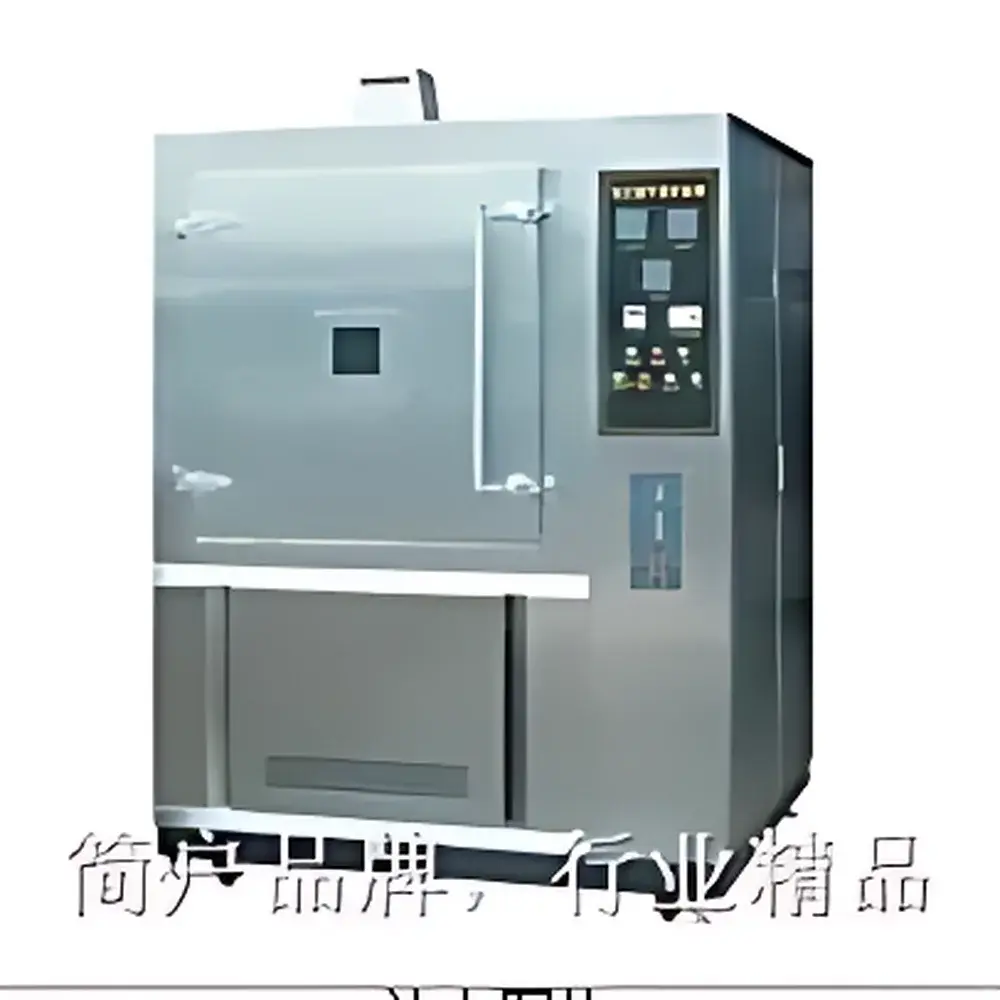
Jianhu JH-7035-UB UV Yellowing Resistance Test Chamber
| Brand | Jianhu |
|---|---|
| Model | JH-7035-UB |
| Origin | Beijing, China |
| Light Source | UV fluorescent lamp (UVA-340 or UVB-313 configurable) |
| Internal Chamber Dimensions | 460 × 300 × 875 mm / 500 × 500 × 1500 mm |
| External Dimensions | 650 × 400 × 1125 mm / 1000 × 650 × 3500 mm |
| Temperature Range | Ambient to 200 °C |
| UV Irradiance | Adjustable via electronic controller |
| Sample Tray | Motor-driven rotating turntable (360° continuous rotation) |
| Timer | Digital electronic timer (0–999.9 h) |
| Power Supply | 220 V AC, 50 Hz |
| Net Weight | 15 kg / 140 kg (depending on configuration) |
Overview
The Jianhu JH-7035-UB UV Yellowing Resistance Test Chamber is an engineered environmental simulation system designed to evaluate the photochemical stability of polymeric materials, coatings, textiles, and plastic components under controlled ultraviolet (UV) irradiation and thermal stress. It operates on the principle of accelerated aging through standardized UV exposure—primarily utilizing UVA-340 or UVB-313 spectral output lamps that replicate critical portions of natural sunlight (295–365 nm), as defined in ASTM G154, ISO 4892-3, and GB/T 14522. Unlike broad-spectrum xenon arc testers, this chamber delivers high-intensity, narrow-band UV radiation with precise thermal coupling, enabling reproducible assessment of surface yellowing, gloss loss, chalking, and embrittlement over time. Its dual-chamber configurations support both small-batch R&D validation and large-scale quality control testing, with temperature regulation synchronized to irradiance intensity to simulate real-world service conditions such as indoor UV exposure or elevated-temperature storage environments.
Key Features
- Configurable UV light source: Compatible with industry-standard UVA-340 (sunlight-simulating) or UVB-313 (accelerated degradation) fluorescent lamps, each with calibrated spectral output and replaceable after specified radiant exposure hours.
- Motorized rotating sample tray: Ensures uniform irradiance distribution across all specimens by maintaining consistent angular exposure; rotation speed is fixed at 3 rpm for optimal dose homogeneity per ASTM D4329.
- Independent temperature control: PID-regulated heating system maintains setpoint accuracy within ±2 °C across the full range (ambient to 200 °C), with forced-air convection for thermal uniformity inside the test chamber.
- Digital programmable timer: High-resolution electronic timer (0.1-hour resolution, max 999.9 h) supports unattended operation and repeatable test cycles; auto-shutdown upon completion.
- Modular mechanical architecture: Two standard chamber sizes accommodate diverse sample geometries—from small film strips and molded plaques to oversized panels—without compromising UV flux density or thermal profile integrity.
- Front-access transparent door with UV-blocking safety glass: Enables visual monitoring while preventing operator exposure to hazardous UV radiation; interlocked circuitry cuts power when opened.
Sample Compatibility & Compliance
The JH-7035-UB accommodates rigid and flexible substrates including ABS, PC, PP, PVC, acrylic paints, automotive interior trim, optical lenses, and medical-grade elastomers. Specimens are mounted on perforated aluminum trays or clamped directly to the rotating platform using non-reactive fixtures. The system complies with core international test standards for yellowing resistance evaluation, including ASTM D1148 (Standard Test Method for Rubber Deterioration—Yellowing), ISO 4892-3 (Plastics—Methods of Exposure to Laboratory Light Sources—Part 3: Fluorescent UV Lamps), and Chinese national standard GB/T 14522. It supports GLP-aligned documentation practices when integrated with external data loggers or laboratory information management systems (LIMS). While not inherently 21 CFR Part 11 compliant, audit trails and calibration records can be maintained externally to satisfy regulated QC workflows.
Software & Data Management
The JH-7035-UB operates via embedded microcontroller logic with no proprietary software dependency. All operational parameters—including elapsed time, set temperature, and lamp status—are displayed on a backlit LCD interface. For traceable data capture, users may integrate optional RS-485 or analog 4–20 mA outputs with third-party SCADA platforms or custom Python-based logging scripts. Calibration certificates for UV irradiance sensors (traceable to NIM, China) and temperature probes are provided with each unit. Firmware updates are performed manually via USB port; version history and change logs are documented in the technical manual.
Applications
- Quality assurance of white or pastel-colored plastic housings used in consumer electronics and home appliances.
- Evaluation of UV stabilizer efficacy in automotive clearcoats and interior polymers exposed to dashboard-level solar loading.
- Stability screening of optical adhesives and lens coatings subjected to long-term indoor lighting conditions.
- Regulatory pre-compliance testing for RoHS-compliant polymer formulations where halogen-free flame retardants may increase susceptibility to photooxidation.
- R&D of biodegradable packaging films requiring verification of color retention during shelf-life simulation.
FAQ
What UV lamp types are supported, and how often must they be replaced?
UVA-340 and UVB-313 fluorescent lamps are supported. Lamp replacement intervals are determined by cumulative radiant exposure: UVA-340 lamps require replacement after 1600–2000 hours of operation; UVB-313 lamps after 500–1000 hours, per manufacturer specifications and spectral decay monitoring.
Is the chamber suitable for testing coated metal substrates?
Yes—provided the coating thickness and thermal expansion coefficient are compatible with the 200 °C upper temperature limit. Direct contact between bare metal and chamber surfaces should be avoided to prevent localized hot spots.
Does the system include UV irradiance calibration capability?
A calibrated UV radiometer (optional accessory) is required for absolute irradiance measurement. The base unit includes relative intensity monitoring only; NIST-traceable calibration services are available through authorized Jianhu service partners.
Can multiple temperature and UV intensity profiles be programmed?
No—the JH-7035-UB supports single-setpoint operation only. Multi-step cycling requires external programmable controllers interfaced via analog I/O ports.
What maintenance is required for long-term reliability?
Monthly inspection of lamp reflectors for dust accumulation, quarterly verification of door gasket integrity, and annual thermocouple calibration using a reference dry-block calibrator are recommended.
Related Products



