
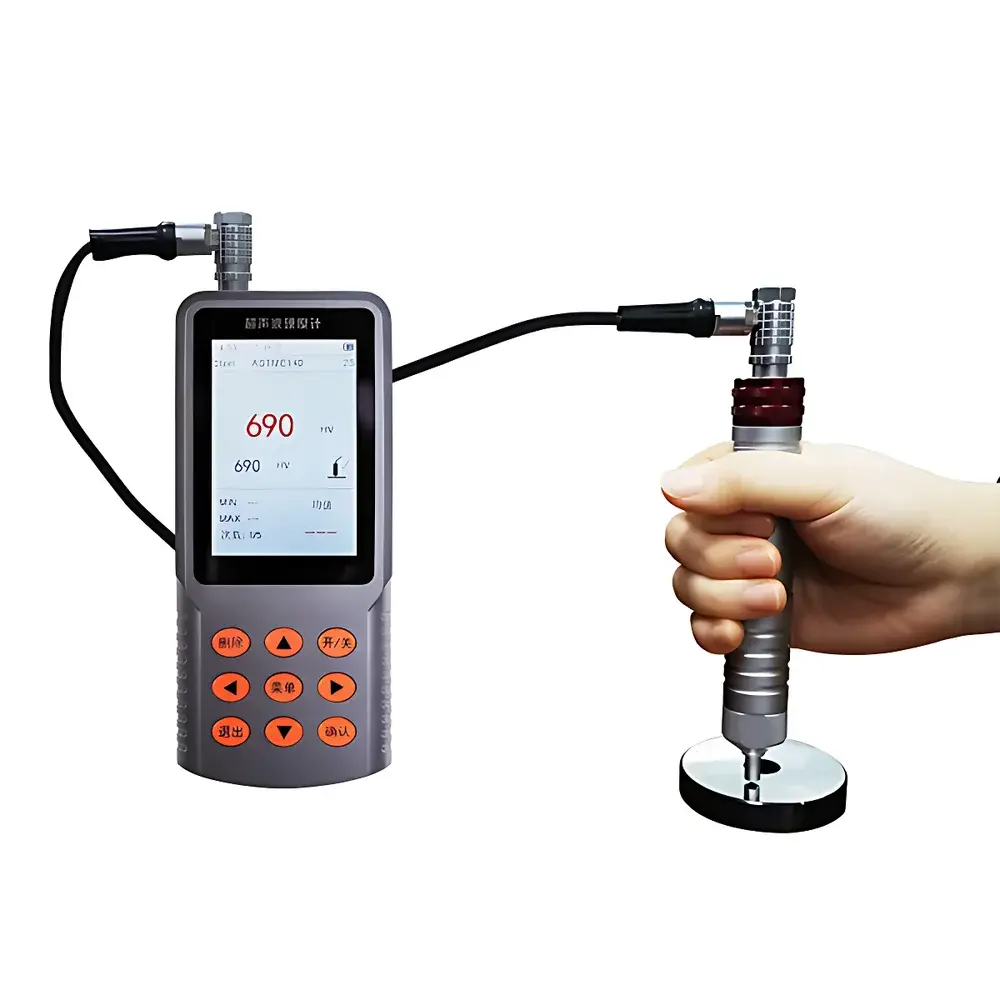
Olympus U918 Ultrasonic Contact Impedance (UCI) Hardness Tester
| Brand | Olympus |
|---|---|
| Origin | Japan |
| Model | U918 |
| Compliance | DIN 50159-1:2008, ASTM A1038-2005, JB/T 9377-2010, JJG 654-2013, GB/T 34205-2017 |
| Calibration Modes | 10-point factory calibration, single-point elastic modulus compensation, multi-point direct hardness calibration (HRC, HRB, HRA, HB, HV5) |
| Display | 3.5″ color LCD with real-time statistics (min/max/avg/count/timestamp) |
| Indentation Size | <20 µm diameter (requires >200× optical magnification for visualization) |
| Measurement Time | ≤2 s per test |
| Battery | 3.6 V / 3000 mAh Li-ion, up to 15 h operation |
| Data Storage | 50 test sets + 10 calibration profiles |
| Connectivity | Bluetooth printer support (optional), USB-C PC data export |
| Test Orientation | Omnidirectional (±5° tolerance from perpendicular) |
| Hardness Scales | HV, HRC, HRA, HRB, HB (directly calibrated, no conversion tables required) |
Overview
The Olympus U918 Ultrasonic Contact Impedance (UCI) Hardness Tester is an engineered solution for non-destructive, portable microhardness assessment of finished components, thin coatings, heat-affected zones (HAZ), and small-diameter parts where conventional indentation methods are impractical. Based on the ultrasonic contact impedance principle, the instrument measures the resonant frequency shift of a vibrating tungsten carbide probe under controlled static load (typically 10–100 N). This shift correlates directly with the material’s resistance to plastic deformation—i.e., its hardness—without requiring optical evaluation of indent geometry. Unlike optical microhardness testers, the U918 delivers quantitative hardness values in seconds without surface preparation beyond standard cleaning, making it suitable for in-process QA/QC, field service verification, and maintenance inspections across aerospace, power generation, automotive, and precision manufacturing sectors.
Key Features
- Multi-standard compliance: Fully aligned with DIN 50159-1:2008, ASTM A1038-2005, JB/T 9377-2010, JJG 654-2013, and GB/T 34205-2017—ensuring traceability and acceptance in global regulatory and quality audit environments.
- Three-tier calibration architecture: Factory 10-point calibration using certified Vickers reference blocks; single-point mode compensates for material-specific elastic modulus (E-modulus), eliminating systematic bias in non-ferrous or low-E alloys; multi-point direct calibration enables traceable HRC, HRB, HRA, HB, and HV5 measurements without reliance on empirical conversion tables—critical for composites, additively manufactured parts, or functionally graded materials.
- Omnidirectional measurement capability: Operates reliably at any orientation (0–360°), provided probe-to-surface angle remains within ±5° of perpendicular—enabling hardness mapping on curved surfaces, internal bores, weld caps, and vertically mounted turbine blades.
- Minimal surface impact: Generates sub-20 µm indentations—smaller than those produced by rebound-type instruments (e.g., Leeb)—preserving part integrity and eliminating post-test polishing requirements. Indents are optically resolvable only under ≥200× metallurgical microscopy.
- Integrated metrology interface: 3.5″ high-contrast color LCD displays real-time measurement statistics—including min/max/avg, cumulative count, timestamp, selected material group, and active hardness scale—alongside live probe contact status and battery level.
Sample Compatibility & Compliance
The U918 is validated for use on metallic materials including carbon steels, stainless steels, aluminum alloys, titanium grades, nickel-based superalloys, and hardened tool steels. Its elastic modulus compensation algorithm extends applicability to cast irons, copper alloys, and precipitation-hardened aluminum, provided appropriate calibration references are employed. Surface roughness should not exceed Ra 3.2 µm; curvature radius must be ≥5 mm for reliable readings. The device meets electromagnetic compatibility (EMC) requirements per IEC 61326-1 and carries CE marking for industrial use. All calibration profiles and measurement logs retain full audit trails compliant with ISO/IEC 17025 and FDA 21 CFR Part 11 when exported via USB-C to validated laboratory information management systems (LIMS).
Software & Data Management
Measurement data—including raw frequency shift values, applied load, temperature-compensated hardness results, and operator-defined metadata (batch ID, location, material grade)—are stored internally in non-volatile memory. Each dataset includes time/date stamping and user-selectable units. Up to 50 independent test series (each containing up to 99 individual readings) and 10 distinct calibration configurations can be retained onboard. Data export is supported via USB-C to Windows/macOS platforms using Olympus-provided CSV-compatible software, enabling integration into statistical process control (SPC) dashboards or enterprise quality databases. Optional Bluetooth thermal printers allow on-site hardcopy generation with embedded calibration certificate IDs and measurement uncertainty statements.
Applications
- Verification of case depth hardness in carburized or nitrided gears and shafts
- In-service assessment of turbine blade leading-edge erosion resistance
- QA sampling of weld overlay cladding hardness in petrochemical piping
- Hardness profiling across heat-affected zones (HAZ) in laser-welded battery tabs
- Batch release testing of medical implant-grade titanium components
- Field validation of coating hardness (e.g., CrN, TiAlN) on cutting tools without disassembly
FAQ
Does the U918 require periodic recalibration against national standards?
Yes—annual recalibration against NIST-traceable Vickers reference blocks is recommended for ISO/IEC 17025-compliant laboratories. Internal self-diagnostic routines verify probe resonance stability before each measurement sequence.
Can the U918 measure hardness on coated substrates?
Yes, provided coating thickness exceeds three times the indentation depth (typically ≥60 µm for 100 N load) and substrate hardness differs by <30% from coating hardness. Cross-sectional validation is advised for critical applications.
Is operator training required for GLP/GMP compliance?
Yes—Olympus provides documented training modules covering probe handling, surface conditioning, calibration protocol execution, and data integrity practices aligned with Annex 11 and ALCOA+ principles.
What is the measurement uncertainty budget for HRC readings?
At 23 °C ambient, with proper calibration and surface preparation, expanded uncertainty (k=2) is ±1.5 HRC for materials within 20–65 HRC range, per ASTM E18 repeatability guidelines.
Does the instrument support custom hardness scale definitions?
No—the U918 implements only standardized scales (HV, HRC, HRB, HRA, HB) as defined in referenced national/international standards. Custom curve fitting is intentionally excluded to maintain regulatory defensibility.



