
English Product Name
| Brand | Langbo |
|---|---|
| Model | LBJK-2 |
| Origin | Jiangsu, China |
| Power Consumption | ≤ 2 × 4 kW |
| Temperature Range | 0–999 °C |
| Temperature Accuracy | Class 0.5 |
| Temperature Resolution | 1 °C |
| Timing Range | 0–999 min |
| Timing Accuracy | ±30 s per 24 h |
| Heating Profile | 30 min to 250 °C |
| Supply Voltage | 220 V, 50 Hz |
| Temperature Sensor | Armored K-type Thermocouple |
| Configuration | Dual-furnace or single-furnace operation mode |
Overview
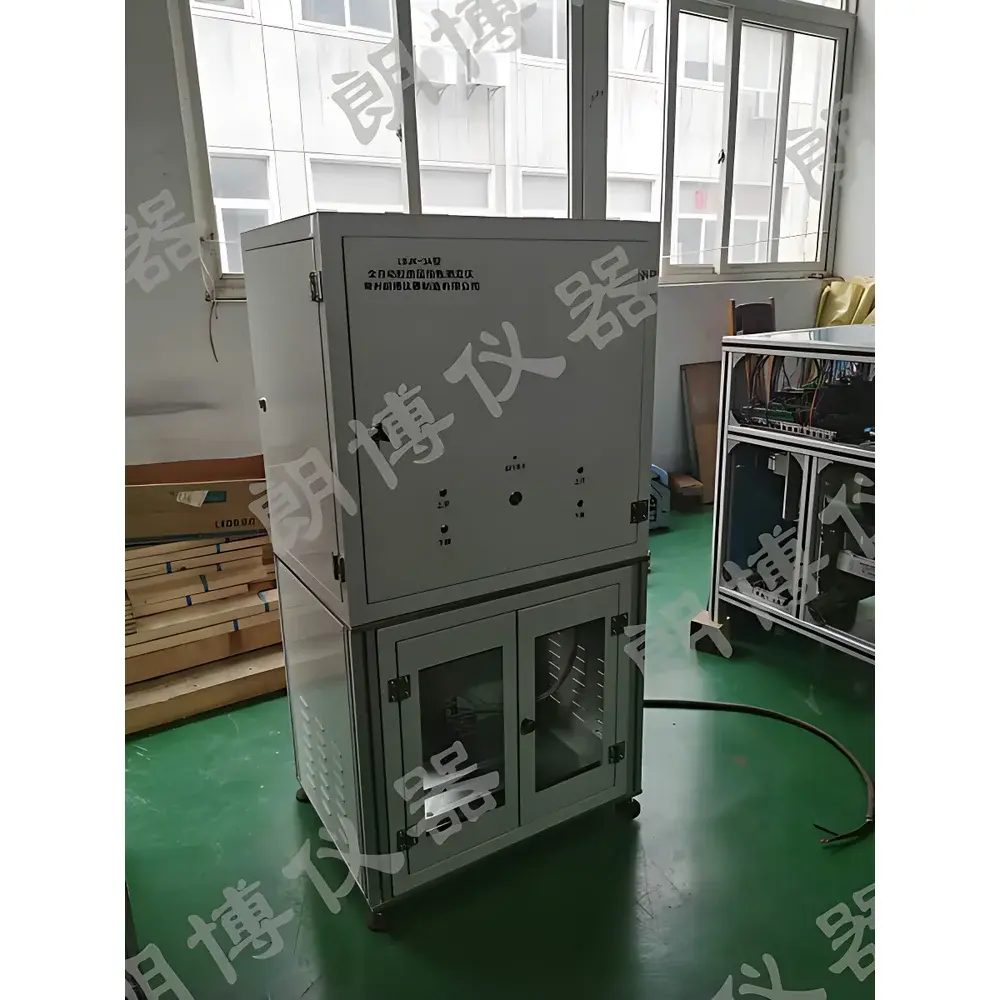
The Langbo LBJK-2 Intelligent Gieseler Plastometer is a dedicated laboratory instrument engineered for the standardized determination of coal plasticity parameters—specifically the maximum thickness of the plastic layer (Y-value) and the final contraction distance (X-value)—in accordance with GB/T 479–2000, the Chinese national standard equivalent to ISO 501:2016 and ASTM D720–20. The system operates on the Gieseler plastometry principle: a cylindrical coal charge is heated under controlled conditions while subjected to a constant load (typically 35 kgf), causing thermal softening, swelling, and subsequent resolidification. The vertical displacement of the upper and lower surfaces of the plastic layer is measured continuously, generating characteristic X- and Y-curves that define the coal’s caking behavior during carbonization. This measurement is critical for coke oven feedstock evaluation, blending optimization, and quality assurance in metallurgical coal procurement.
Key Features
- Computer-controlled temperature regulation synchronized precisely with GB/T 479–2000 heating schedules, including the mandatory ramp profile (30 min to 250 °C, then 3 °C/min up to 730 °C).
- Digital displacement sensing using high-stability linear position transducers—replacing legacy mechanical recording drums—to ensure traceable, noise-resistant acquisition of upper and lower plastometer surface movements.
- Real-time dual-curve visualization: simultaneous display of furnace temperature vs. time and coal expansion (X-curve) vs. time on a calibrated graphical interface.
- Integrated PID controller with online tuning capability: users may adjust proportional, integral, and derivative parameters during active runs to optimize thermal response stability.
- Automated Y-value computation: upon manual entry of observed upper and lower surface positions at peak plasticity, the software calculates Y (in mm) per GB/T 479–2000 Section 8.3 and generates compliant output reports.
- Configurable operation modes: independent or synchronized dual-furnace testing enables comparative analysis of two coal samples under identical thermal conditions.
- Full data persistence: all raw sensor outputs (temperature, displacement, time stamps), derived curves, and operator annotations are timestamped and archived in a structured binary format for audit readiness.
Sample Compatibility & Compliance
The LBJK-2 accepts standard 100-g coal charges prepared according to GB/T 479–2000 Section 6 (particle size ≤ 1.5 mm, air-dried, free of visible impurities). It supports both vitrinite-rich bituminous coals and low-volatile blends commonly used in blast furnace coke production. The instrument meets mechanical and electrical safety requirements per GB 4793.1–2007 (equivalent to IEC 61010-1). While not certified to ISO/IEC 17025, its measurement traceability aligns with GLP-aligned laboratory practices when operated with NIST-traceable thermocouple calibrators and documented calibration intervals. All generated reports include metadata (operator ID, sample ID, test date/time, furnace ID) required for internal QA documentation.
Software & Data Management
The embedded Windows-based application provides a deterministic real-time acquisition environment with millisecond-level sampling synchronization between thermocouple inputs and displacement sensors. Data files are stored in a proprietary but exportable binary format (.ljk), with optional CSV export for third-party statistical analysis (e.g., JMP, Minitab). Audit trails record all user actions—including curve edits, parameter modifications, and report generation—with immutable timestamps. Software versioning and firmware update logs are retained locally. The system supports basic 21 CFR Part 11 readiness via configurable user access levels (administrator, technician, viewer) and electronic signature prompts for final report approval—though full compliance requires integration with institutional identity management systems.
Applications
- Metallurgical coal quality control in mining and trading laboratories.
- Coke plant R&D for optimizing coal blend ratios prior to pilot-scale carbonization trials.
- Academic research on coal pyrolysis kinetics and plastic phase rheology.
- Third-party verification testing for international coal contracts referencing GB/T 479 or ISO 501.
- Regulatory submissions requiring documented Y/X values for environmental or customs classification (e.g., HS Code 2701.12).
FAQ
Does the LBJK-2 comply with ISO 501:2016?
The instrument implements the same thermal and mechanical protocol as ISO 501:2016; however, formal ISO certification requires independent verification by an accredited body. Users should validate performance against reference coals certified to ISO 501 before regulatory submission.
Can historical test data be migrated to newer software versions?
Yes—the .ljk file structure remains backward-compatible across Langbo firmware releases v2.1 and later. A conversion utility is provided for migration to v3.x formats.
Is external calibration of the displacement sensor required?
Yes. Annual calibration using a certified micrometer standard (±0.02 mm uncertainty) is recommended per GB/T 479–2000 Annex C and internal QA procedures.
What maintenance is required for the furnace assembly?
Furnace insulation integrity and thermocouple sheath condition should be inspected quarterly. Graphite crucibles must be replaced after 150–200 cycles or upon visible cracking or warping.





