
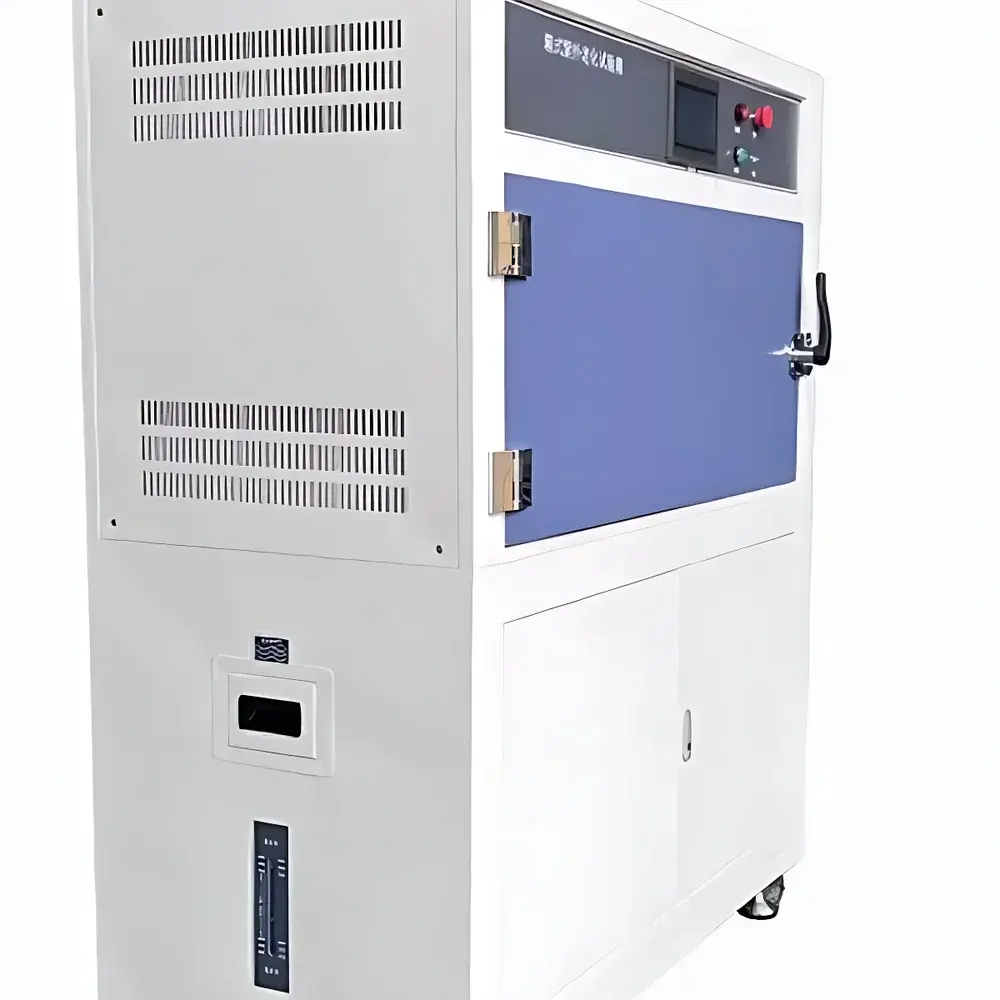
Jianhu UV Aging Test Chamber for Photovoltaic Module Durability Testing
| Brand | Jianhu |
|---|---|
| Origin | Shanghai, China |
| Manufacturer Type | Authorized Distributor |
| Model | PV-Series UV Aging Test Chamber |
| Price Range | USD 280 – 28,000 |
| Humidity Range | ≥95% RH |
| UV Lamp Power | 40 W per lamp |
| Irradiance Range | 0.72 W/m² (UVA-340 spectrum) |
| Test Duration | 1–9999 hours, programmable |
Overview
The Jianhu PV-Series UV Aging Test Chamber is an engineered environmental simulation system designed specifically for accelerated photostability evaluation of photovoltaic (PV) modules and their constituent materials—particularly ethylene-vinyl acetate (EVA) encapsulants, backsheet polymers, and anti-reflective coatings. It operates on the principle of controlled ultraviolet irradiation within the critical 295–365 nm spectral band, replicating the most photochemically damaging portion of terrestrial solar radiation. Unlike broad-spectrum weathering chambers, this system employs calibrated UVA-340 fluorescent lamps to deliver spectrally accurate irradiance, enabling quantitative correlation between laboratory exposure time and real-world field degradation. The chamber integrates simultaneous control of UV intensity, black-panel temperature (typically 60–80 °C), and high-humidity condensation cycles (≥95% RH), thereby accelerating hydrolytic and photo-oxidative aging mechanisms that drive yellowing, delamination, and transmittance loss in PV laminates.
Key Features
- UVA-340 lamp array with traceable irradiance calibration (0.72 W/m² at specimen plane), compliant with ISO 4892-3 and ASTM G154 Class A requirements
- Programmable exposure cycles: UV-only, UV + condensation, or UV + thermal cycling—configurable to match IEC 61215-2 MQT10, IEC 61730-2, and UL 1703 test protocols
- High-fidelity humidity control via water-jacketed condensation system, maintaining ≥95% RH during dark condensation phases
- Black-panel temperature sensor feedback loop with ±0.5 °C stability across 60–80 °C operational range
- Stainless-steel interior chamber with quartz glass UV-transmissive viewing window and interlocked safety cutoff
- Modular lamp rack design allowing individual lamp replacement without system downtime
- Compliant with CE, RoHS, and GB/T 2423.24 national standards for environmental testing equipment
Sample Compatibility & Compliance
The chamber accommodates standard PV module samples up to 1.8 m × 1.2 m (custom fixtures available). It supports both full-size module testing and material coupons (e.g., EVA strips, PET backsheets, glass/AR-coated substrates). All test methodologies align with internationally recognized reliability standards including IEC 61215-2 (MQT10: UV pre-conditioning), IEC 61730-2 (UV resistance of encapsulation), and JIS C 8912. Data generated is suitable for GLP-compliant reporting and supports root-cause analysis for failure modes such as browning index increase (>ΔYI = 5), optical density shift (OD > 0.1 at 400 nm), and interfacial adhesion loss measured via peel strength (ASTM D903). The system architecture meets foundational requirements for audit readiness under ISO/IEC 17025 and supports integration into QMS workflows requiring traceable calibration records and instrument qualification (IQ/OQ/PQ).
Software & Data Management
Equipped with a Windows-based control interface featuring real-time irradiance monitoring, temperature/humidity logging at 1-second intervals, and automated cycle sequencing. All operational parameters—including elapsed UV dose (kJ/m²), cumulative condensation time, and thermal profile—are timestamped and exportable in CSV or XML format. Audit trails record user login, parameter changes, and alarm events, satisfying basic data integrity expectations aligned with FDA 21 CFR Part 11 Annex 11 principles. Optional Ethernet connectivity enables remote supervision and integration with enterprise LIMS or MES platforms. Calibration certificates for irradiance sensors are issued annually and archived with NIST-traceable reference documentation.
Applications
- Accelerated validation of EVA, POE, and silicone encapsulant formulations for UV resistance and yellowing kinetics
- Comparative lifetime modeling of bifacial vs. monofacial module architectures under high-irradiance desert conditions
- Qualification of new AR coating technologies against spectral transmittance decay (350–1100 nm)
- Root-cause investigation of field failures linked to backsheet cracking, delamination, or PID susceptibility
- Supporting Tier-1 manufacturers’ internal reliability roadmaps and bankability documentation for project financing
- Academic research on polymer photochemistry, including carbonyl index evolution (FTIR), gel content reduction (solvent extraction), and crosslink density mapping (DMA)
FAQ
What UV spectrum does the chamber replicate, and why is UVA-340 used?
The chamber uses UVA-340 fluorescent lamps, which closely match the solar cutoff at 295 nm and peak at 340 nm—covering the most aggressive photochemical band for polymer degradation. This spectral fidelity ensures laboratory results correlate meaningfully with outdoor exposure in regions like Arizona, Saudi Arabia, or Northwest China.
Can the chamber perform combined UV + damp heat testing?
Yes. The system supports sequential or overlapping UV irradiation and high-humidity condensation phases, enabling simulation of diurnal moisture ingress and UV-driven oxidation—key drivers of acetic acid formation in EVA and subsequent corrosion of silver grids.
Is irradiance uniformity validated across the test area?
Yes. Uniformity is verified per ISO 4892-3 Annex B using a calibrated UV radiometer grid scan; typical deviation is ≤±5% across the central 80% of the exposure plane.
How is calibration maintained over time?
Each lamp batch is supplied with individual spectral power distribution (SPD) data. Irradiance sensors are recalibrated annually using a NIST-traceable reference meter, and lamp replacement intervals are tracked based on accumulated UV dose (typically 1,500–2,000 hours for optimal spectral stability).
Does the system support compliance reporting for IEC 61215 certification?
It provides the core UV preconditioning capability required by MQT10. Full certification requires integration with accredited third-party labs for electroluminescence imaging, power measurement, and visual inspection—but the chamber delivers the reproducible, documented UV exposure component essential for audit submission.



