
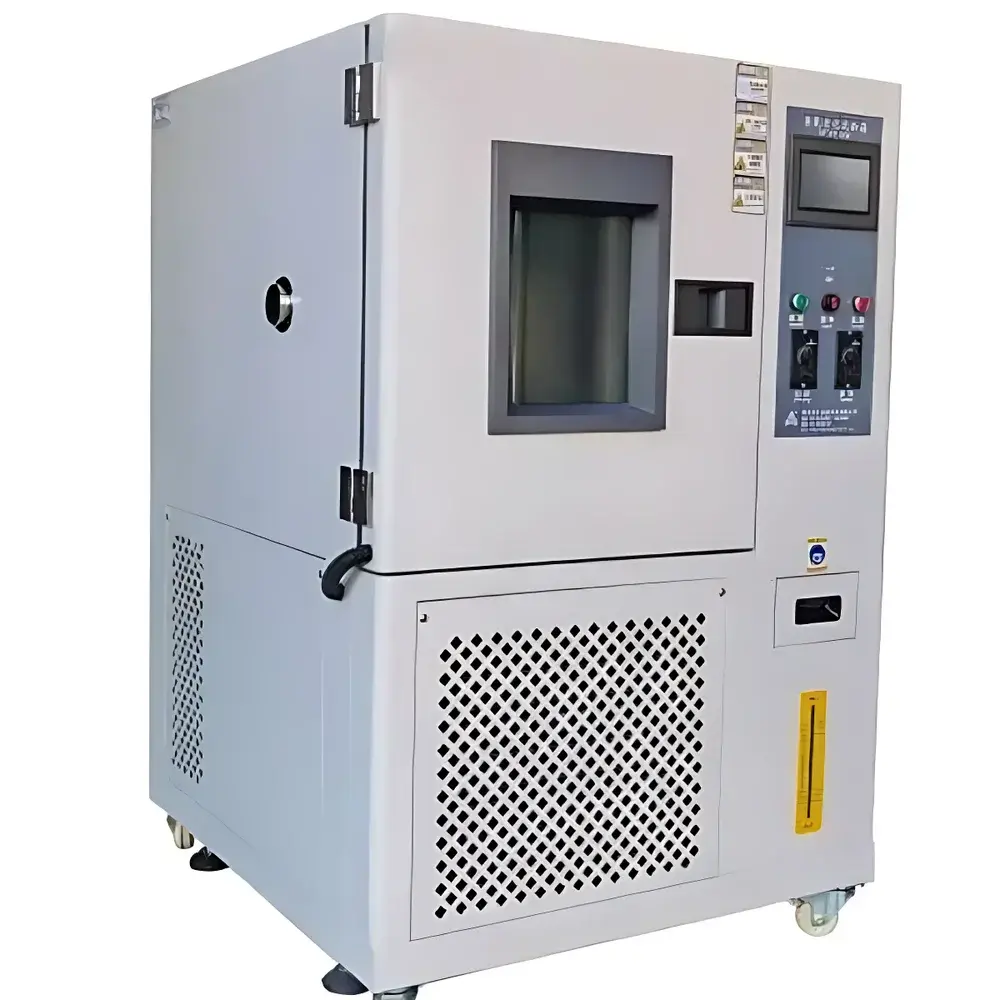
Jianhu JH-THE-150 High-Low Temperature Environmental Test Chamber
| Brand | Jianhu |
|---|---|
| Origin | Shanghai, China |
| Manufacturer Type | Authorized Distributor |
| Product Category | Domestic |
| Model | JH-THE-150 |
| Instrument Type | Benchtop |
| Cooling Method | Air-Cooled |
| Temperature Range | -80 °C to +150 °C |
| Humidity Range | 30–98 % RH |
| Temperature Uniformity | ≤ ±2 °C |
| Temperature Fluctuation | ±1 °C (high temp), ±2 °C (low temp) |
| Humidity Uniformity | ≤ ±3 % RH |
| Humidity Fluctuation | ±3 % RH |
| Heating Rate | 1.0–3.0 °C/min |
| Compliance | GB/T 2423 (IEC 60068-2 series equivalent) |
Overview
The Jianhu JH-THE-150 High-Low Temperature Environmental Test Chamber is an engineered precision system designed for controlled thermal stress evaluation of electronic components, battery modules, automotive ECUs, and semiconductor packaging under defined climatic conditions. Operating on forced-air convection with dual-stage cascade refrigeration and PID-controlled electric heating, the chamber delivers stable, reproducible temperature profiles across a wide operational envelope—from cryogenic -80 °C to elevated +150 °C. Its architecture adheres to the fundamental requirements of IEC 60068-2 environmental testing standards, with direct alignment to GB/T 2423—China’s national implementation of the IEC framework—ensuring technical equivalence for qualification testing in global supply chains. Unlike general-purpose incubators or storage chambers, the JH-THE-150 integrates real-time thermal inertia compensation, multi-point sensor mapping, and programmable ramp/soak sequences essential for reliability validation per AEC-Q200, ISO 16750-4, and JEDEC JESD22-A104.
Key Features
- Wide operational range: -80 °C to +150 °C with independent humidity control (30–98 % RH), enabling combined temperature-humidity stress profiling
- Air-cooled cascade refrigeration system with environmentally compliant R404A/R23 mixed-refrigerant circuitry, eliminating water-chiller dependency
- Benchtop footprint (W600 × D750 × H1600 mm) optimized for lab integration; internal workspace volume: 150 L (W500 × D500 × H600 mm)
- High-stability PID control algorithm with dual-channel feedback: platinum RTD sensors (Class A, ±0.15 °C tolerance) for temperature and capacitive hygrometers (±2 % RH accuracy) for humidity
- Temperature uniformity ≤ ±2 °C and fluctuation ±1 °C (at 60 °C) / ±2 °C (at -40 °C); humidity uniformity ≤ ±3 % RH over full load
- Programmable heating rate: 1.0–3.0 °C/min (adjustable via controller interface), supporting accelerated thermal cycling protocols
- Corrosion-resistant stainless-steel interior (SUS304), double-layer insulated door with anti-fog heated glass viewport, and over-temperature/over-humidity safety cutoffs
Sample Compatibility & Compliance
The JH-THE-150 accommodates samples up to 30 kg with unrestricted airflow access—critical for thermal mass characterization of EV battery cells (e.g., 21700, 4680 formats), power modules (SiC MOSFETs, IGBTs), and PCB assemblies. Internal chamber geometry supports standardized test fixtures per GB/T 2423.1 (cold), GB/T 2423.2 (dry heat), GB/T 2423.3 (damp heat, cyclic), and GB/T 2423.34 (combined temperature/humidity). All calibration and performance verification procedures follow JJG 2052–2019 (National Metrological Verification Regulation for Environmental Test Chambers). The system is compatible with GLP-compliant audit trails when paired with optional data logging hardware meeting FDA 21 CFR Part 11 requirements (electronic signature, audit log, user access control).
Software & Data Management
Equipped with Jianhu’s proprietary JH-TCM v3.2 controller firmware, the chamber supports up to 100 programmable test profiles with 99 segments per profile—including linear ramps, dwell periods, and conditional branching. USB and RS485 interfaces enable direct connection to host PCs running Windows-based JH-DataLink software, which provides real-time graphing, CSV export, alarm event tagging, and automated report generation (PDF/Excel). Optional Ethernet module enables Modbus TCP integration into centralized MES or LabVantage environments. Raw sensor data (1-second resolution) is timestamped and stored locally on SD card (up to 32 GB), with configurable retention policies aligned with ISO/IEC 17025 documentation retention guidelines.
Applications
- Automotive electronics: Thermal shock screening of ADAS sensors, infotainment units, and BMS controllers per ISO 16750-4 Level 3
- Lithium-ion battery validation: Low-temperature discharge capacity retention at -30 °C; high-temperature storage aging per UN 38.3 T.3
- Semiconductor reliability: Preconditioning of IC packages prior to solder reflow simulation or HAST testing
- Material science: Coefficient of thermal expansion (CTE) measurement support via integrated sample mounting brackets
- Quality assurance labs: Routine environmental qualification per customer-specific PPAP or APQP deliverables
- Academic research: Controlled variable studies on polymer degradation kinetics, electrolyte volatility, and separator shrinkage thresholds
FAQ
Does the JH-THE-150 meet international standards beyond GB/T 2423?
Yes—it is functionally aligned with IEC 60068-2-1 (cold), -2 (dry heat), -30 (cyclic damp heat), and -14 (change of temperature), and has been validated against ASTM E1545 for thermal performance verification.
Can this chamber perform rapid thermal cycling between extremes?
While optimized for stability rather than ultra-fast transitions, it achieves 10 °C/min average ramp rates within ±5 °C of setpoint during standard operation; dedicated thermal shock configurations require the JH-TSC series.
Is remote monitoring supported out-of-the-box?
Basic remote status viewing is available via optional web server module (JH-WebLink); full SCADA-level integration requires third-party OPC UA gateway configuration.
What maintenance intervals are recommended for long-term calibration integrity?
Annual NIST-traceable sensor recalibration is advised; compressor oil inspection every 24 months; condenser coil cleaning quarterly in high-dust environments.
How is data integrity ensured during power interruption?
The controller retains active profile state and logs all events to non-volatile memory; upon recovery, it resumes from last valid segment without data loss.



