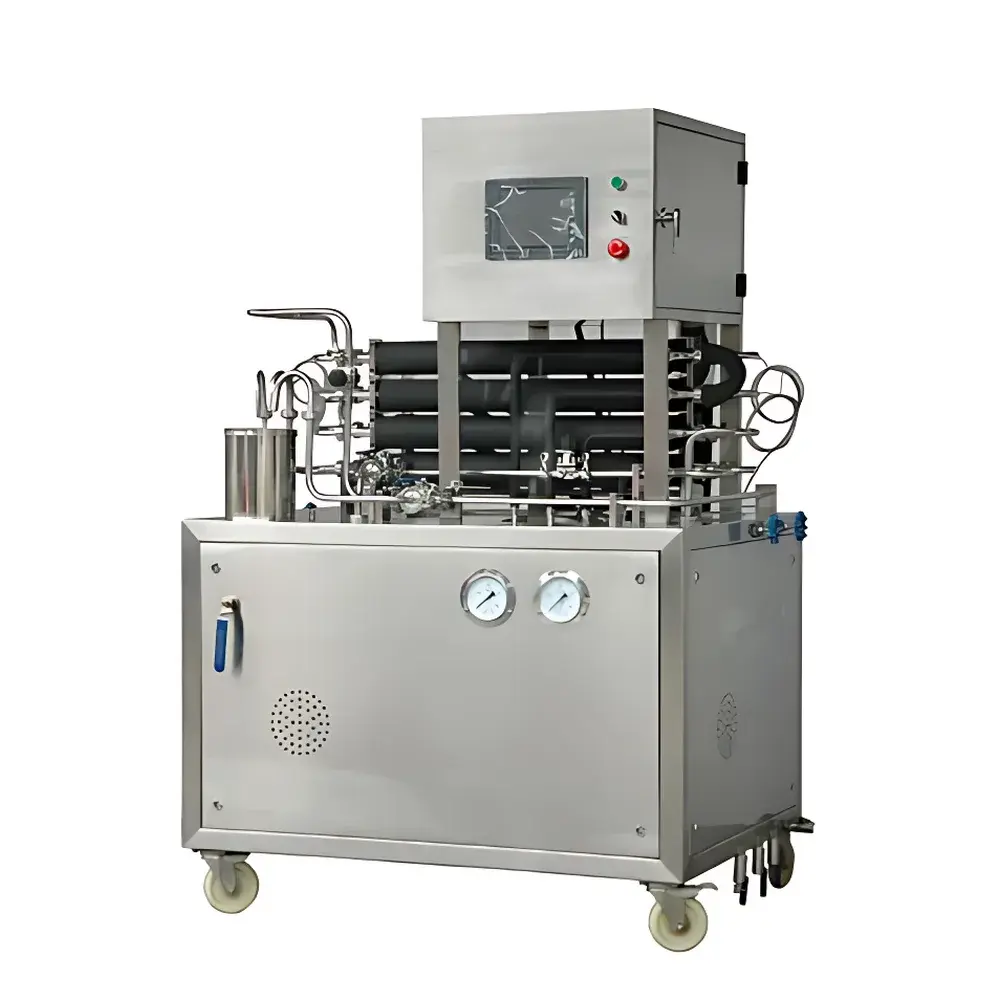
YaCheng / PILOTECH YC-02 Pilot-Scale Tubular Ultra-High Temperature Sterilizer
| Brand | YaCheng / PILOTECH |
|---|---|
| Origin | Shanghai, China |
| Manufacturer Type | OEM Manufacturer |
| Country of Origin | China |
| Model | YC-02 |
| Rated Capacity | 20–25 L/h (adjustable flow: 5–50 L/h) |
| Minimum Sample Volume | 3–5 L |
| Sterilization Temperature Range | Up to 150 °C |
| Temperature Control Accuracy | ±0.5 °C (PID-controlled) |
| Sterilization Hold Time Options | 3, 5, 10, 30 s (optional up to 300 s) |
| Max Operating Pressure | 8 bar |
| CIP Flow Rate | 400 L/h |
| Product Flow Rate (Sterilization Mode) | 5–25 L/h |
| Heating Medium | Integrated Overheated Water Generator + Dual High-Temp Circulating Pumps |
| Cooling | Dual-stage tubular cooling (tap water to near-ambient) |
| Construction Material | Full 316L stainless steel |
| Control System | PLC with 10.4″ color touchscreen HMI |
| Data Export | USB export to Excel (.xlsx), direct thermal printing support |
| SIP & CIP | Built-in SIP capability |
| Dimensions (H×L×W) | 1650 × 1150 × 910 mm |
| Power Rating | 10 kW |
| Optional Add-ons | Homogenizer integration, aseptic filling chamber (10 L jacketed buffer tank + single-head filler) |
Overview
The YaCheng / PILOTECH YC-02 Pilot-Scale Tubular Ultra-High Temperature Sterilizer is an integrated, self-contained UHT processing system engineered for research laboratories in academic institutions, government institutes, and R&D centers within the dairy, beverage, flavor & fragrance, and functional food industries. Designed to replicate full-scale industrial UHT production conditions at laboratory scale, the YC-02 employs continuous-flow tubular heat exchange technology—based on precise residence time control within heated stainless-steel tubes—to deliver reproducible thermal lethality profiles under defined temperature-time-pressure parameters. Its core architecture supports both aseptic and non-aseptic thermal processing protocols, enabling validation of microbial inactivation kinetics (e.g., F0, B*, or D-value modeling), shelf-life prediction, and formulation stability assessment under GMP-aligned experimental conditions.
Key Features
- Full-system autonomy: Integrated overheated water generator, dual high-temperature circulating pumps, tubular preheating (2 stages), sterilization zone, and tap-water-based cooling section—no external utility dependencies beyond power and potable water.
- Precision thermal control: Real-time PID-regulated heating with ±0.5 °C accuracy across the full 60–150 °C range; independent outlet temperature modulation down to 5 °C enables immediate post-sterilization quenching.
- Hygienic fluid handling: German-made NETZSCH (formerly SEEPEX) hygienic screw pump (EHEDG-compliant), featuring self-cleaning CIP capability and pulsation-free flow delivery across viscosities up to 10,000 mPa·s—including suspensions containing particles ≤3 mm and short fibers.
- Regulatory-ready operation: Onboard pressure monitoring via calibrated transducers; automated overpressure relief (ASME BPVC Section VIII compliant valves); back-pressure control via sanitary diaphragm valves and three-way diverters ensuring consistent dwell time integrity.
- Flexible process programming: Predefined hold times (3/5/10/30 s) with user-configurable extension up to 300 s; dual-mode operation (fully automatic “one-touch” startup vs. granular manual parameter override).
- Aseptic-enabling configuration: Optional integrated SIP module and 10 L jacketed buffer tank with steam-jacketed aseptic filling valve—validated for ISO 13408-1 and ASTM F1640-22 compatibility.
Sample Compatibility & Compliance
The YC-02 accommodates low- to medium-viscosity liquid foods—including milk, plant-based beverages, fruit juices, liquid eggs, sauces, and emulsions—with suspended solids (e.g., pulp, seeds, herbal extracts) and thermally labile actives (e.g., probiotics, enzymes, vitamins). Its 316L stainless-steel wetted path meets FDA 21 CFR Part 110 and EC No. 1935/2004 requirements for food contact surfaces. All control logic, data logging, and audit trails comply with ALCOA+ principles. Electronic records support 21 CFR Part 11 compliance when paired with validated user access controls and electronic signatures. The system is designed to facilitate IQ/OQ documentation per ASTM E2500-22 and supports GLP/GMP-aligned validation protocols including thermal mapping (per ISO 17025), hold-time verification, and microbial challenge studies (e.g., using Geobacillus stearothermophilus spores).
Software & Data Management
The embedded Siemens S7-1200 PLC interfaces with a 10.4″ resistive touchscreen HMI running custom SCADA firmware. Process animations display real-time status of all zones (preheat, sterilize, hold, cool, fill), valve positions, and pump states. All critical parameters—including temperature (inlet/outlet/zone), pressure (pre-sterilization, sterilization, back-pressure), flow rate, and time stamps—are logged at 1 Hz resolution. Data exports directly to .xlsx via USB 2.0 port; optional Ethernet/IP interface enables integration into LabVantage or STARLIMS LIMS environments. Thermal profile curves are auto-saved with metadata (operator ID, batch ID, date/time, recipe name), supporting traceability for publication, regulatory submission, or technology transfer dossiers.
Applications
- Thermal process optimization for novel plant-based milks and fermented beverages.
- Validation of UHT stability for protein-fortified drinks and functional nutraceutical suspensions.
- Microbial inactivation modeling (D-value, z-value determination) under controlled residence time and temperature gradients.
- Accelerated shelf-life testing (ASLT) of heat-sensitive formulations containing probiotics or bioactive peptides.
- Process scale-up support: Correlation of lab-scale lethality (F0) with commercial retort or direct-injection UHT systems.
- Development of clean-label thermal stabilization strategies avoiding chemical preservatives.
FAQ
Can the YC-02 be used for non-aseptic pasteurization trials?
Yes—the system operates in open or closed-loop configurations and supports pasteurization temperatures (72–85 °C) with adjustable hold times from 15 s to 30 s, fully compliant with ISO 707 and IDF Standard 87.
Is third-party calibration certification available for temperature and pressure sensors?
Yes—NIST-traceable calibration certificates (per ISO/IEC 17025) can be provided upon request, covering all Class A Pt100 RTDs and 0.25% FS pressure transducers.
What is the minimum volume required to achieve stable thermal equilibrium during a run?
Stable thermal profiling is achieved after 3 L of product has passed through the system; however, the recommended minimum test volume is 5 L to ensure representative hold-time distribution and avoid inlet/outlet transient effects.
Does the system support integration with external homogenizers or inline viscosity sensors?
Yes—standardized 1.5″ tri-clamp ports and 4–20 mA/Modbus RTU interfaces enable seamless integration with APV, GEAs, or Tetra Pak homogenizers and RheoSense or Anton Paar inline viscometers.
How is cleaning validation documented for CIP cycles?
The PLC logs conductivity, temperature, flow rate, and time for each CIP phase (pre-rinse, caustic, intermediate rinse, acid, final rinse); reports include pass/fail criteria based on conductivity thresholds and thermal hold verification—supporting Annex 15 and EU GMP Chapter 3 compliance.
Related Products