
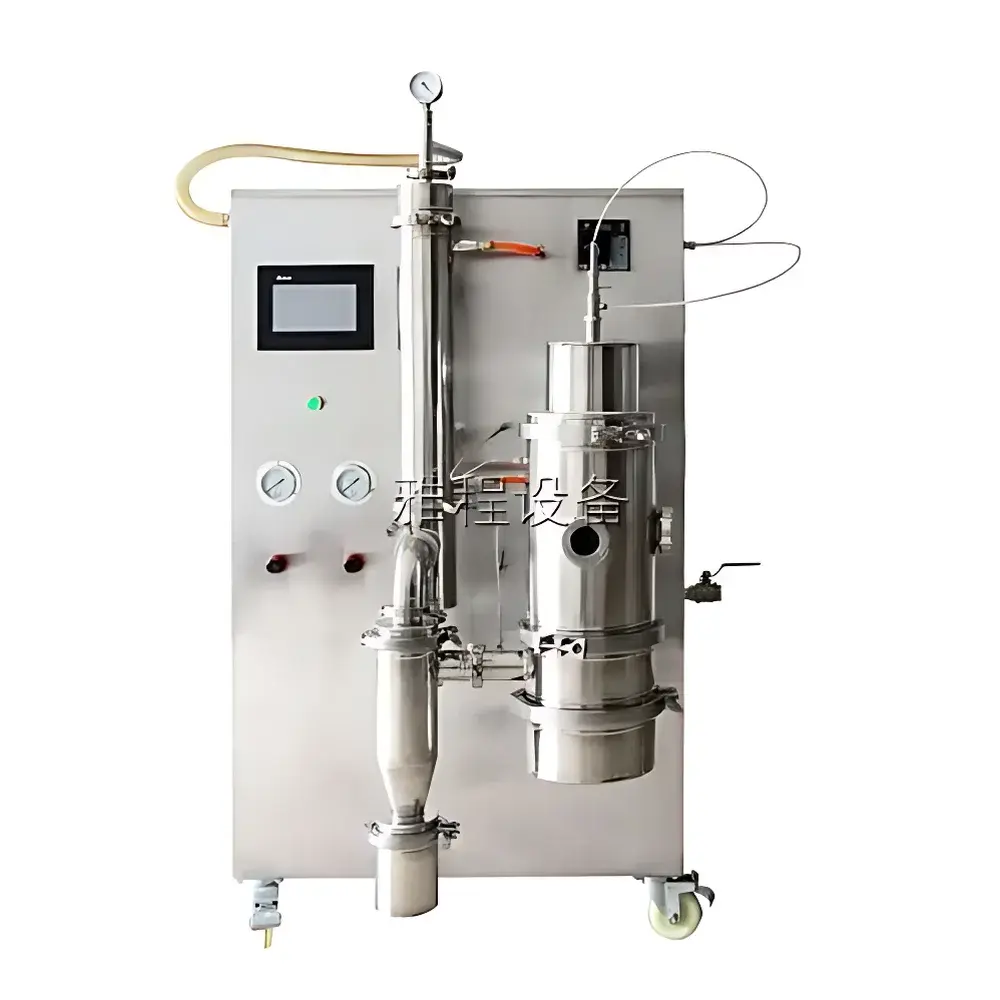
YaCheng YC-2000 Benchtop Vacuum Spray Dryer
| Brand | YaCheng / PILOTECH |
|---|---|
| Origin | Shanghai, China |
| Manufacturer Type | Direct Manufacturer |
| Model | YC-2000 |
| Vacuum Range | −0.05 to −0.06 MPa |
| Max Feed Rate | 800 mL/h |
| Minimum Sample Volume | 50 mL (varies with solids content) |
| Heating Temperature Control | PID-controlled, ±1 °C accuracy |
| Nozzle Orifice Options | 0.5, 0.7, 1.0, 1.5, 2.0 mm (stainless steel, customizable) |
| Integrated Oil-Free Compressor | Yes |
| Power Supply | 6 kW / 380 V AC |
| Chamber Construction | Full 316L stainless steel |
| Operating Temp Range | 60–80 °C (under vacuum) |
Overview
The YaCheng YC-2000 Benchtop Vacuum Spray Dryer is an integrated, self-contained laboratory-scale system engineered for the gentle, rapid dehydration of thermolabile materials under reduced pressure. Unlike conventional atmospheric spray dryers, the YC-2000 operates within a controlled vacuum environment (−0.05 to −0.06 MPa), enabling solvent evaporation at significantly lower temperatures—typically 60–80 °C—thereby preserving molecular integrity, enzymatic activity, and structural conformation in sensitive biologics, natural extracts, polymers, and volatile compounds. Its design follows core principles of vacuum-assisted flash evaporation coupled with two-fluid nozzle atomization, where compressed gas shears liquid feed into fine droplets; under sub-atmospheric conditions, these droplets undergo near-instantaneous solvent removal without thermal degradation. The system is fully compliant with standard laboratory infrastructure requirements—no external air compressors, chillers, or exhaust ducting are needed—and meets ISO 14644-1 Class 8 cleanroom-compatible footprint specifications.
Key Features
- Integrated oil-free diaphragm air compressor (imported), eliminating lubricant contamination risk and ensuring GMP-aligned powder purity
- Two-fluid stainless steel nozzle assembly (316L), precision-machined for consistent droplet size distribution and long-term corrosion resistance
- Automated nozzle clearance mechanism (“needle cleaner”) with adjustable frequency to prevent clogging during high-solids or viscous feed processing
- Real-time PID temperature regulation across the entire heating zone, achieving ±1 °C thermal stability at setpoints between 60 °C and 120 °C (vacuum-dependent effective drying range: 60–80 °C)
- Color LCD touchscreen interface with full Chinese/English bilingual support, enabling both fully automated operation and manual parameter override modes
- Modular nozzle orifice selection (0.5–2.0 mm) allows optimization for viscosity, surface tension, and desired particle size distribution (PSD) without hardware modification
- Benchtop footprint (W×D×H ≈ 850 × 650 × 1,450 mm) with full 316L stainless steel construction, meeting ASME BPE surface finish standards (Ra ≤ 0.8 µm)
Sample Compatibility & Compliance
The YC-2000 is validated for processing aqueous and organic solvent-based solutions containing heat-sensitive actives—including live probiotics, monoclonal antibody formulations, plant-derived glycosides, polyphenolic extracts, and synthetic hydrophilic polymers. Its vacuum-enabled low-temperature operation aligns with ICH Q5C stability guidelines for biopharmaceuticals and supports compliance with USP , EP 2.9.34, and ISO 22000–related drying validation protocols. All wetted parts conform to FDA 21 CFR Part 11 data integrity requirements when paired with optional audit-trail-enabled firmware. The system supports GLP/GMP documentation workflows through timestamped parameter logging, user-access controls, and exportable CSV reports.
Software & Data Management
The embedded control system records real-time process variables—including inlet/outlet temperature, vacuum level, feed rate, and compressor pressure—at 1 Hz resolution. Data is stored locally on internal flash memory (≥10,000-cycle retention) and exportable via USB 2.0 to external PCs for post-processing in MATLAB, Python (Pandas), or statistical analysis platforms. Optional firmware upgrade enables remote monitoring via Ethernet (Modbus TCP), integration with LIMS systems, and electronic signature functionality per FDA 21 CFR Part 11 Annex 11. All operational logs include metadata (user ID, session timestamp, parameter set ID) to satisfy traceability mandates in regulated R&D environments.
Applications
- Preformulation studies of protein-based therapeutics and vaccine adjuvants requiring residual moisture control below 3% w/w
- Rapid screening of excipient compatibility for amorphous solid dispersions using low-Tg polymers
- Stabilization of lactic acid bacteria and bifidobacteria for functional food ingredient development
- Drying of anthocyanin-rich berry extracts without anthocyanidin degradation or browning reactions
- Production of inhalable microparticles (Dv50 = 2–8 µm) from PVP or leucine-stabilized suspensions
- Process mapping for scale-up to pilot-scale vacuum spray dryers (e.g., 10–50 kg/h capacity systems)
FAQ
What vacuum level does the YC-2000 achieve, and how is it maintained?
The system delivers a stable operating vacuum of −0.05 to −0.06 MPa using a dual-stage rotary vane vacuum pump with integrated condensate trap; vacuum integrity is monitored continuously and compensated via automatic throttle valve modulation.
Can the YC-2000 handle organic solvents such as ethanol or acetone?
Yes—when configured with explosion-proof electrical components (optional ATEX-certified variant) and compatible solvent-resistant gasket materials (Viton/FKM), the system supports Class IB solvent drying under nitrogen purge mode.
Is particle size distribution reproducible across batches?
Under fixed nozzle orifice, feed concentration, and vacuum setpoint, RSD of Dv50 remains ≤3.2% (n=6, same operator, same material batch), verified by laser diffraction (Malvern Mastersizer 3000).
Does the system support 21 CFR Part 11 compliance out of the box?
Base configuration includes electronic logbook and password-protected user roles; full Part 11 compliance requires optional audit-trail firmware and external PKI certificate integration.
What maintenance intervals are recommended for the integrated air compressor?
The oil-free compressor requires no scheduled lubrication; filter elements should be replaced every 2,000 operating hours, and desiccant cartridges every 12 months under continuous use.



