
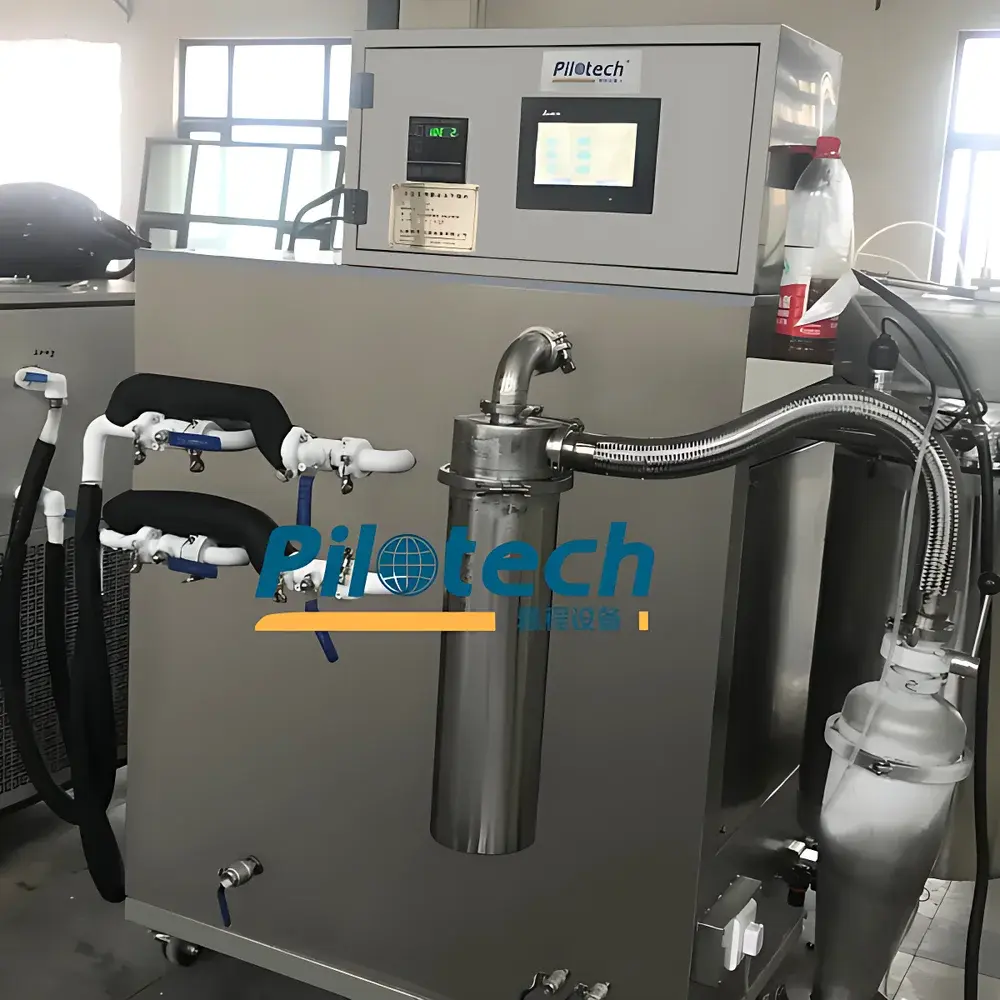


Yacheng YC-3000 Laboratory-Scale Spray Freeze Dryer
| Brand | Yacheng / PILOTECH |
|---|---|
| Origin | Shanghai, China |
| Manufacturer Type | Direct Manufacturer |
| Product Category | Domestic |
| Model | YC-3000 |
| Instrument Type | Standard Shelf-Type Freeze Dryer |
| Application Scope | Laboratory Use |
| Batch Capacity | 1500 mL per cycle |
| Total Process Time | <6 hours (1500 mL) |
| Inlet Air Temperature | <−50 °C |
| Cold Trap Temperature | ≤−60 °C |
| Ultimate Vacuum Pressure | <20 Pa (empty chamber) |
| Vacuum Pump Power | 1.1 kW |
| 雾化压力 | 1–3 bar (adjustable) |
| Air Compressor Output | 32 L/min |
| Nozzle Type | Concentric Dual-Fluid Nozzle with Vertical Adjustment |
| Display | Color LCD Touchscreen (Inlet Temp, Fan Frequency, Peristaltic Pump Speed, Needle Clearance Frequency) |
Overview
The Yacheng YC-3000 Laboratory-Scale Spray Freeze Dryer is an integrated thermal processing system that merges the rapid atomization capability of spray drying with the low-temperature preservation integrity of vacuum freeze drying. Unlike conventional lyophilizers—where samples are frozen statically and dried slowly via sublimation under deep vacuum—the YC-3000 atomizes liquid feed into fine droplets directly into a cryogenic environment (<−50 °C), inducing instantaneous freezing upon contact. These micro-droplets are then transferred to a condenser chamber operating at ≤−60 °C and subjected to primary drying under vacuum (<20 Pa), enabling water removal via升华 (sublimation) without melting. This hybrid approach preserves thermolabile structures—including proteins, enzymes, polysaccharides, and labile phytochemicals—while yielding free-flowing, spherical powder particles with narrow size distribution and minimal aggregation. The entire process—from feed introduction to dry powder collection—is completed in under six hours for standard 1500 mL batches, significantly reducing cycle time compared to traditional shelf-based lyophilization (typically 24–72 hours).
Key Features
- Integrated cryogenic spray-freeze architecture combining controlled atomization and rapid solidification in one sealed chamber
- Concentric dual-fluid nozzle with vertical position adjustment for optimized droplet uniformity and reduced wall deposition
- Digital touchscreen interface displaying real-time parameters: inlet gas temperature, fan frequency, peristaltic pump speed, and anti-clogging needle clearance frequency
- Air-cooled, hermetic refrigeration system with high-capacity compressor delivering stable cold trap performance at ≤−60 °C
- Standardized ISO-KF vacuum flange connections (per ISO 2861) ensuring leak-tight integrity and compatibility with third-party vacuum pumps
- Onboard vacuum pump power socket eliminating external power routing and simplifying installation
- Low-noise operation (<62 dB(A)) suitable for shared laboratory environments without dedicated acoustic enclosures
Sample Compatibility & Compliance
The YC-3000 is engineered for heat-sensitive, viscous, or structurally fragile materials where conventional thermal drying causes denaturation, caramelization, or phase separation. It routinely processes aqueous extracts of traditional Chinese medicinal herbs, whey protein isolates, bacterial lysates, fruit juice concentrates (e.g., pomegranate, acerola), polymer dispersions, and liposomal suspensions. Its operational envelope supports formulations with total solids content up to 40% w/w and viscosity up to 500 mPa·s (measured at 25 °C). While not certified to ISO 22000 or FDA 21 CFR Part 11 out-of-the-box, the system’s digital logging capabilities—including timestamped parameter records and user-accessible data export (CSV/Excel)—support GLP-compliant documentation workflows. All wetted surfaces contact-grade 316L stainless steel or food-grade PTFE-lined components, meeting USP Class VI biocompatibility requirements for pharmaceutical intermediates.
Software & Data Management
The embedded control firmware provides non-volatile storage of up to 200 complete drying protocols, each retaining setpoints for inlet temperature, pump speed, vacuum ramp rate, and duration per drying stage. All operational logs—including actual vs. target values, alarm events, and manual intervention timestamps—are retained internally for ≥90 days and exportable via USB 2.0 port. Optional Ethernet connectivity enables remote monitoring through HTTP-based status dashboards compatible with institutional SCADA systems. Audit trail functionality meets ALCOA+ principles (Attributable, Legible, Contemporaneous, Original, Accurate, Complete, Consistent, Enduring, Available) when paired with validated user access controls—a prerequisite for GMP-aligned process development labs.
Applications
- Rapid formulation screening of biopolymer-based delivery systems (e.g., chitosan nanoparticles, alginate microparticles)
- Stabilization of monoclonal antibody fragments and vaccine candidates prior to long-term storage
- Production of inhalable dry powders from nebulizer-grade solutions without excipient crystallization
- Preservation of probiotic cultures and fermented plant extracts while maintaining viable cell counts >10⁹ CFU/g
- Preparation of reference standards for LC-MS quantification of unstable metabolites (e.g., anthocyanins, glucosinolates)
- Scale-down modeling for process transfer to pilot-scale spray freeze dryers (e.g., 5 L and 10 L configurations)
FAQ
What is the maximum allowable total solids concentration for stable atomization?
For consistent droplet formation and minimal nozzle clogging, feed solutions should not exceed 40% w/w total solids. Viscosity above 500 mPa·s at 25 °C may require pre-filtration or dilution.
Can the YC-3000 be used under inert atmosphere (e.g., N₂ or Ar)?
Yes—optional gas purge ports enable continuous inert gas flow during atomization and primary drying, critical for oxygen-sensitive compounds such as unsaturated lipids or catecholamines.
Is the collected powder sterile after processing?
No. The YC-3000 is not a sterile-processing device. Aseptic handling must occur downstream using ISO Class 5 laminar flow hoods or isolators.
Does the system support automated batch reporting compliant with 21 CFR Part 11?
The base configuration provides electronic records but lacks electronic signatures and role-based access control. These features are available via validated software add-ons subject to site-specific IQ/OQ/PQ protocols.
What maintenance intervals are recommended for the refrigeration system?
Compressor oil and filter driers should be replaced every 3,000 operating hours; cold trap condenser coils require quarterly visual inspection and ethanol wipe cleaning to prevent ice buildup and thermal resistance.



