
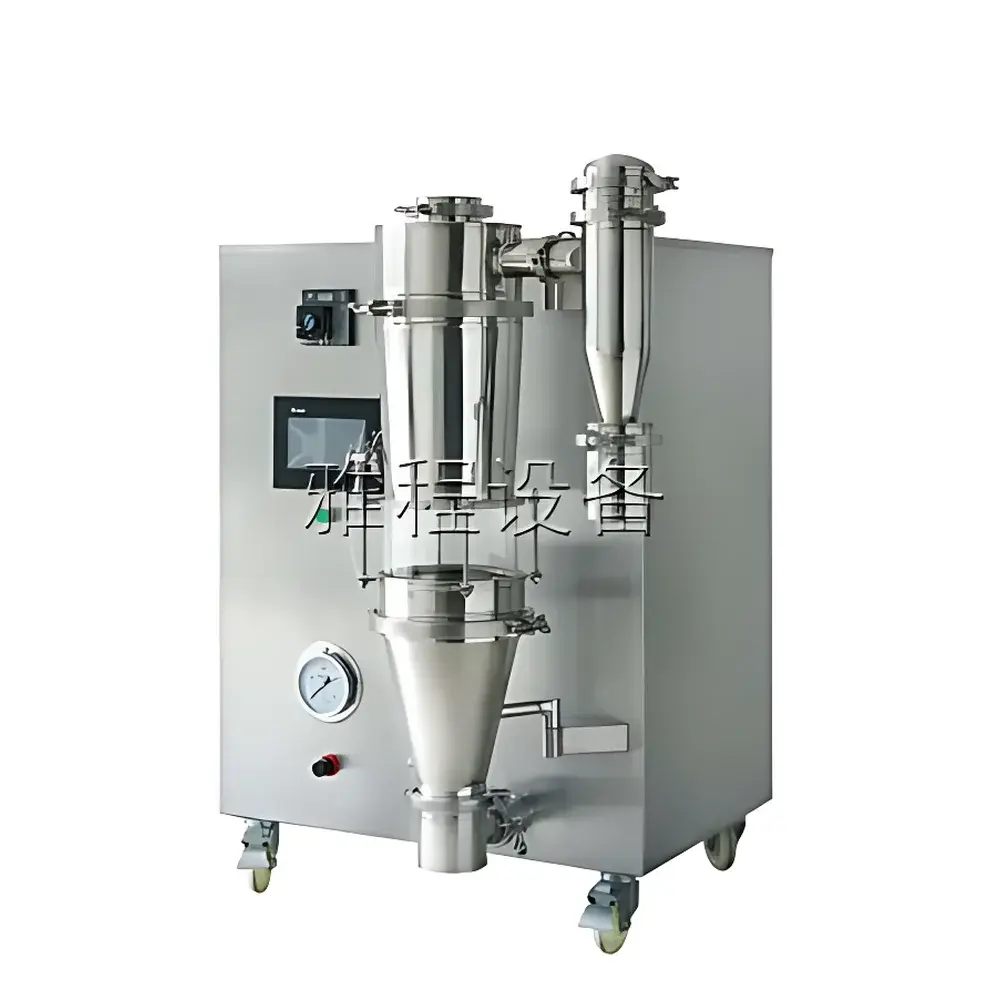
Yacheng PILOTECH YC-1800 Miniature Spray Dryer for Juice and Thermosensitive Extracts
| Brand | Yacheng/PILOTECH |
|---|---|
| Origin | Shanghai, China |
| Manufacturer Type | Direct Manufacturer |
| Country of Origin | China |
| Model | YC-1800 |
| Heating Temperature Range | 110–150 °C |
| Max. Feed Rate | 1800 mL/h |
| Minimum Sample Volume | 50 mL |
| Nozzle Orifice Options | 0.5 / 0.7 / 1.0 / 1.5 / 2.0 mm |
| Temperature Control Accuracy | ±1 °C (PID) |
| Power Supply | 4 kW / 380 V |
| Construction | Full Stainless Steel |
| Atomization | Two-Fluid Pneumatic Nozzle |
| Display | Color LCD Touchscreen (Chinese Interface) |
Overview
The Yacheng PILOTECH YC-1800 Miniature Spray Dryer for Juice and Thermosensitive Extracts is an integrated, benchtop-scale spray drying system engineered specifically for the gentle, high-fidelity conversion of heat-labile liquid feeds—such as fruit juice concentrates, herbal extracts, polysaccharide-rich botanical supernatants, and biopolymer solutions—into free-flowing, amorphous or microcrystalline powders. Unlike conventional laboratory spray dryers operating at inlet temperatures ≥160 °C, the YC-1800 achieves complete droplet-to-particle transition at a precisely controlled inlet air temperature as low as 110 °C. This capability is enabled by optimized thermal mass management, high-efficiency two-fluid atomization, and real-time PID-regulated air heating—making it uniquely suited for materials prone to caramelization, Maillard degradation, enzymatic deactivation, or volatile loss under standard drying conditions. The system operates on the principle of flash evaporation: liquid feed is pneumatically atomized into fine droplets (d₃₂ typically 10–30 µm depending on nozzle size and feed viscosity), which rapidly desiccate upon contact with heated drying gas in a coaxial concurrent-flow chamber. Particle formation occurs within <1.5 seconds, minimizing thermal residence time and preserving structural integrity of labile functional groups.
Key Features
- Low-temperature operation (110–150 °C inlet air) enables processing of sucrose-dense juices, glycoside-rich herbal extracts, and protein-containing bioprocess streams without thermal agglomeration or browning.
- Two-fluid stainless steel nozzle assembly with five interchangeable orifice sizes (0.5–2.0 mm) allows precise control over droplet size distribution and particle morphology.
- Integrated automatic needle cleaner (‘通针’) with user-adjustable activation frequency prevents nozzle clogging during high-solids or high-viscosity feed applications—critical for >30% w/w fruit juice solids or mucilaginous plant extracts.
- Color LCD touchscreen interface with full Chinese-language firmware supports both fully automated mode (pre-programmed temperature/flow ramps) and manual supervisory control with real-time parameter logging.
- PID-controlled heating system delivers ±1 °C thermal stability across the entire operational range, ensuring reproducible particle properties between runs.
- Self-contained architecture requires no external compressed air regulators, chillers, or exhaust ducting—only single-point 380 V / 4 kW electrical connection and ambient air intake.
- Stainless steel construction (AISI 316 contact surfaces) complies with basic hygienic design principles for R&D-scale food, phytomedicine, and nutraceutical development.
Sample Compatibility & Compliance
The YC-1800 is validated for use with aqueous and hydroalcoholic solutions containing up to 55% total dissolved solids (TDS), including citrus, apple, and berry juice concentrates; ethanol-water extracts of *Ginkgo biloba*, *Panax ginseng*, or *Camellia sinensis*; and fermentation broths containing thermolabile enzymes or peptides. Its low-thermal-load profile aligns with ASTM E2652–22 (Standard Guide for Spray Drying of Heat-Sensitive Materials) and supports GLP-compliant documentation when paired with external data loggers. While not certified to ISO 22000 or FDA 21 CFR Part 11 out-of-the-box, the system’s deterministic process parameters (temperature, feed rate, airflow) are fully recordable and exportable via USB—enabling traceability for internal quality review and regulatory submission preparation.
Software & Data Management
The embedded controller stores up to 100 experiment profiles, each containing setpoints for inlet temperature, outlet temperature, feed pump speed (0.1–100 rpm), and nozzle cleaning interval. Real-time trend graphs for all active parameters are displayed during operation and saved as CSV files on removable USB storage. No proprietary software installation is required for data retrieval; files are natively readable in Excel, Python (pandas), or MATLAB. Audit trail functionality is limited to timestamped parameter changes—advanced electronic signature or role-based access control is not implemented, consistent with its classification as a research-grade instrument rather than GMP production equipment.
Applications
- Rapid prototyping of fruit powder formulations for functional food matrices, avoiding starch or cyclodextrin bulking agents.
- Stabilization of polyphenol-rich botanical extracts while retaining antioxidant capacity (e.g., ORAC assay correlation post-drying).
- Production of inhalable or oral dispersible microparticles from viscous herbal decoctions (<500 cP at 25 °C).
- Process development for continuous downstream unit operations—e.g., feeding directly into capsule fillers or tablet presses after minimal milling.
- Comparative studies of drying kinetics across nozzle geometries and temperature gradients to model particle porosity and reconstitution behavior.
FAQ
What is the minimum feed volume required to achieve stable atomization?
Typical minimum working volume is 50 mL, though consistent雾化 requires ≥30% w/w total solids for juice-based feeds. Lower-solids feeds may require pre-concentration or addition of inert carriers to maintain droplet integrity.
Can the YC-1800 handle feeds containing suspended pulp or insoluble fiber?
No—it is designed exclusively for clarified liquids or low-viscosity colloidal dispersions (≤500 cP). Particulates >50 µm will cause immediate nozzle blockage, even with automatic needle cleaning.
Is the outlet temperature actively controlled?
Outlet temperature is monitored but not regulated; it serves as a critical process indicator reflecting feed load, evaporation efficiency, and potential wall deposition. Users correlate outlet readings with powder yield and morphology.
Does the system include inert gas compatibility for oxygen-sensitive materials?
The standard configuration uses ambient air as drying gas. Optional nitrogen purge kits (with flow meter and sealed inlet manifold) are available as accessories—contact technical support for integration specifications.
How is cleaning validation performed between batches?
Manual wet cleaning using food-grade alkaline detergent followed by ethanol rinse is recommended. Residue verification relies on visual inspection and water-break testing of interior surfaces; no built-in cleaning-in-place (CIP) cycle is provided.



