
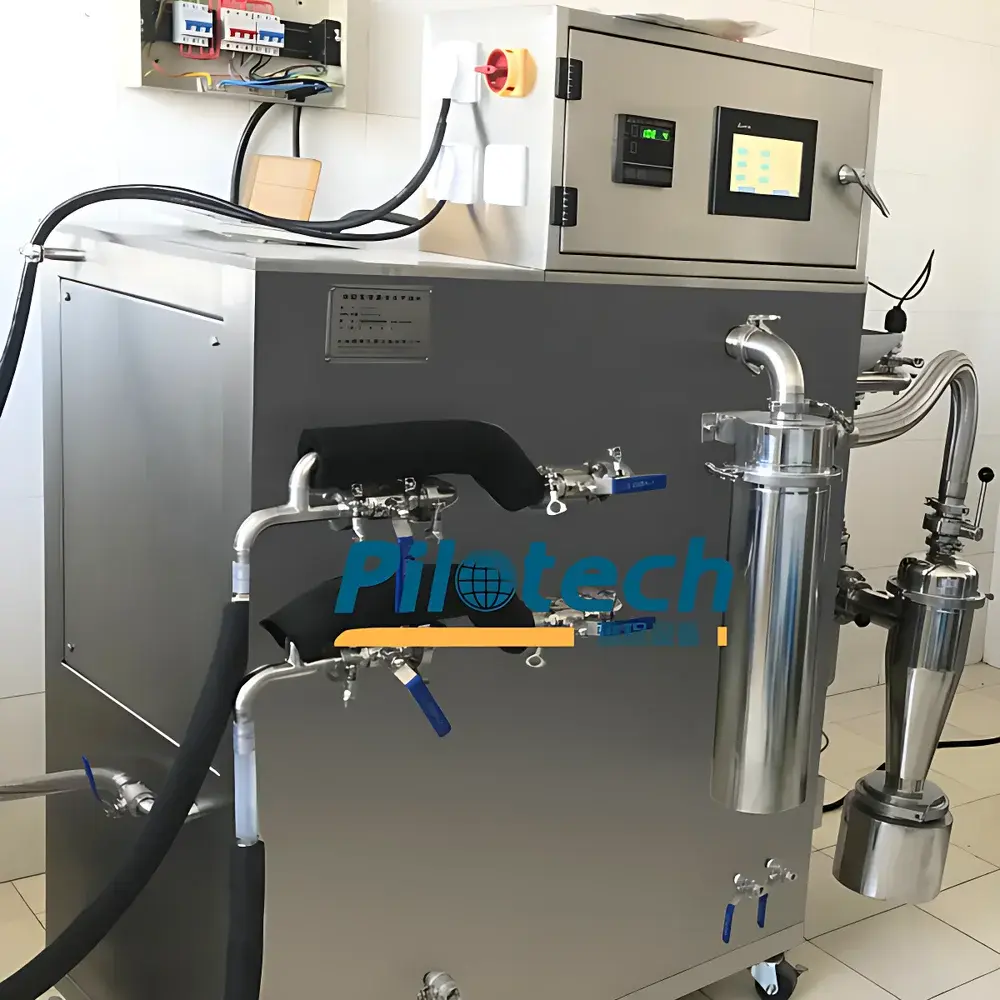
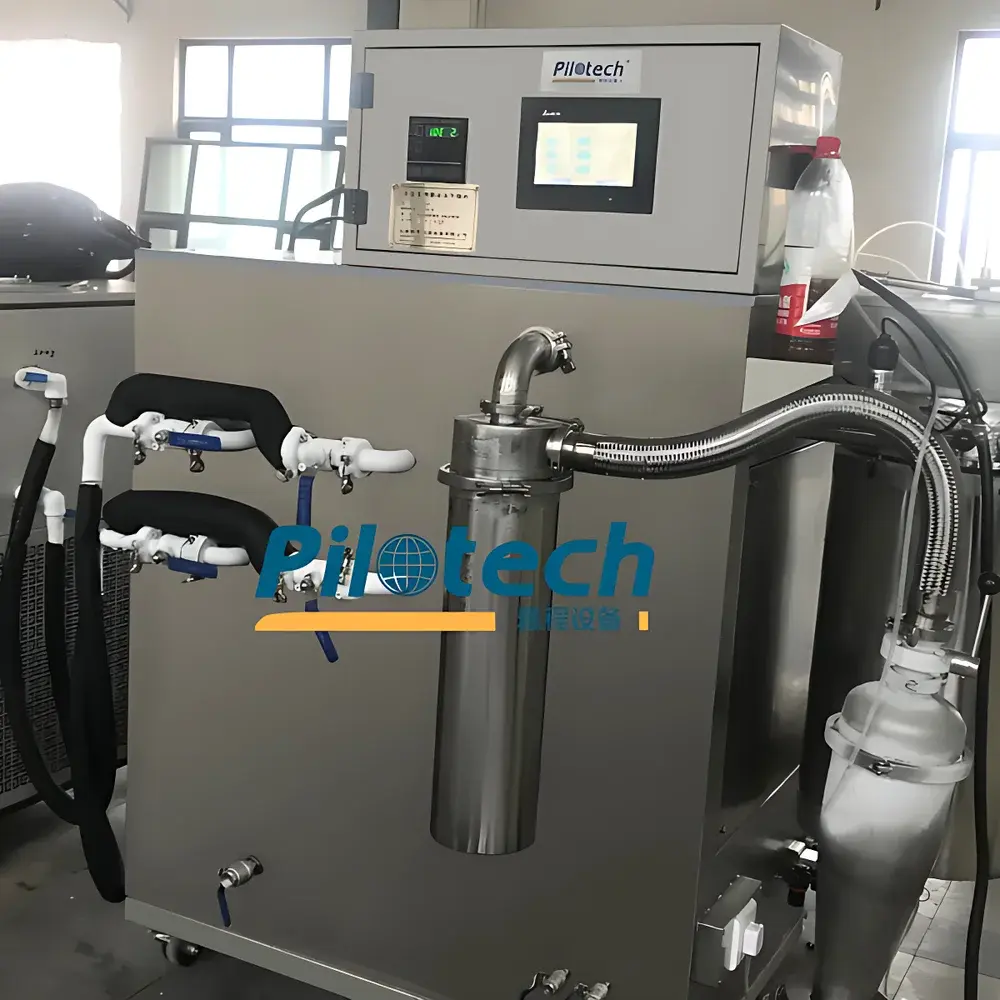
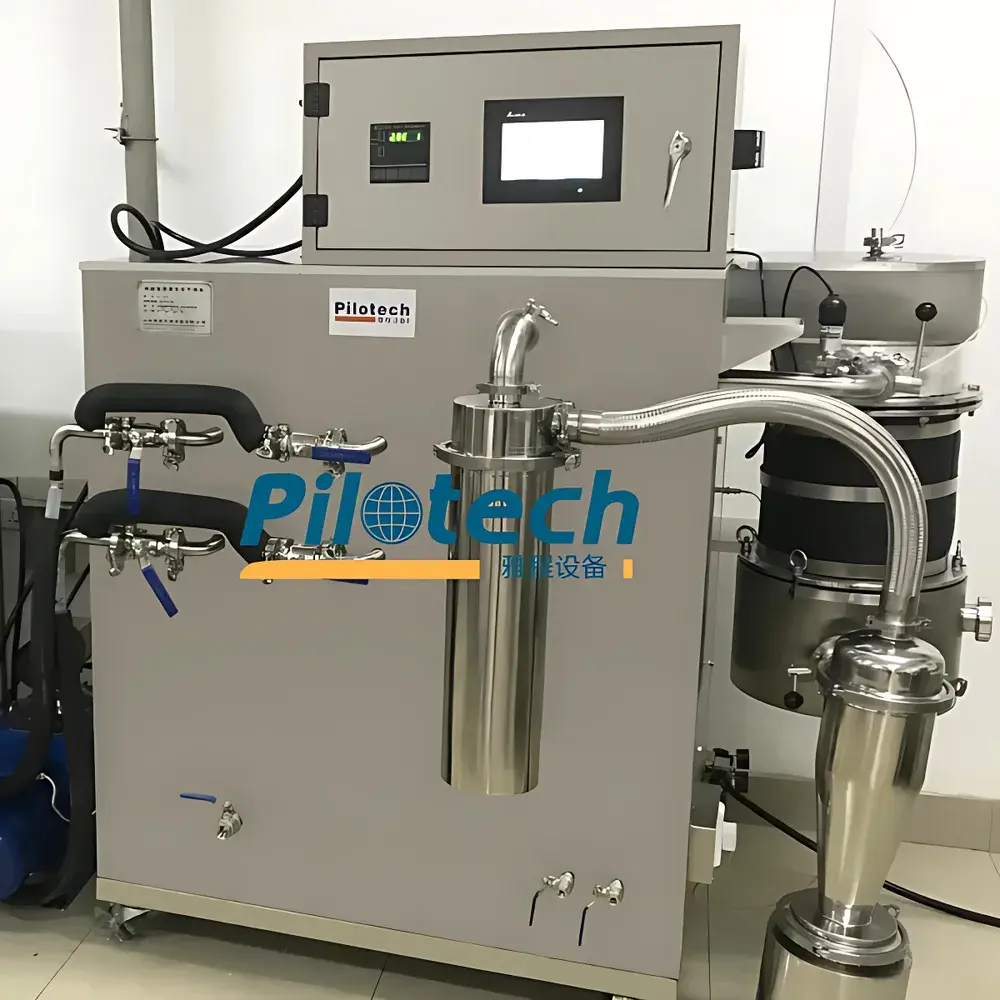
YaCheng YC-3000 Laboratory-Scale Spray Freeze Dryer
| Brand | YaCheng / PILOTECH |
|---|---|
| Origin | Shanghai, China |
| Manufacturer Type | Direct Manufacturer |
| Instrument Type | Standard Shelf-Type Spray Freeze Dryer |
| Batch Capacity | 1.5 L per cycle |
| Total Processing Time | < 6 hours (1.5 L load) |
| Inlet Air Temperature | ≤ −50 °C |
| Cold Trap Temperature | ≤ −60 °C |
| Ultimate Vacuum Pressure | < 20 Pa (empty chamber) |
| Vacuum Pump Power | 1.1 kW |
| Spray Pressure Range | 1–3 bar (adjustable) |
| Compressed Air Flow Rate | 32 L/min |
| Nozzle Type | Adjustable coaxial two-fluid spray nozzle |
| Display | Full-color LCD touchscreen (inlet temp, fan frequency, peristaltic pump speed, anti-clogging needle frequency) |
| Compliance | Designed for GLP-compliant lab environments |
Overview
The YaCheng YC-3000 Laboratory-Scale Spray Freeze Dryer is an integrated benchtop system that merges the rapid atomization of spray drying with the low-temperature stabilization of vacuum freeze drying. Unlike conventional lyophilizers—which rely on slow sublimation of pre-frozen bulk samples—the YC-3000 atomizes liquid feed into fine droplets under cryogenic inlet air conditions (≤ −50 °C), followed by immediate flash-freezing and simultaneous primary drying under high vacuum (< 20 Pa). This hybrid process achieves full powder formation in under six hours for a 1.5 L batch, preserving thermolabile structures (e.g., proteins, enzymes, probiotics, and polyphenolic extracts) without denaturation or Maillard degradation. The system operates on the principle of controlled nucleation and ice crystal morphology modulation via rapid droplet quenching, enabling reproducible particle morphology, narrow size distribution, and enhanced reconstitution kinetics—critical for pharmaceutical, nutraceutical, and natural product R&D.
Key Features
- Coaxial two-fluid spray nozzle with vertical adjustability for precise雾化 (atomization) optimization and minimized wall deposition—especially critical for viscous, sugar-rich, or polymer-containing feeds such as herbal extracts, fruit concentrates, and biopolymer suspensions.
- Self-contained air-cooled, hermetic refrigeration system with dual-stage cascade compressors, maintaining cold trap temperatures ≤ −60 °C to ensure high water vapor capture efficiency and prevent condenser icing during extended runs.
- Integrated vacuum pump (1.1 kW) with quick-connect ISO-KF standard flanges and stainless-steel vacuum lines—eliminating external hose routing and reducing leak risk.
- Full-color LCD touchscreen interface displaying real-time parameters: cryogenic inlet air temperature, peristaltic feed pump speed (0–50 rpm), atomizing air pressure (1–3 bar), anti-clogging needle oscillation frequency, and chamber vacuum level.
- Air-assisted passive升华 (sublimation) heating—no direct contact heating elements—ensuring uniform thermal exposure and eliminating localized overheating risks for sensitive biomolecules.
- Low-noise design (< 62 dB(A)) and compact footprint (W × D × H: 850 × 720 × 1650 mm), suitable for ISO Class 5–7 cleanroom-adjacent lab spaces and shared core facilities.
Sample Compatibility & Compliance
The YC-3000 is engineered for challenging feedstocks commonly encountered in life science and food research: aqueous extracts with >30% total solids (e.g., ginseng or green tea decoctions), whey protein isolates, lactic acid bacteria suspensions, nanoemulsions, and hydrocolloid-based delivery systems. Its ability to produce free-flowing, non-hygroscopic powders—with particle size distributions tunable via nozzle geometry and feed concentration—addresses key limitations of conventional freeze dryers in handling sticky, low-glass-transition formulations. From a regulatory standpoint, the system supports documentation workflows aligned with FDA 21 CFR Part 11 (when paired with validated third-party data logging software), GLP audit trails, and ISO 22000/ISO 13485-aligned process mapping. All wetted parts are electropolished 316L stainless steel or food-grade PTFE, compliant with USP Class VI and EC 1935/2004 material safety requirements.
Software & Data Management
While the YC-3000 operates as a standalone instrument with embedded firmware, its analog and digital I/O ports (RS-485, 0–10 V analog outputs) enable seamless integration into laboratory information management systems (LIMS) or SCADA platforms. Raw sensor data—including vacuum decay rate, temperature gradient across the drying chamber, and mass loss profile inferred from pump power draw—can be logged at 1 Hz resolution for post-run kinetic analysis. Optional Ethernet-enabled data acquisition modules support time-stamped CSV export, electronic signature validation, and alarm-triggered email notifications—facilitating compliance with ALCOA+ (Attributable, Legible, Contemporaneous, Original, Accurate) data integrity principles.
Applications
- Stabilization of heat-labile biologics: monoclonal antibody fragments, viral vectors, and mRNA-LNPs without cryoprotectant overload.
- Rapid formulation screening for oral dispersible tablets (ODTs), inhalable dry powders, and encapsulated probiotics.
- Production of reference standards from botanical matrices—preserving volatile terpenes and unstable glycosides lost in spray-dried or oven-dried equivalents.
- Scale-down modeling for clinical-phase lyophilization process development, bridging lab-to-pilot transfer gaps in CMC (Chemistry, Manufacturing, and Controls) packages.
- Functional food ingredient development: encapsulation of anthocyanins, omega-3 oils, or vitamin C derivatives with >92% retention of antioxidant activity post-drying.
FAQ
How does spray freeze drying differ from conventional lyophilization in terms of cycle time and product quality?
Conventional lyophilization requires pre-freezing (often overnight), primary drying (12–48 h), and secondary drying (6–24 h). The YC-3000 eliminates pre-freezing and compresses the entire cycle to <6 h while producing spherical, low-density particles with superior wettability and dissolution profiles.
Can the YC-3000 handle feeds containing organic solvents?
No—it is designed exclusively for aqueous or water-miscible solvent systems (e.g., ethanol/water ≤ 20% v/v). Flammable or chlorinated solvents pose explosion and corrosion risks incompatible with its compressor-based refrigeration architecture.
Is the system compatible with GMP documentation requirements?
Yes—when operated with validated external data loggers and SOP-controlled parameter settings, it meets foundational GMP expectations for equipment qualification (IQ/OQ) and process consistency verification per ICH Q5C and Q8(R2).
What maintenance intervals are recommended for the vacuum pump and refrigeration system?
Vacuum pump oil should be changed every 500 operational hours; cold trap condenser coils require manual defrosting after every 10 cycles or when frost accumulation exceeds 3 mm; compressor oil analysis is advised annually.
Does YaCheng provide application support for method development?
Yes—dedicated technical support includes protocol templates for common matrices (e.g., whey protein, curcumin nanoemulsions), DOE guidance for nozzle pressure vs. feed rate optimization, and particle morphology correlation reports using SEM and laser diffraction.



