
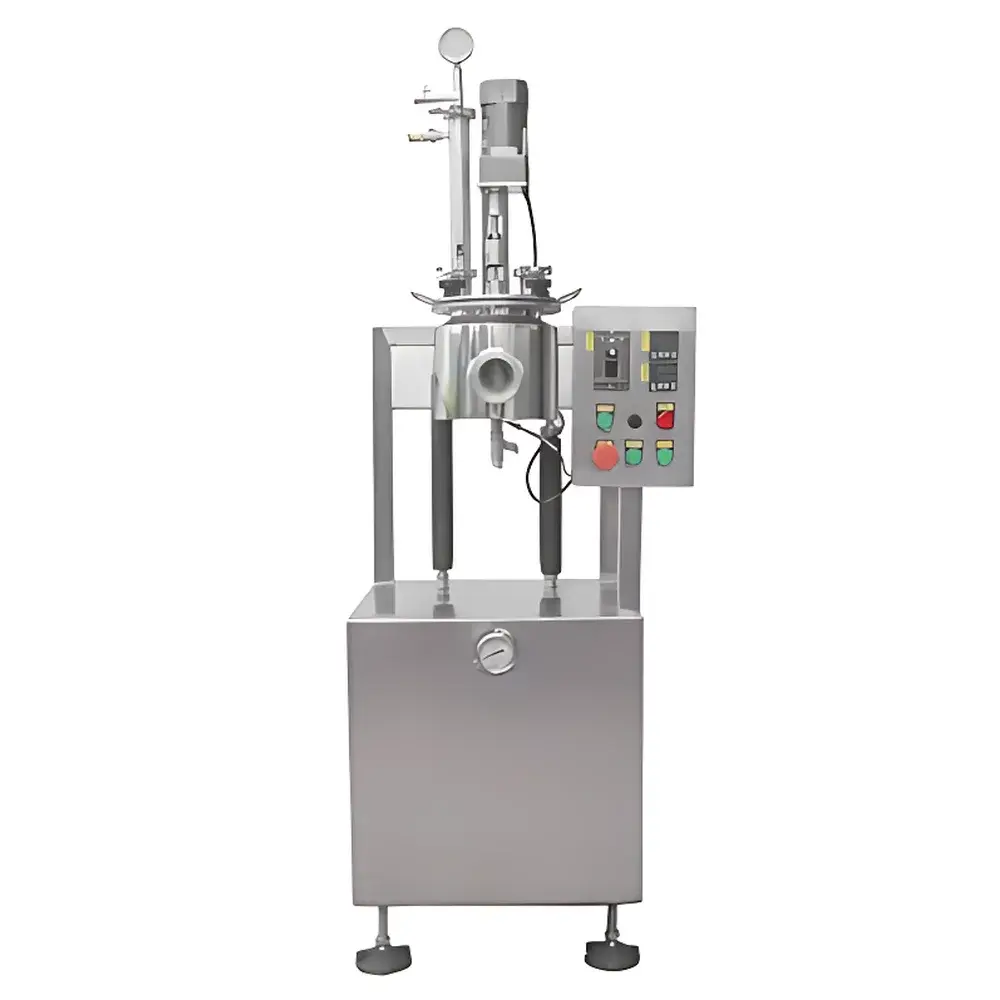
Microscale Multifunctional Extraction Vessel YC-TQ Series by Pilotech
| Brand | Pilotech |
|---|---|
| Origin | Shanghai, China |
| Manufacturer Type | Direct Manufacturer |
| Country of Origin | China |
| Model | YC-TQ |
| Price | USD 3,950 (FOB Shanghai) |
| Vessel Capacities | 3 L, 5 L, 10 L, 20 L, 30 L, 50 L |
| Heating | Integrated Electric Heating (Jacket + Bottom) |
| Temperature Control | Dual-zone (Extraction Temp & Heater Surface Temp) |
| Insulation | Triple-layer thermal insulation |
| Structure | Open-top, modular benchtop design |
| Safety | Low-level liquid detection with automatic heater cutoff |
| Data Acquisition | Real-time monitoring of temperature, time, pH, vacuum, agitation speed/type, liquid level, inline concentration (e.g., refractive index), dissolved oxygen |
| Controller | Central programmable PLC-based unit with expansion slots for multi-unit synchronization (up to 20 units) |
Overview
The Pilotech YC-TQ Series Microscale Multifunctional Extraction Vessel is an engineered benchtop platform designed for precise, reproducible solid–liquid extraction under controlled thermal, mechanical, and environmental conditions. Built on the principles of convective heat transfer, dynamic mass transfer kinetics, and process-integrated analytics, the system supports a wide range of extraction methodologies—including maceration, percolation, reflux, and vacuum-assisted extraction—within volumes scalable from 3 L to 50 L. Its open-top architecture enables rapid loading/unloading of heterogeneous botanicals, granular matrices, or powdered APIs while maintaining full operator visibility and accessibility for in-process sampling. The vessel’s dual heating configuration—simultaneous electric heating of both cylindrical jacket and conical bottom—ensures uniform thermal distribution across the entire active volume, minimizing thermal gradients that could otherwise induce localized degradation or inconsistent solute release.
Key Features
- Modular scalability: Central PLC controller includes standardized expansion slots, enabling synchronized operation of up to 20 independent YC-TQ units for parallel experimental design (DoE) or high-throughput method development.
- Dual-temperature control loop: Independent regulation and real-time display of both extraction medium temperature and heater surface temperature—critical for thermally sensitive compounds and validation of thermal equilibrium conditions.
- Triple-layer thermal insulation: Composed of ceramic fiber, aluminum foil barrier, and stainless-steel cladding—reducing ambient heat loss by >75% and improving energy efficiency during prolonged extraction cycles.
- Integrated safety logic: Low-liquid-level detection triggers immediate power cutoff to heating elements, preventing dry-run damage and ensuring compliance with IEC 61000-6-2 electromagnetic compatibility and IEC 60335-1 household/industrial appliance safety standards.
- Open-system adaptability: Designed for seamless integration with external condensers, vacuum pumps, peristaltic feeders, or inline spectrophotometers via standardized 1/4″–1″ sanitary fittings (ISO 2852 compatible).
Sample Compatibility & Compliance
The YC-TQ accommodates diverse sample forms—including dried herbs, cell pellets, polymer beads, and lyophilized biologics—without requiring pre-grinding or slurry homogenization. Its 316L stainless-steel wetted parts meet ASTM A276 and ASME BPE-2022 surface finish requirements (Ra ≤ 0.4 µm). All electrical components comply with CE marking directives (2014/30/EU EMC, 2014/35/EU LVD), and the control architecture supports audit-ready data logging aligned with FDA 21 CFR Part 11 requirements when paired with validated software modules. The system is routinely deployed in GLP-compliant R&D environments for herbal active ingredient screening, natural product isolation, and early-stage formulation feasibility studies.
Software & Data Management
Data acquisition is handled via a real-time embedded HMI interface with configurable alarm thresholds and timestamped event logging. Optional Ethernet/IP or Modbus TCP connectivity allows integration into centralized SCADA or LIMS platforms. Raw sensor outputs—including Pt100 temperature readings, 4–20 mA pH/vacuum signals, and pulse-width modulated agitation feedback—are stored in CSV or SQLite format with metadata tags (operator ID, batch tag, protocol version). Exported datasets include ISO 8601 timestamps, measurement uncertainty annotations (per ISO/IEC 17025 calibration traceability), and digital signatures for integrity verification.
Applications
- Academic research: Optimization of solvent-to-solid ratios, temperature ramping profiles, and dwell-time effects on polyphenol yield from plant matrices.
- Pharmaceutical development: Extraction kinetics modeling for botanical drug substances per USP residual solvent guidance and ICH Q5C stability protocols.
- Food & nutraceutical QA/QC: Batch consistency evaluation of anthocyanin recovery from berry pomace under varying pH and redox conditions.
- Biopolymer processing: Solvent-mediated depolymerization of chitosan or alginate under inert atmosphere with dissolved oxygen monitoring.
FAQ
What is the maximum allowable operating pressure for the YC-TQ series?
The standard YC-TQ configuration operates at atmospheric or sub-atmospheric pressure only; optional pressure-rated variants (up to 0.3 MPa g) are available under custom engineering order.
Can the system be validated for GMP use?
Yes—when equipped with IQ/OQ documentation packages, calibrated transducers (NIST-traceable), and 21 CFR Part 11–compliant software add-ons, the system meets equipment qualification requirements for Stage 1–2 pharmaceutical process development.
Is cleaning-in-place (CIP) supported?
The open-top design and smooth internal welds permit manual CIP using validated detergent cycles; fully automated CIP integration requires external pump manifolds and is offered as a turnkey option.
How is agitation implemented, and what types are supported?
Standard configurations include top-entry magnetic drive impellers (Rushton or pitched-blade); optional anchor, helical ribbon, or gas-inducing impellers can be installed with matching motor controllers.
Does the controller support custom protocol scripting?
Yes—the PLC firmware accepts user-defined ladder logic sequences and time-based setpoint ramps, with up to 99 step programs storable locally and exportable for cross-lab method transfer.





