
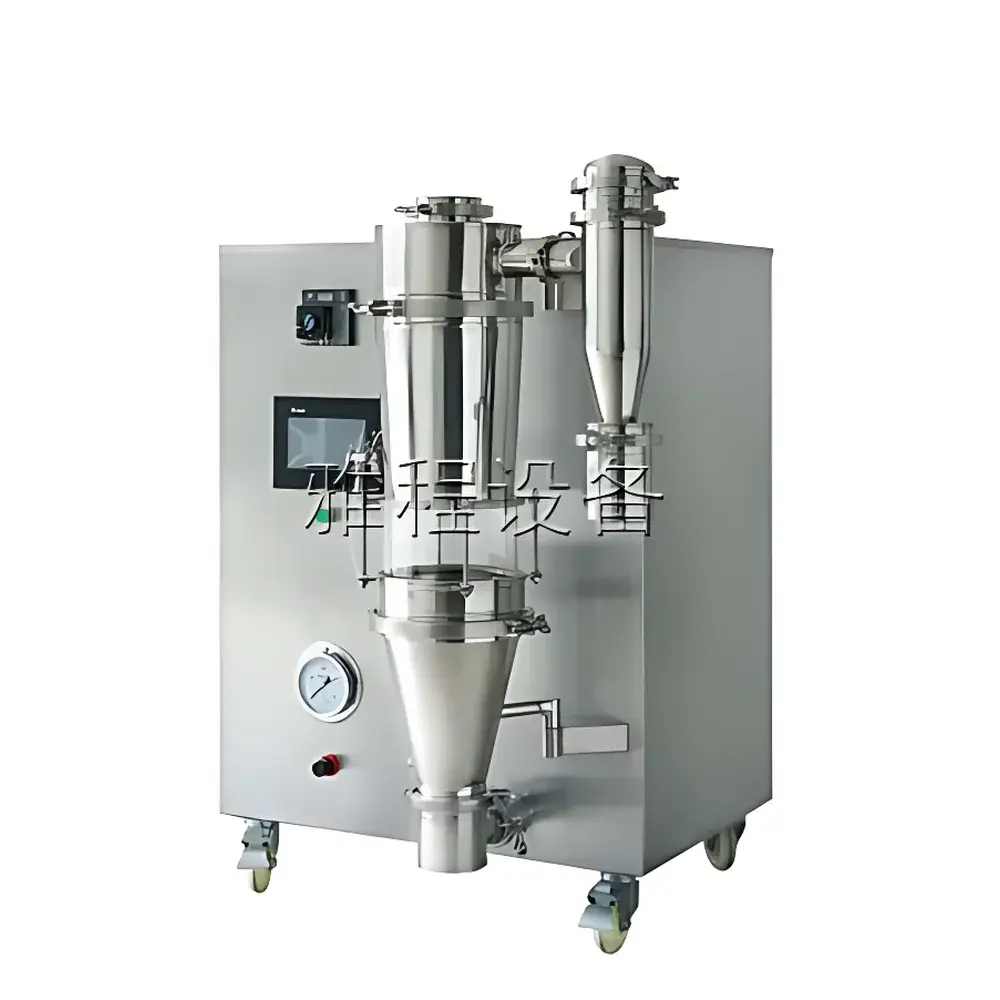
Yacheng / PILOTECH YC-1800 Benchtop Low-Temperature Spray Dryer for Juice and Thermosensitive Extracts
| Brand | Yacheng / PILOTECH |
|---|---|
| Origin | Shanghai, China |
| Manufacturer Type | Direct Manufacturer |
| Product Origin | Domestic (China) |
| Model | YC-1800 |
| Pricing | Upon Request |
| Max Feed Rate | 1500 mL/h |
| Minimum Sample Volume | 50 mL (varies with solids content) |
| Inlet Air Temperature Range | 110–150 °C |
| Temperature Control Accuracy | ±1 °C (PID-controlled) |
| Nozzle Orifice Options | 0.5, 0.7, 1.0, 1.5, 2.0 mm (stainless steel) |
| Power Supply | 4 kW / 380 V AC |
| Construction | Full 316L stainless steel |
| Atomization | Two-fluid pneumatic nozzle system |
| Integrated Needle Cleaner | Auto-adjustable frequency |
| Noise Level | Compliant with ISO 7779 laboratory noise standards |
Overview
The Yacheng / PILOTECH YC-1800 Benchtop Low-Temperature Spray Dryer is an engineered solution for the gentle, reproducible conversion of heat-sensitive liquid feeds—including fruit juices, herbal extracts, natural product concentrates, and biopolymer solutions—into free-flowing, amorphous powders. Unlike conventional laboratory spray dryers operating at inlet temperatures ≥160 °C, the YC-1800 achieves complete drying at a precisely controlled inlet air temperature as low as 110 °C. This capability is critical for preserving labile compounds such as anthocyanins in berry juice, glycosides in traditional Chinese medicinal extracts, enzymes, probiotics, and thermolabile polymers. The system employs two-fluid (air-assisted) pneumatic atomization to generate fine, uniform droplets, followed by rapid convective drying within a compact, insulated stainless-steel drying chamber. Its integrated thermal management architecture ensures minimal residence time (<2 seconds) and avoids caramelization or Maillard-driven agglomeration—common failure modes when drying high-sugar feeds. Designed for stand-alone operation, the YC-1800 requires no external chillers, compressed air boosters, or exhaust ducting, making it suitable for Class II biosafety cabinets and regulated R&D environments.
Key Features
- Low-temperature operation (110–150 °C inlet air) enabled by optimized airflow dynamics and high-efficiency heat exchange, minimizing thermal degradation of sensitive actives.
- Full-color 7-inch LCD touchscreen interface with intuitive Chinese/English bilingual navigation; supports both fully automated sequences and real-time manual override.
- PID-based digital temperature control with ±1 °C accuracy across the entire operating range, ensuring method reproducibility between runs and users.
- Adjustable peristaltic feed pump (0–1500 mL/h) with calibrated flow feedback, enabling precise mass balance studies and scalability assessment.
- Interchangeable stainless-steel two-fluid nozzles (0.5–2.0 mm orifice) for tailored droplet size distribution and powder morphology control.
- Self-cleaning needle mechanism (‘通针’) with programmable activation frequency to prevent nozzle clogging during high-viscosity or particulate-laden feed processing.
- Compact monoblock construction (W×D×H: 850 × 600 × 1300 mm), fabricated entirely from electropolished 316L stainless steel for corrosion resistance and cleanability.
Sample Compatibility & Compliance
The YC-1800 is validated for use with aqueous and ethanol-based solutions containing up to 65% total solids, including citrus, apple, and pomegranate juices; polysaccharide-rich botanical extracts (e.g., ginseng, goji, schisandra); protein hydrolysates; and synthetic polymer emulsions. Its low-thermal-stress profile aligns with key regulatory expectations for early-phase formulation development under GLP and GMP-aligned workflows. While not certified to ISO 22000 or FDA 21 CFR Part 11 out-of-the-box, the system’s audit-trail-capable touchscreen logs timestamped parameters (inlet/outlet temperature, feed rate, blower speed, nozzle pressure) to support data integrity requirements. All wetted parts comply with USP Class VI and EU 1935/2004 food-contact material directives. Chamber surface finish meets Ra ≤ 0.8 µm for effective CIP validation.
Software & Data Management
The embedded control firmware records all operational parameters at 1-second intervals to internal non-volatile memory (≥10,000-run capacity). Data export is supported via USB 2.0 to CSV format for integration with LIMS, JMP, or MATLAB. Optional Ethernet connectivity enables remote monitoring and alarm notification (SMTP/email) for unattended overnight runs. The interface supports user-defined method templates with password-protected parameter locking—critical for SOP adherence in QC labs. No cloud dependency or third-party subscription is required; raw log files include checksum verification for ALCOA+ compliance (Attributable, Legible, Contemporaneous, Original, Accurate).
Applications
- Rapid screening of excipient compatibility in juice-based nutraceutical powder formulations.
- Stabilization of anthocyanins and vitamin C in functional beverage powders without antioxidant additives.
- Production of inhalable herbal extract microparticles with aerodynamic diameter <5 µm (Dv50).
- Drying of bacterial lysates and enzyme solutions for lyophilization pre-concentration.
- Scale-down modeling for industrial spray drying process transfer (QbD-compliant).
- Thermal stability assessment of natural sweeteners (e.g., steviol glycosides, mogrosides) under controlled drying kinetics.
FAQ
What is the minimum sample volume required for a valid run?
A minimum of 50 mL is recommended, though actual feasibility depends on total solids concentration—feeds ≥20% w/w typically yield sufficient powder for analytical characterization.
Can the YC-1800 handle viscous feeds like concentrated pectin solutions?
Yes, provided viscosity remains below 500 cP at processing temperature; optional high-torque peristaltic pump upgrade is available for feeds up to 1,200 cP.
Is outlet air temperature monitored and logged?
Yes—both inlet and outlet air temperatures are continuously measured using calibrated Pt100 sensors and recorded alongside all other process variables.
Does the system meet electrical safety standards for international labs?
It complies with IEC 61010-1:2010 for laboratory equipment and carries CE marking; 380 V three-phase configuration conforms to EN 60204-1.
How is cleaning validation supported?
The smooth, crevice-free chamber geometry and full 316L construction allow validated WIP (water-only) cycles; residue swab testing protocols are documented in the supplied IQ/OQ package.



