
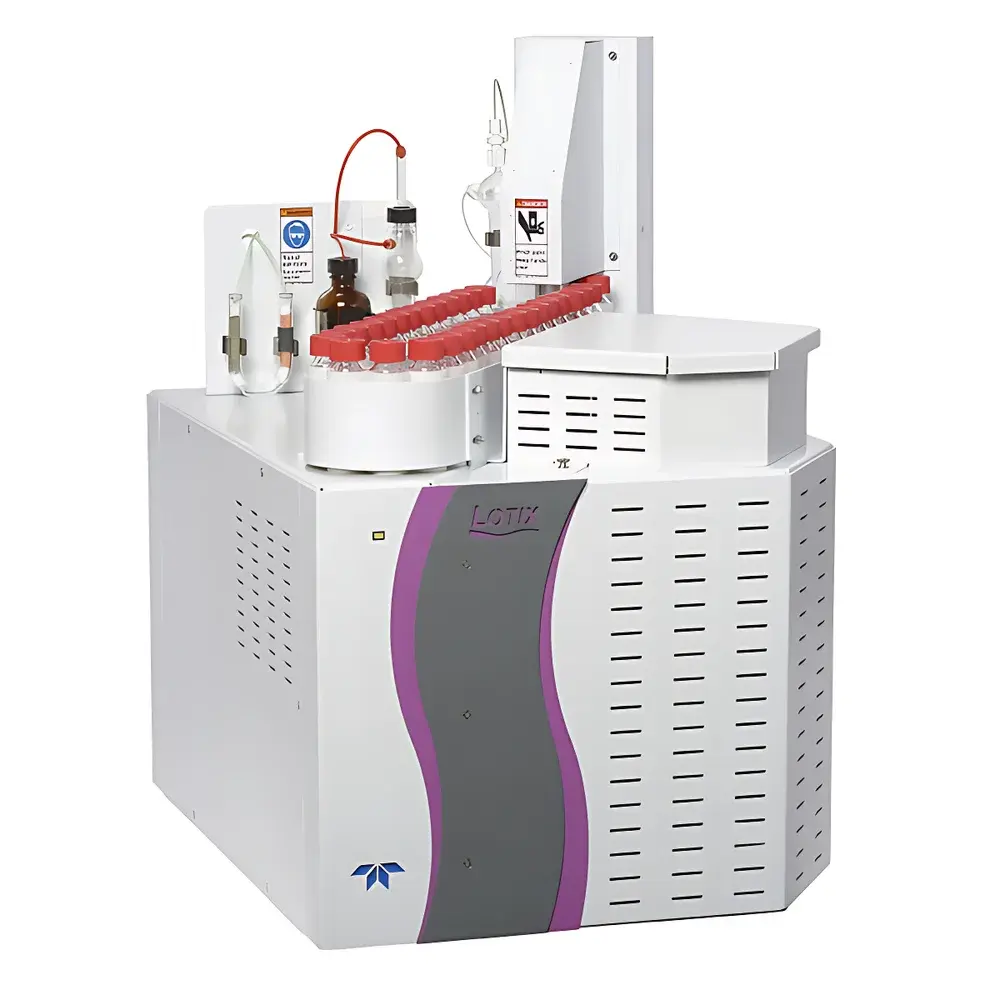
Tekmar Lotix Total Organic Carbon Analyzer
| Brand | Tekmar |
|---|---|
| Origin | Imported |
| Manufacturer Type | Authorized Distributor |
| Instrument Type | Laboratory TOC Analyzer |
| Detection Principle | Non-Dispersive Infrared (NDIR) Absorption |
| Oxidation Method | High-Temperature Catalytic Combustion |
| Detection Limit | 50 ppb |
| Linear Range | 0–20,000 ppm (with 0.5 mL injection volume) |
| Compliance Standards | EPA 415.1/415.3/9060A, ISO 8245, EN 1484, USP <643>, ASTM D2579, SM 5310B, HJ 501-2009, GB/T 32116-2015, AOAC 973.47 |
Overview
The Tekmar Lotix Total Organic Carbon (TOC) Analyzer is a laboratory-grade instrument engineered for precise, reliable quantification of organic carbon in aqueous matrices using high-temperature catalytic combustion coupled with non-dispersive infrared (NDIR) detection. This dual-stage analytical architecture ensures complete oxidation of refractory organic compounds—including humic substances, hydrocarbons, and saline-resistant organics—into CO2, which is then selectively measured by a thermally stabilized NDIR sensor. Designed for regulatory compliance and method robustness, the Lotix delivers trace-level sensitivity (50 ppb detection limit) without compromising dynamic range, supporting applications from ultra-pure water validation to highly contaminated industrial effluents.
Key Features
- High-temperature catalytic combustion system operating at 680 °C, enabling quantitative oxidation of recalcitrant organics commonly found in seawater, produced water, and landfill leachate.
- Proprietary high-sensitivity NDIR detector with temperature-compensated optics and drift-stabilized electronics, minimizing baseline noise and enhancing long-term measurement reproducibility.
- Single-curve calibration architecture covering 0–20,000 ppm C with 0.5 mL sample injection—eliminating need for multiple calibrations or dilution workflows.
- Optional high-salt catalyst tube configuration featuring proprietary ceramic-supported Pt/Pd formulation, extending catalyst service life by up to 3× in brine-rich samples (e.g., >35,000 mg/L Cl−).
- Modular hardware design permitting full maintenance of furnace assembly, combustion tube, and NDIR cell within 5 minutes—no tools required beyond standard hex keys.
- Real-time data visualization with on-the-fly report generation; completed analyses may be printed immediately post-run or queued for batch export.
- Priority interrupt functionality allowing urgent samples to be inserted mid-sequence without disrupting ongoing analysis or calibration integrity.
Sample Compatibility & Compliance
The Lotix accommodates a broad spectrum of liquid matrices, including deionized water, drinking water, wastewater, groundwater, surface water, seawater, pharmaceutical process water, and high-salinity industrial streams. Its oxidation efficiency meets or exceeds requirements defined in EPA Method 415.1 (for drinking water), EPA 9060A (for wastewater), USP (pharmaceutical water quality), and ISO 8245 (general water analysis). The system supports full audit trail capability compliant with FDA 21 CFR Part 11 when paired with validated software configurations, and maintains full traceability for GLP/GMP environments through time-stamped event logging, user authentication, and electronic signature support.
Software & Data Management
Controlled via Tekmar’s intuitive Windows-based software platform, the Lotix enables rapid method setup—calibration curves can be configured in under 60 seconds using guided wizard interfaces. All raw detector signals, calibration parameters, and system diagnostics are stored in an embedded SQL database with automatic backup scheduling. Analytical outputs are exportable in CSV (for LIMS integration) and PDF (for regulatory submission), while batch import of calibration standards or QC reference values is supported via CSV templates. Software versioning, change logs, and electronic signature workflows align with ALCOA+ data integrity principles and support inspection readiness for ISO/IEC 17025-accredited laboratories.
Applications
- Environmental monitoring: Compliance testing per HJ 501-2009 (China) and EPA 415.3 for municipal wastewater discharge permits.
- Pharmaceutical manufacturing: Routine TOC verification of purified water (PW) and water-for-injection (WFI) per USP and EU Annex 1.
- Petrochemical operations: Monitoring of cooling tower water, boiler feedwater, and produced water treatment efficacy.
- Academic and research laboratories: Kinetic studies of organic degradation pathways and catalyst performance evaluation under variable salinity conditions.
- Food & beverage industry: Verification of cleaning-in-place (CIP) rinse water cleanliness and process water purity assurance.
FAQ
What oxidation temperature does the Lotix employ, and how is catalyst longevity managed in high-chloride samples?
The Lotix operates at a fixed 680 °C combustion temperature. For samples exceeding 10,000 mg/L chloride, the optional high-salt catalyst tube—featuring a thermally resilient ceramic substrate and optimized noble metal dispersion—is recommended to maintain >1,000 injections before regeneration.
Is the NDIR detector field-replaceable, and what calibration frequency is recommended?
Yes, the NDIR module is a plug-and-play subassembly with factory pre-alignment. Daily system suitability checks using certified sucrose standards are advised; full multi-point calibration is recommended every 72 hours or after maintenance.
Does the Lotix support remote monitoring or integration with enterprise LIMS platforms?
Via optional Ethernet interface and OPC UA-compliant drivers, the Lotix supports bidirectional communication with major LIMS vendors (e.g., LabVantage, STARLIMS, Thermo Fisher SampleManager) and allows secure remote status viewing through TLS-encrypted web dashboard.
How does the Lotix handle particulate-laden samples?
Samples must be filtered to ≤0.45 µm prior to analysis. An integrated 0.2 µm inline filter is available as an accessory for automated pre-filtration in unattended operation modes.
Can the Lotix quantify both TOC and total inorganic carbon (TIC) in a single run?
Yes—the instrument performs sequential acid sparging (for TIC) and combustion (for TOC) within one automated cycle, calculating TC = TOC + TIC and delivering all three values with associated RSDs.
Related Products







