
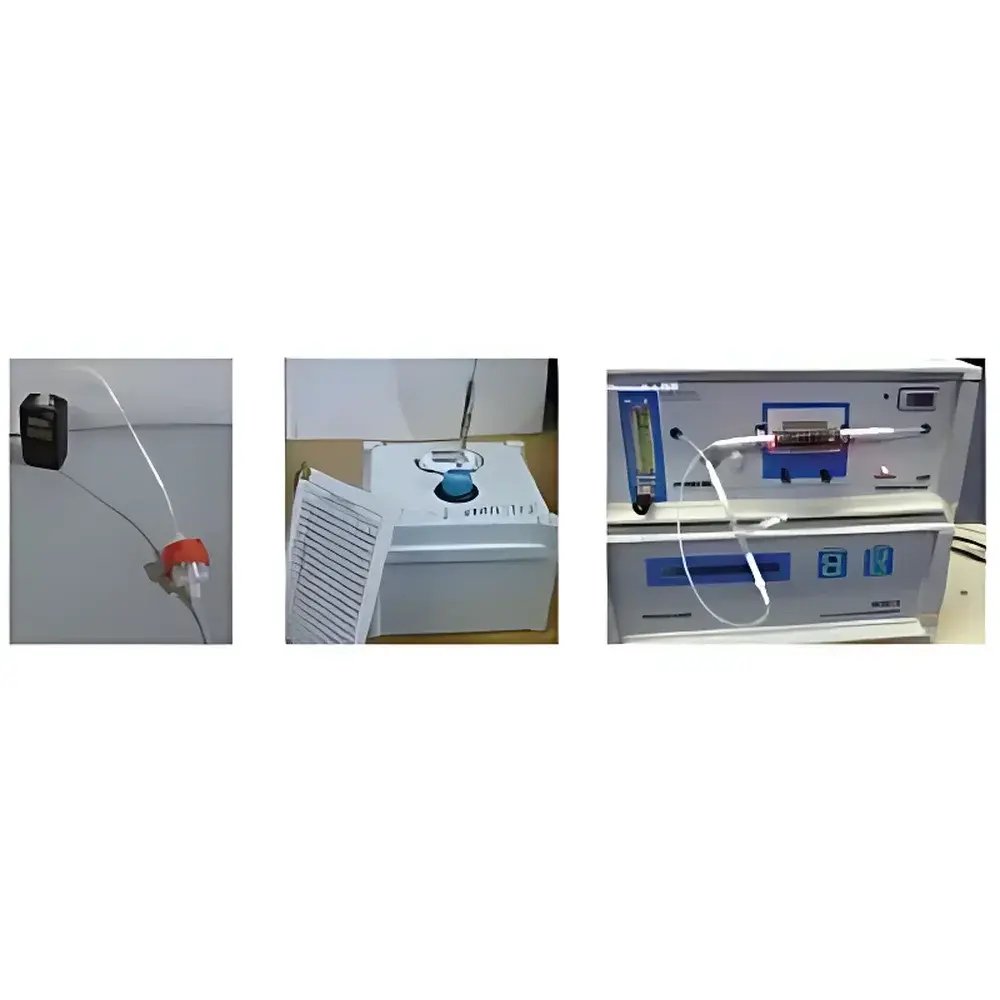
Brooks Rand Lab MERX Total Mercury Analyzer for Ambient Air (EPA Method IO-5 Compliant)
| Brand | Brooks Rand Lab |
|---|---|
| Origin | Imported |
| Manufacturer Type | Authorized Distributor |
| Model | MERX Total Mercury Analyzer |
| Instrument Type | Portable |
| Measurement Principle | Cold Vapor Atomic Fluorescence Spectrometry (CVAFS) |
| Detection Limit | 0.3 ng/m³ (equivalent to 0.3 pg/L at standard temperature and pressure) |
| Precision | RSD ≤ 3% at 500 pg loading |
| Linear Dynamic Range | 0.2–400 ng per sample |
| Analysis Time | < 4 minutes per sample |
| Airflow Control | 20–3,000 mL/min (±3% accuracy) |
| Sample Collection | Dual-bed gold-coated sand amalgamation traps |
| Compliance | EPA Method IO-5, ASTM D6784-22 (for mercury in ambient air), ISO 15202-2:2021 |
Overview
The Brooks Rand Lab MERX Total Mercury Analyzer is a field-deployable, EPA Method IO-5–compliant system engineered for quantitative determination of total gaseous mercury (TGM) in ambient air. It employs cold vapor atomic fluorescence spectrometry (CVAFS), a technique recognized for its exceptional sensitivity, selectivity, and low interference in trace-level mercury analysis. The system integrates sample collection, thermal desorption, vapor generation, and high-sensitivity detection into a single coordinated workflow. Unlike traditional laboratory-based mercury analyzers requiring off-site sample transport and time-intensive preparation, the MERX enables real-time or near-real-time measurement directly at monitoring sites—including urban airsheds, industrial perimeters, landfill boundaries, and remote background stations—while maintaining full traceability to NIST-traceable standards.
Key Features
- Portable, battery-operated air sampling module with programmable flow control (20–3,000 mL/min) and integrated particulate filtration via replaceable glass-fiber membranes
- Reusability-engineered dual-bed gold-coated sand amalgamation traps, validated for ≥50 thermal cycles without performance degradation
- Dual-tube thermal desorption unit with precise temperature ramping (up to 850 °C) and inert carrier gas purging to ensure quantitative mercury release and transfer efficiency
- High-stability CVAFS detector featuring pulsed xenon lamp excitation, optimized optical path geometry, and low-noise photomultiplier tube detection
- Integrated touchscreen interface with embedded Linux OS, supporting on-device method setup, real-time signal visualization, and automated calibration sequence execution
- Modular architecture enabling field maintenance, component-level replacement, and seamless integration with external meteorological sensors or telemetry systems
Sample Compatibility & Compliance
The MERX system is validated for use with ambient air matrices across diverse environmental conditions (temperature: −20 °C to +50 °C; relative humidity: 10–95% non-condensing). Its gold amalgamation chemistry ensures selective capture of elemental mercury (Hg⁰) while minimizing interference from oxidized mercury species (Hg²⁺) and organic mercury compounds—consistent with EPA IO-5’s definition of “total mercury” as Hg⁰ plus reducible Hg²⁺. All hardware and software components meet applicable requirements for environmental monitoring under U.S. EPA Quality Assurance Guidance Documents (QAGD) and are compatible with GLP-compliant data handling workflows. System validation reports include documented linearity (R² ≥ 0.999 over 0.2–400 ng range), method detection limit (MDL) verification per 40 CFR Part 136, and inter-laboratory precision assessment per ASTM D6784-22 Annex A3.
Software & Data Management
The MERX Control Software provides full instrument orchestration, including automated trap conditioning, multi-point calibration, blank subtraction, and peak integration using second-derivative algorithms. Raw spectral data, calibration logs, and audit trails are stored in encrypted SQLite databases compliant with FDA 21 CFR Part 11 requirements for electronic records and signatures. Export formats include CSV, XML, and EPA-compatible .DAT files suitable for ingestion into EPA’s AMoN, CASTNet, or IMPROVE network databases. Optional cloud synchronization enables remote diagnostics, firmware updates, and centralized fleet management for multi-unit deployments.
Applications
- Regulatory compliance monitoring for ambient air quality standards (e.g., U.S. NAAQS precursor tracking, EU Directive 2004/107/EC)
- Source attribution studies around coal-fired power plants, waste incinerators, chlor-alkali facilities, and artisanal gold mining zones
- Long-term trend analysis in global mercury observation networks (e.g., GMOS, ACTRIS)
- Short-term emission event characterization during stack testing, fugitive release investigations, or remediation site surveillance
- Method development and reference material certification in accredited environmental testing laboratories (ISO/IEC 17025)
FAQ
What regulatory methods does the MERX system support?
EPA Method IO-5 for total mercury in ambient air; also operationally aligned with ASTM D6784-22 and ISO 15202-2:2021.
Can the gold traps be regenerated in the field?
Yes—thermal regeneration is fully automated within the dual-tube desorption module, requiring no manual chemical treatment or off-site servicing.
Is the system suitable for unattended long-term deployment?
Yes—configured with optional solar-charging kits and cellular telemetry, it supports continuous 30-day autonomous operation with scheduled sampling and data upload.
How is calibration traceability maintained?
Calibration standards are prepared from NIST SRM 3133 (mercury in aqueous matrix) and verified using gravimetrically generated permeation tubes traceable to NPL (UK) and BAM (Germany).
Does the software support audit trail review and electronic signature capability?
Yes—the embedded software includes role-based user access, timestamped action logging, and digital signature enforcement per 21 CFR Part 11 Subpart B.





