
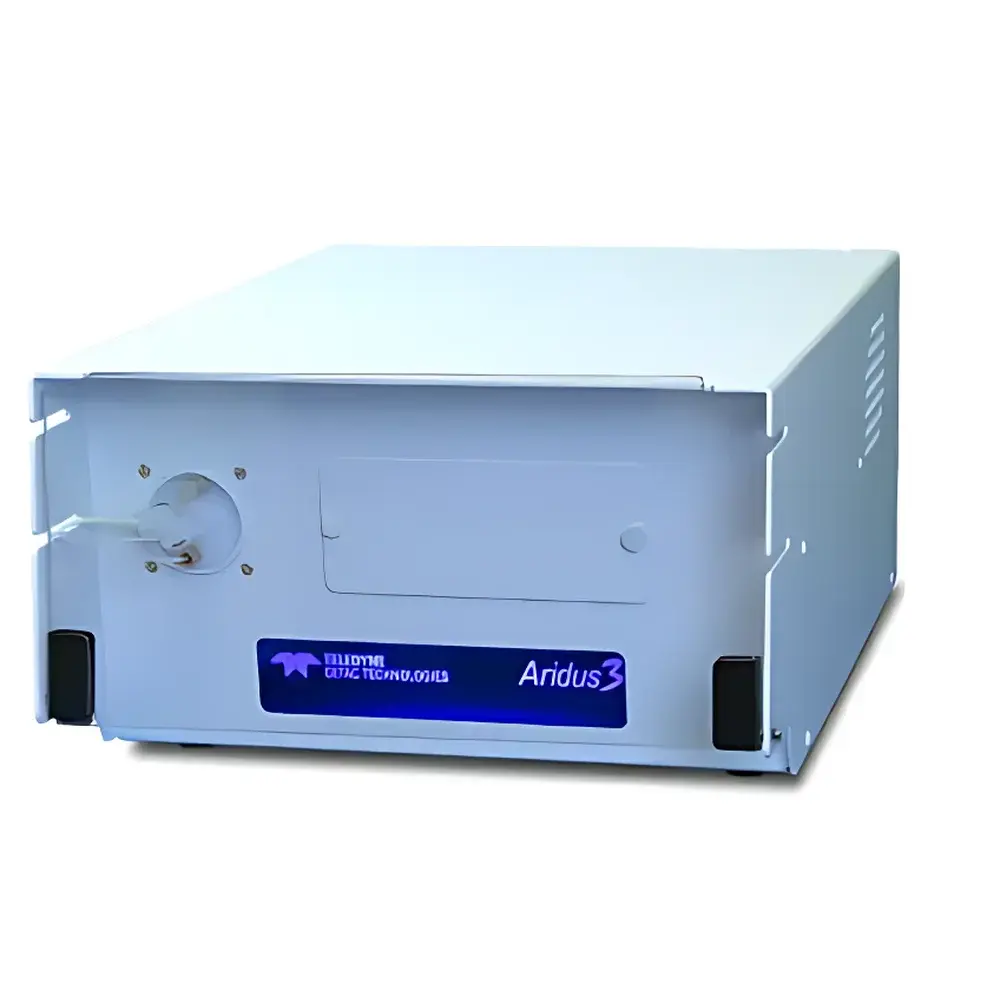
Teledyne CETAC Aridus3 Membrane Desolvation Nebulization System
| Brand | CETAC |
|---|---|
| Origin | Imported |
| Model | Aridus3 |
| Instrument Type | Multifunctional Autosampler for ICP-MS/ICP-OES |
| Construction Materials | PFA-only fluid path |
| Nebulizer Type | Low-flow, micro-consumption concentric nebulizer |
| Desolvation Technology | Heated hydrophobic membrane-based solvent removal |
| Waste Liquid Handling | Active vacuum-assisted back-purge |
| Gas Control | Integrated mass flow controllers (MFCs) for carrier and make-up gases |
| Software Interface | Aridus Link with remote temperature and flow setpoint control |
| Compliance | Compatible with GLP/GMP workflows |
| Safety | Full PFA compatibility enables direct analysis of HF-containing matrices (e.g., geological digests, semiconductor etchants) |
Overview
The Teledyne CETAC Aridus3 Membrane Desolvation Nebulization System is a high-performance sample introduction solution engineered specifically for inductively coupled plasma mass spectrometry (ICP-MS) and optical emission spectroscopy (ICP-OES). It employs a thermally regulated, hydrophobic polytetrafluoroethylene (PFA) membrane interface to selectively remove solvent vapor—primarily water and organic volatiles—while retaining analyte aerosol for efficient transport into the plasma. Unlike conventional desolvation systems relying on chilled spray chambers or cryogenic traps, the Aridus3 operates at elevated temperatures (typically 120–180 °C) to drive rapid solvent evaporation prior to membrane permeation. This design minimizes polyatomic interferences—particularly oxides (MO⁺), hydroxides (MOH⁺), and argides (ArO⁺, ArN⁺)—that degrade detection limits and spectral purity in ultra-trace elemental analysis. Its low-sample-consumption architecture (≤100 µL/min uptake) ensures compatibility with microflow nebulizers and micro-volume sample introduction strategies, making it ideal for limited or precious samples such as single-cell digests, laser ablation eluents, or high-value clinical isolates.
Key Features
- Modular, field-serviceable membrane desolvation unit—enables rapid disassembly, cleaning, and replacement without system downtime or specialized tools.
- PFA-lined, lid-enclosed spray chamber eliminates electrostatic charge buildup, ensuring stable aerosol generation across diverse matrix types including saline, acidic, and organic-rich solutions.
- Integrated mass flow controllers (MFCs) deliver precise, repeatable regulation of both carrier gas (argon or nitrogen) and auxiliary make-up gas flows—critical for maintaining consistent desolvation efficiency and plasma stability.
- Aridus Link software provides real-time remote monitoring and control of membrane heater temperature, gas flow rates, and system status via Ethernet or USB; supports automated method sequencing and parameter logging.
- Post-run auto-shutdown protocol activates gas cutoff and cooling ramp upon method completion—reducing argon consumption by up to 40% during unattended operation.
- Full-PFA fluidic pathway certified for direct handling of hydrofluoric acid (HF) matrices up to 5% v/v, eliminating risk of quartz or glass corrosion in geological, nuclear, or semiconductor applications.
Sample Compatibility & Compliance
The Aridus3 accommodates aqueous standards, high-salt brines (up to 25% w/v NaCl), dilute organic solvents (methanol, ethanol, acetonitrile ≤10% v/v), and aggressive HF-HNO₃ digestates. Its inert PFA construction meets ASTM D5673 and ISO 17294-2 requirements for trace metal analysis in environmental waters, while its interference suppression performance aligns with USP and criteria for elemental impurities in pharmaceuticals. When operated within validated ICP-MS methods, the system supports 21 CFR Part 11-compliant electronic records when paired with audit-trail-enabled instrument control software. Routine maintenance logs, calibration histories, and method parameters are exportable in CSV or XML formats for regulatory reporting.
Software & Data Management
Aridus Link serves as the dedicated control interface, offering intuitive graphical configuration of temperature ramps, gas flow profiles, and safety interlocks (e.g., overtemperature shutdown, low-flow alarms). All operational parameters—including actual vs. setpoint values—are timestamped and stored locally with optional network synchronization. The software exports metadata-compatible files (.csv, .txt) that integrate seamlessly with Thermo Fisher Qtegra, Agilent MassHunter, or PerkinElmer Syngistix platforms. For laboratories under GLP or GMP oversight, Aridus Link can be deployed in locked-down mode with user-level access controls and electronic signature support.
Applications
- Ultra-trace rare earth element (REE) quantification in seawater and groundwater using high-mass-resolution ICP-MS.
- Isotopic ratio measurements (e.g., U/Pb, Sr/Nd) requiring minimal oxide formation and long-term signal stability.
- Analysis of HF-digested silicate rocks, zircons, and nuclear fuel cycle materials without quartz contamination.
- Direct introduction of LC-ICP-MS eluents containing methanol/water gradients, enabling robust coupling without post-column dilution.
- Single-particle ICP-MS (spICP-MS) where low background and high pulse-to-pulse reproducibility are essential for nanoparticle size distribution modeling.
FAQ
Can the Aridus3 be used with all commercial ICP-MS instruments?
Yes—it interfaces via standard 1/4″ Swagelok fittings and is compatible with all major ICP-MS platforms, including those from Thermo Fisher, Agilent, PerkinElmer, and Shimadzu.
Does the system require liquid nitrogen or external chillers?
No—the Aridus3 uses only heated membrane desolvation and requires no cryogens, reducing operational complexity and infrastructure demands.
How often does the PFA membrane need replacement?
Under typical use with clean aqueous standards, membrane service life exceeds 6 months; with HF matrices, inspection every 2–3 months is recommended.
Is Aridus Link compatible with LIMS integration?
Yes—via configurable ASCII output and REST API endpoints, enabling bidirectional communication with laboratory information management systems for automated result ingestion and instrument scheduling.
What validation documentation is provided?
Each unit ships with a Factory Acceptance Test (FAT) report, material certification for PFA components, and a NIST-traceable temperature calibration certificate. IQ/OQ protocols are available upon request.






