
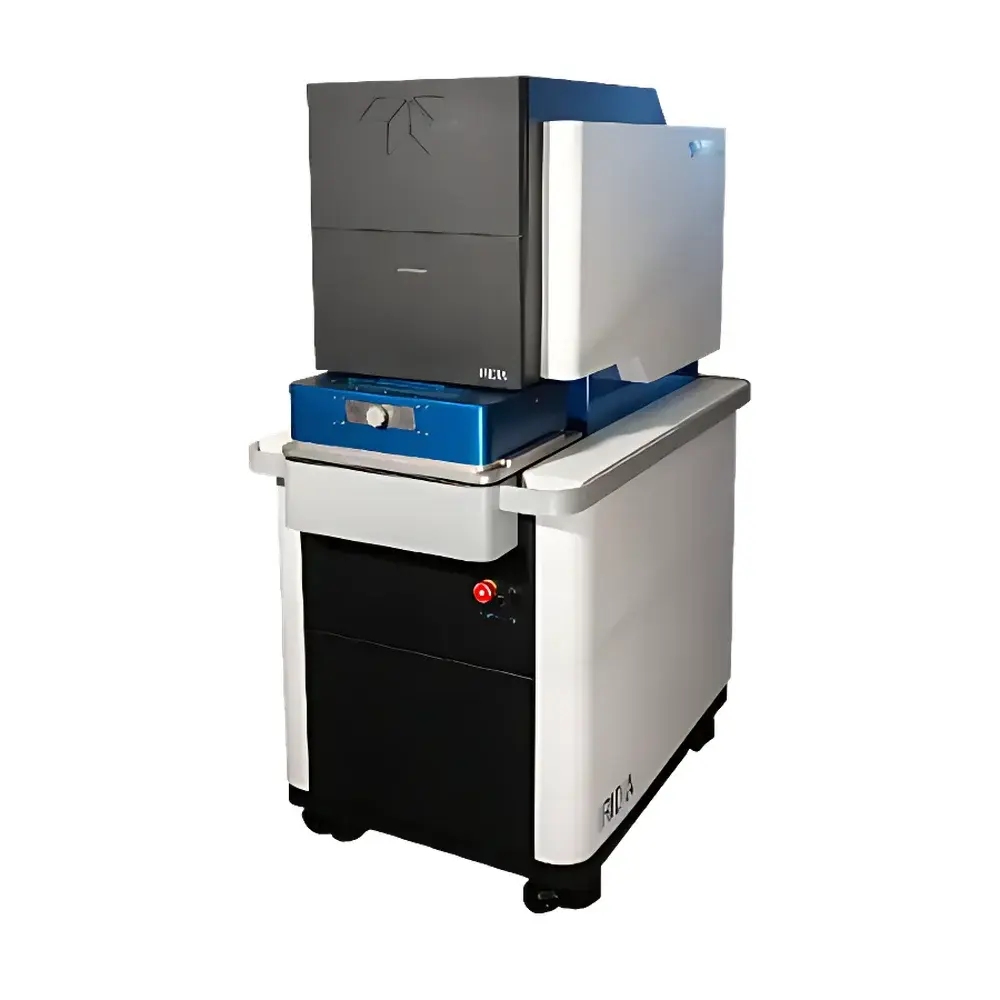
IRIDIA by Teledyne Photon Machines Ultra-Fast Imaging Excimer Laser Ablation System
| Brand | Teledyne Photon Machines |
|---|---|
| Origin | Imported |
| Manufacturer Type | Authorized Distributor |
| Model | IRIDIA Ultra-Fast Imaging Excimer |
| Laser Type | ArF Excimer (193 nm) |
| Repetition Rate | 300 Hz / 500 Hz |
| Ablation Cell | Cobalt™ Fast-Washout Chamber (< 5 ms aerosol washout) |
| Gas Integration | Integrated ArF pre-mixed and He gas cabinets with active pressure relief and fully enclosed design |
| Gas Management | Patented ExiCheck™ automated ArF gas exchange module |
| Optical Path | Class 1 laser safety architecture |
| Beam Delivery | Dual-polarization optics (Geo Edition) or dual-attenuator configuration (BIO Edition) |
| Mirror Lifetime | 5× extended service life via multi-use reflective optics |
| Warranty | 2 years / 2 billion shots |
Overview
The IRIDIA Ultra-Fast Imaging Excimer Laser Ablation System, developed by Teledyne Photon Machines, is a purpose-built, high-repetition-rate 193 nm ArF excimer laser ablation platform engineered for spatially resolved elemental imaging in tandem with quadrupole, magnetic sector, or multi-collector ICP-MS instruments. Leveraging over two decades of laser ablation system design rooted in the original Photon Machines innovation legacy (first commercial LA system launched in 1995), IRIDIA integrates fundamental advances in excimer laser stability, aerosol transport dynamics, and real-time optical control to deliver sub-second pixel dwell times and micron-scale lateral resolution across large-area geological, biological, and materials science samples. Its core operational principle relies on pulsed UV photolysis—where 193 nm photons induce non-thermal bond dissociation in solid matrices—minimizing elemental fractionation and thermal diffusion effects commonly observed with longer-wavelength or nanosecond IR/visible lasers. The system operates as a Class 1 laser enclosure per IEC 60825-1:2014, ensuring full compliance with occupational safety standards without requiring external interlocks or laser safety officers during routine operation.
Key Features
- High-stability 193 nm ArF excimer laser with selectable repetition rates of 300 Hz and 500 Hz—optimized for rapid rastering and line-scan acquisition while maintaining pulse-to-pulse energy stability ≤ ±1.5% (RSD) over 2 billion shots.
- Cobalt™ ablation cell featuring <5 ms aerosol washout time, achieved through laminar flow geometry and low-dead-volume transport tubing—critical for preserving temporal fidelity between ablation events and MS signal transients.
- Fully integrated gas management cabinet housing pressurized ArF pre-mix (Ar/F₂) and ultra-high-purity helium (He) cylinders, including active pressure-relief valves, leak-tight sealing, and redundant pressure monitoring per ISO 8573-1 Class 1 air quality specifications.
- ExiCheck™ automated gas exchange module—programmable via software to replace ArF gas at user-defined intervals (e.g., every 10⁶ shots or 48 hours), eliminating manual cylinder swaps and associated downtime or contamination risk.
- Dual-configuration optical train: Geo Edition employs patented dual-polarization optics for consistent beam profile across variable spot sizes (1–120 µm); BIO Edition integrates dual motorized attenuators enabling precise, reproducible fluence control from 0.1–15 J/cm² without mechanical recalibration.
- Multi-use reflective optics architecture extends mirror service life by 5× versus conventional single-pass designs—reducing consumable costs and alignment drift over extended campaign usage.
Sample Compatibility & Compliance
IRIDIA supports flat, polished, or embedded solid samples up to 100 mm × 100 mm, including silicate minerals, zircon standards, bio-tissues (frozen or FFPE), metal alloys, ceramics, and thin-film coatings. Sample stage motion is controlled via high-precision stepper motors with 0.1 µm positional resolution and closed-loop feedback. The system complies with ISO/IEC 17025:2017 requirements for calibration traceability, and all firmware and control logic adhere to IEC 61508 SIL2 functional safety principles. When operated with validated methods, data acquisition meets GLP and GMP documentation standards—including full audit trails, electronic signatures, and raw data immutability—as required under FDA 21 CFR Part 11 for regulated laboratories.
Software & Data Management
Control and acquisition are managed through LaserDesk™ v5.2 software, a Windows-based platform supporting synchronized hardware triggering, real-time ablation map preview, and bidirectional communication with ICP-MS vendors (Agilent, Thermo Fisher, Nu Instruments, Elementar). All acquisition parameters—including laser fluence, repetition rate, scan speed, dwell time, and gas flow profiles—are stored in XML metadata alongside raw intensity time-series. Export formats include .csv, .mzML (for MS coupling), and vendor-neutral HDF5 containers compliant with the IUPAC Analytical Chemistry Data Interchange Standard. Software updates are delivered via secure HTTPS channels with SHA-256 signature verification.
Applications
- High-resolution elemental mapping of accessory minerals (e.g., monazite, apatite) for U–Th–Pb geochronology and trace-element fingerprinting.
- Quantitative Zn, Cu, Fe distribution analysis in murine brain tissue sections for neurodegenerative disease research.
- Isotopic ratio imaging (e.g., ⁸⁷Sr/⁸⁶Sr, ²⁰⁷Pb/²⁰⁶Pb) using multi-collector ICP-MS with <0.05% internal precision (2SE) at 10 µm resolution.
- Depth-profiling of thin-film solar cells (CIGS, perovskites) to assess interfacial diffusion and stoichiometric gradients.
- Reference material homogeneity assessment (e.g., NIST SRM 610, USGS GSE-1G) under certified laboratory conditions.
FAQ
What laser wavelength does the IRIDIA system use, and why is 193 nm preferred for high-fidelity ablation?
The IRIDIA system uses a 193 nm ArF excimer laser. This deep-UV wavelength enables efficient photochemical ablation with minimal thermal load, reducing elemental fractionation and improving accuracy in isotopic and elemental ratio measurements—particularly critical for geological and biological applications.
Is the IRIDIA system compatible with my existing ICP-MS platform?
Yes. IRIDIA provides native drivers and trigger protocols for all major ICP-MS platforms, including Thermo Fisher iCAP RQ/QQQ, Agilent 8900/7900, Nu Instruments Attom, and Element XR. Custom API integration is available upon request.
How often must the ArF gas be replaced, and does the system alert users before depletion?
The ExiCheck™ module automatically replaces ArF gas based on shot count or elapsed time—configurable thresholds trigger both on-screen notifications and email alerts via SMTP integration, ensuring uninterrupted operation.
Does the system support automated calibration routines for quantitative analysis?
Yes. LaserDesk™ includes built-in calibration workflows for sensitivity normalization, background subtraction, and matrix-matched standard bracketing—fully scriptable and exportable for method validation under ISO 17025.
What maintenance intervals are recommended for optics and ablation cell cleaning?
Mirror inspection is recommended every 500 million shots; cobalt chamber cleaning is advised after 200 ablation sessions or when aerosol carryover exceeds 5%—both procedures are documented in the Maintenance Manual v3.1 and require <15 minutes of technician time.






