
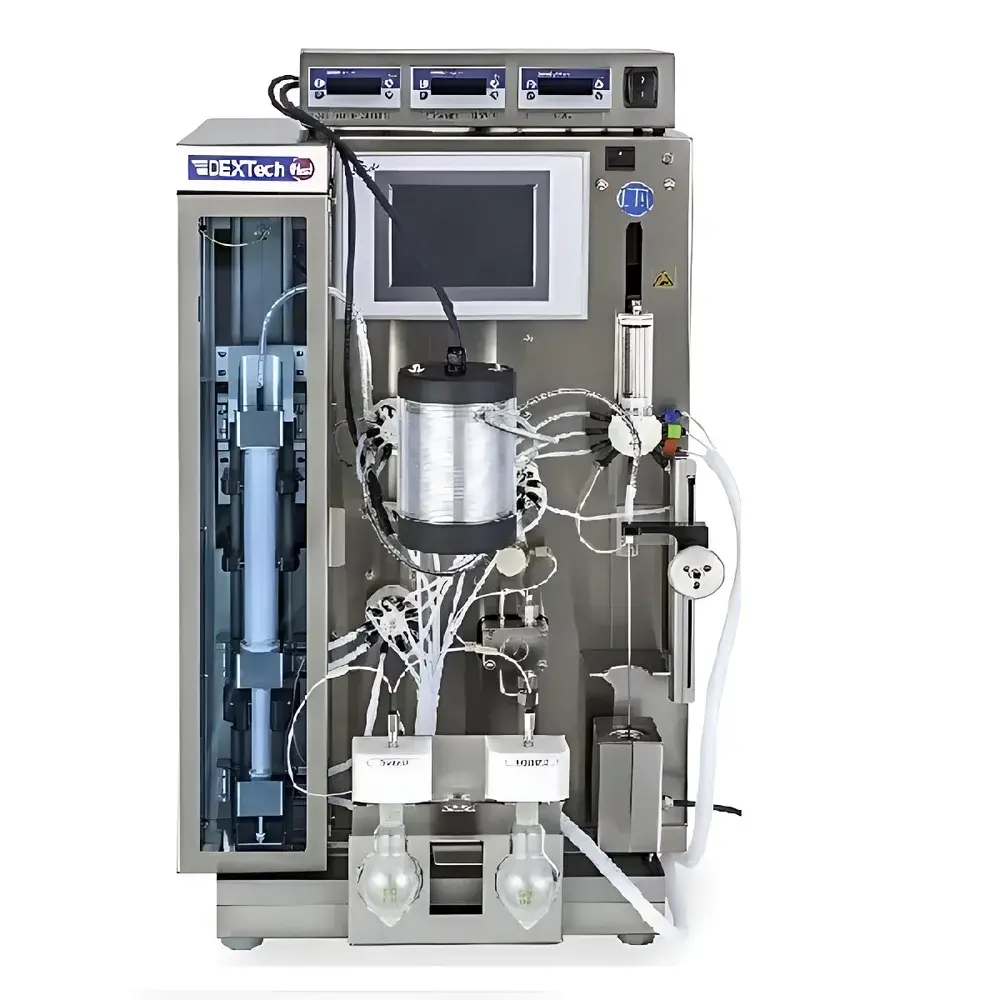
LCTech DEXTech Heat Automated Heating Purification System for Dioxins and PCBs
| Brand | LCTech |
|---|---|
| Origin | Germany |
| Model | DEXTech Heat |
| Weight | 40 kg |
| Standards Compliance | GB 5009.205-2013 |
Overview
The LCTech DEXTech Heat is a fully automated, temperature-controlled sample purification system engineered specifically for the isolation and fractionation of dioxins (PCDD/Fs) and polychlorinated biphenyls (PCBs) from high-melting-point solid or semi-solid matrices. Unlike conventional cleanup platforms, the DEXTech Heat integrates precision heating throughout the fluidic path—including sample vials, transfer lines, injection loops, and column manifolds—to maintain sample homogeneity in liquid phase during automated solid-phase extraction (SPE) and multi-column chromatographic fractionation. This thermal management architecture eliminates cold-zone-induced precipitation—particularly critical for lipid-rich samples such as palm fatty acid distillates (PFADs), glycerol stearate, tallow, lard, and hydrogenated vegetable oils—ensuring complete, reproducible analyte transfer without manual intervention or flow-path clogging. The system operates on a validated three-column sequential separation principle, enabling parallel or sequential isolation of dioxin and PCB fractions under strictly controlled elution gradients, consistent with EPA Method 1613B, EN 1948, and ISO 18073 frameworks.
Key Features
- Integrated heating system: Uniform temperature control (up to 80 °C) across sample vials, syringe pumps, transfer tubing, and quantitative loops to prevent crystallization of high-melting-point lipids
- Three-column fractionation architecture: Independent, programmable column switching for selective elution of PCDD/Fs and non-ortho/mono-ortho PCBs into discrete, contamination-free fractions
- Patented auto-lock column interface: Positive-pressure mechanical coupling ensures leak-tight, repeatable column mounting without manual torque adjustment
- Pre-conditioned, QC-verified columns: Ready-to-use cartridges pre-packed with silica, alumina, and carbon-based sorbents; no equilibration required prior to use
- Non-contact sample handling: Syringe pump actuation and sample aspiration occur without physical contact between pump components and sample vials—eliminating cross-contamination risk
- Automated vial rinsing protocol: Integrated solvent rinse cycles ensure quantitative recovery (>99.5%) of viscous samples from original containers
- Low solvent consumption: Optimized gradient programming reduces total organic solvent usage by up to 40% versus manual or semi-automated alternatives
- Touchscreen HMI with embedded method library: Pre-loaded protocols compliant with Chinese national standards (GB series), EU EN methods, and US EPA guidelines; full parameter customization supported
- Comprehensive safety interlocks: Overtemperature cutoff, pressure monitoring, door-open detection, and emergency stop circuitry aligned with IEC 61010-1
Sample Compatibility & Compliance
The DEXTech Heat is validated for direct processing of undiluted, unhydrolyzed lipid matrices including PFADs, palm oil, rendered animal fats, stearic acid, and cocoa butter—samples routinely rejected by ambient-temperature purification systems due to viscosity-driven channel blockage. Its thermal stability profile supports repeated operation at elevated temperatures without degradation of sorbent integrity or column performance. All hardware and software functions comply with GLP documentation requirements, including audit-trail-enabled method execution logs, user access control levels, and electronic signature support per FDA 21 CFR Part 11. The system meets the instrumental pre-treatment specifications outlined in GB 5009.205–2013 (determination of dioxins in food), GB 5009.190–2014 (PCBs in food), GB/T 28643–2012 (dioxin analysis in feed), and the HJ 77 series (environmental dioxin monitoring standards).
Software & Data Management
The DEXTech Control Suite provides intuitive workflow configuration via a 10.1-inch capacitive touchscreen interface. Each method stores complete thermal profiles, valve sequencing logic, pump timing, and solvent gradient definitions. All system events—including column swaps, temperature deviations, pressure anomalies, and user logins—are timestamped and stored locally with optional network backup. Raw method files are exportable in XML format for third-party LIMS integration. Software validation packages (IQ/OQ/PQ documentation templates) and electronic record retention modules are available upon request to support regulated laboratory environments operating under ISO/IEC 17025 or GMP frameworks.
Applications
- Regulatory testing of edible oils and biodiesel feedstocks for dioxin and PCB contamination
- Monitoring of animal feed and rendering by-products in compliance with EU Commission Regulation (EU) No 2017/891
- Environmental analysis of sediment, sludge, and fly ash extracts containing thermally labile congeners
- Research-scale fractionation of complex lipid extracts prior to HRGC-HRMS analysis
- Quality assurance in oleochemical manufacturing where PFAD purity directly impacts downstream product safety
FAQ
Does the DEXTech Heat require column conditioning before first use?
No—pre-packed, factory-validated columns are shipped ready for immediate installation and use.
Can the system handle samples with >30% free fatty acid content?
Yes—the heated fluidic path maintains fluidity even in highly acidic, high-viscosity PFADs without flow interruption.
Is remote monitoring or troubleshooting supported?
Yes—optional Ethernet connectivity enables secure remote diagnostics and firmware updates via authenticated TLS session.
What is the maximum operating temperature of the heating zones?
All active zones are rated for continuous operation up to 80 °C, with ±0.5 °C thermal stability.
How does the system ensure trace-level recovery for 2,3,7,8-TCDD?
Through closed-loop vial rinsing, minimized surface adsorption via inert PFA tubing, and optimized carbon column loading protocols validated per EN 1948-1 Annex B.
Related Products







