

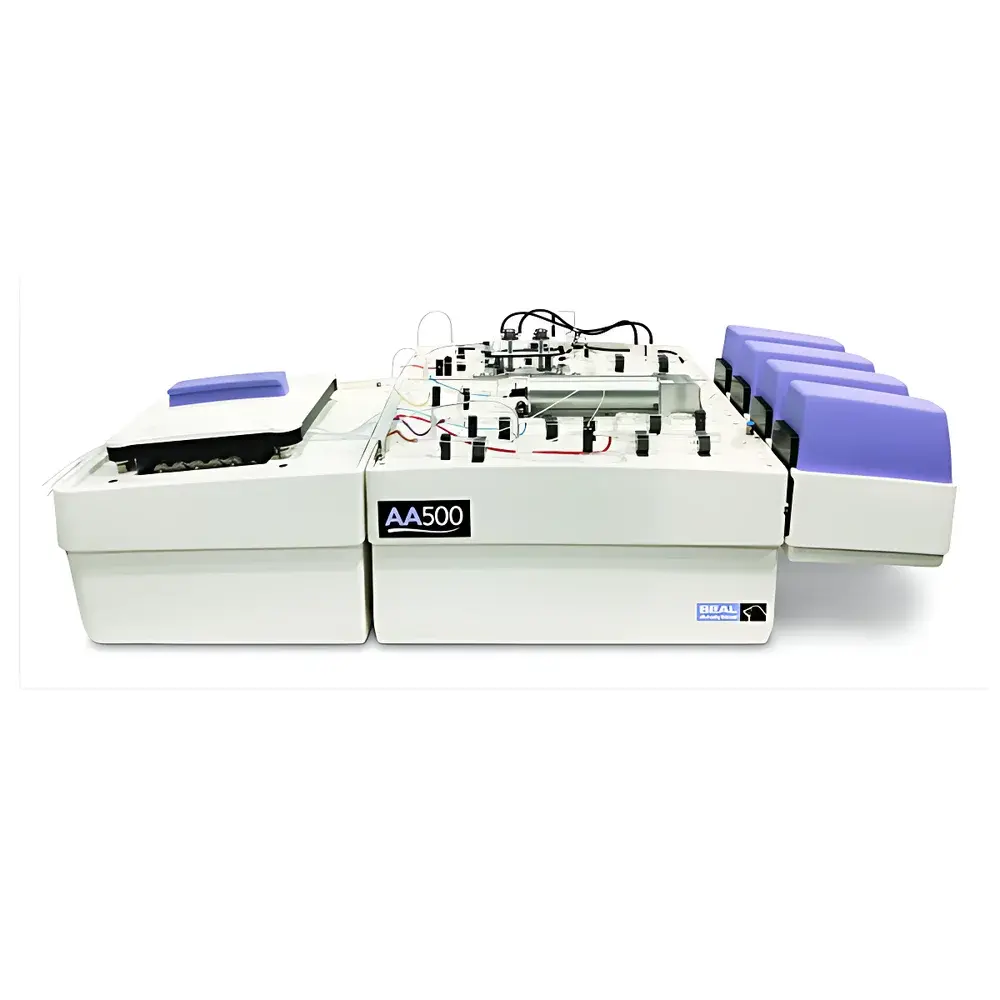
SEAL AA500 Continuous Flow Analyzer
| Brand | SEAL |
|---|---|
| Origin | Germany |
| Model | AA500 |
| Product Type | Continuous Flow Analyzer |
| Wavelength Range | 250–1000 nm |
| Sample Capacity | 180 positions / 120 cups |
| Reagent Positions | 34 |
| Flow Cell Path Length | 10–50 mm (selectable) |
| Light Source | LED |
Overview
The SEAL AA500 Continuous Flow Analyzer is a fully automated, high-throughput analytical platform engineered for precision, reproducibility, and regulatory compliance in environmental, food & beverage, pharmaceutical, and industrial laboratories. Based on the segmented continuous flow analysis (CFA) principle—where discrete sample segments are separated by precisely introduced air bubbles within an inert, continuously flowing carrier stream—the AA500 enables robust, low-interference quantification of analytes via spectrophotometric detection. This physical segmentation minimizes axial dispersion and cross-contamination between samples, delivering exceptional repeatability (<1.0% RSD) and ultra-low detection limits (sub-µg/L for many parameters). The system integrates seamlessly into GLP- and GMP-aligned workflows, supporting audit-ready data integrity through time-stamped, electronic records and full method traceability.
Key Features
- True unattended operation: Full automation including auto-sampler tray loading/unloading, pump priming, valve actuation, flow cell cleaning, and reagent replenishment alerts.
- Modular architecture: Chemistries housed in interchangeable, pre-aligned reaction modules—compatible with legacy SEAL AA3 components for phased laboratory upgrades.
- High-resolution digital photometer: Dual-beam design with selectable path lengths (10–50 mm), temperature-stabilized optics, and real-time reference channel correction at the same wavelength.
- Chemically inert glass reaction coils and diffusion membranes: Ensures minimal adsorption, consistent mixing kinetics, and compatibility with aggressive reagents (e.g., strong acids, oxidants).
- Flexible reaction control: Integrated thermostated reactors (30–100 °C), online dialysis, distillation, digestion, phase separation, and cadmium-column reduction modules—all programmable per method.
- Low consumption design: Typical reagent usage ≤1.5 mL per analysis; sample volume adjustable from 50 µL to 2 mL; optimized bubble frequency for minimal carryover.
- Intuitive method switching: Pre-validated, standards-compliant methods (>1,000 available) loaded via intuitive drag-and-drop interface; no hardware recalibration required.
Sample Compatibility & Compliance
The AA500 accepts liquid samples across wide matrices—including raw and treated waters (drinking water, wastewater, seawater), wines, dairy products, pharmaceutical intermediates, and cosmetic formulations—without manual pretreatment in most cases. Its segmented flow architecture inherently compensates for variable viscosity and particulate load when coupled with optional inline filtration. The system meets or exceeds requirements of major international standards: USEPA Methods 353.2, 354.1, and 365.4; ISO 15681-1/2 (phosphorus, nitrogen); ASTM D7512 (COD); and EN ISO 11923 (total cyanide). It supports full 21 CFR Part 11 compliance via electronic signatures, audit trails, and role-based access control when deployed with SEAL’s validated LIMS-integrated software suite.
Software & Data Management
SEAL’s proprietary Analytical Studio software provides end-to-end instrument control, method development, calibration management, and reporting. All hardware functions—including autosampler positioning, peristaltic pump speed profiling (28/34-channel independent control), valve sequencing, heater setpoints, and photometer gain—are scriptable and version-controlled. Raw absorbance chromatograms, peak integration parameters, calibration curves (linear, quadratic, or cubic), and QC flags (e.g., drift, blank elevation, carryover alert) are stored in a secure, encrypted SQLite database. Export formats include CSV, PDF analytical reports, and XML for LIMS or ELN integration. Audit trail logs record every user action, parameter change, and instrument event with timestamp, operator ID, and reason code—fully compliant with GLP, ISO/IEC 17025, and FDA inspection expectations.
Applications
The AA500 delivers validated, high-volume analysis for routine and regulatory testing across diverse sectors:
- Environmental monitoring: Ammonia-N, nitrate/Nitrite-N, total phosphorus, orthophosphate, COD, sulfide, phenols, cyanide, surfactants, hardness, alkalinity, fluoride, silica, and chloride in surface, groundwater, and effluent streams.
- Food & beverage quality control: Free/total SO₂ in wine; reducing sugars, volatile acidity, citric acid, sorbic/benzoic acid, ascorbic acid, and urea in juices and fermented beverages.
- Dairy analysis: Vitamin A/C, lactose/galactose, free fatty acids, alkaline phosphatase activity, nitrate/nitrite, urea, iodide, and sulfate in milk, whey, and infant formula.
- Pharmaceutical QC: Penicillin, glucose, lysine, vitamin B₁₂, paracetamol, amoxicillin, aspirin, morphine derivatives, calcium, iron, and cephalosporins in raw materials and finished dosage forms.
- Industrial hygiene: Anionic surfactants, total phosphorus, silicates, carbonates, and fluorides in detergents, cosmetics, and process waters.
FAQ
Does the AA500 require mercury lamps or deuterium sources for UV detection?
No—the AA500 uses high-stability, long-life LEDs covering 250–1000 nm, eliminating lamp warm-up delays, spectral drift, and hazardous waste disposal concerns.
Can existing AA3 methods be directly migrated to the AA500?
Yes—method files are backward-compatible; only minor optimization of bubble frequency or reaction timing may be needed due to enhanced flow stability.
Is online digestion supported for total phosphorus or Kjeldahl nitrogen?
Yes—the AA500 accommodates high-temperature (up to 150 °C) segmented digestion modules with integrated catalyst injection and post-digestion neutralization.
How is calibration verification handled during extended unattended runs?
The software schedules automatic bracketing with mid-level standards and blanks at user-defined intervals (e.g., every 20 samples), logging all results with pass/fail status against predefined tolerance limits.
What level of IT infrastructure is required for 21 CFR Part 11 compliance?
A Windows Server environment with domain authentication, encrypted database storage, and scheduled backups is recommended; SEAL provides validation documentation packages (IQ/OQ/PQ) and configuration templates for rapid implementation.
Related Products





