
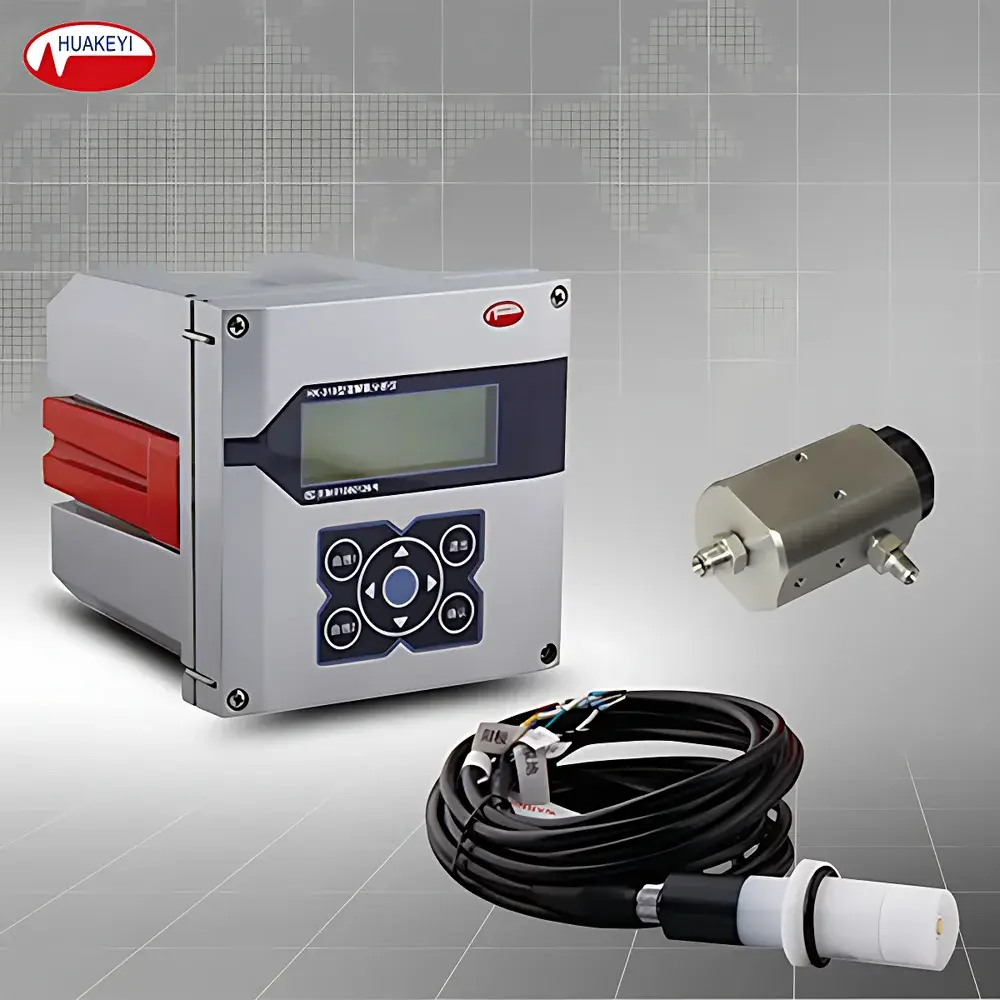
Huake Instrument HK-318 Online Dissolved Oxygen Analyzer
| Brand | Huake Instrument |
|---|---|
| Model | HK-318 |
| Type | Online Dissolved Oxygen Analyzer |
| Measurement Principle | Polarographic (Clark-type) Electrochemical Sensor |
| Range | 0–20 µg/L, 0–200 µg/L, or 0–20 mg/L (auto-ranging) |
| Accuracy | ±1 µg/L or ±1.5% FS (whichever is greater) |
| Repeatability | ±1.5% FS |
| Detection Limit | 0.1 µg/L or 0.1 mg/L |
| Resolution | 0.1 µg/L / 0.1 mg/L |
| Response Time (T90) | ≤60 s at 25 °C |
| Temperature Compensation | 0–50 °C (automatic or manual) |
| Temp. Sensor | Thermistor |
| Temp. Accuracy | ±0.5 °C |
| Output | Dual isolated 4–20 mA (configurable as 0–10 mA or 0–20 mA), max. load 800 Ω |
| Alarm Outputs | 2 programmable relay outputs |
| Communication | RS-485, Profibus DP, HART |
| Power Supply | AC 100–240 V, 50–60 Hz |
| Power Consumption | ≤8 W |
| Enclosure | Cast aluminum, IP65-rated front panel |
| Dimensions | 146 × 146 × 154 mm (W × H × D) |
| Panel Cutout | 139 × 139 mm |
| Weight | 2 kg |
| Operating Ambient | 5–45 °C |
| Storage Temp. | −25–55 °C (electrode must be stored >0 °C) |
| Sample Requirements | 5–50 °C, flow rate 50–350 mL/min, suspended solids ≤5 µm, no colloids or oil, RH ≤90% non-condensing |
Overview
The Huake Instrument HK-318 Online Dissolved Oxygen Analyzer is an industrial-grade electrochemical measurement system engineered for continuous, high-sensitivity monitoring of dissolved oxygen (DO) in ultra-low concentration ranges—specifically tailored for power plant condensate and deaerator outlet streams. It employs a polarographic (Clark-type) membrane-covered amperometric sensor principle: molecular oxygen diffuses through a selective gas-permeable membrane and undergoes reduction at a cathode surface, generating a current linearly proportional to the partial pressure of dissolved O2. This analog signal is conditioned, temperature-compensated, and digitized by an embedded microcontroller architecture optimized for long-term stability and minimal drift. Unlike optical (luminescence-based) DO sensors, the HK-318’s electrochemical design delivers consistent performance in low-conductivity, low-ionic-strength water matrices typical of high-purity thermal cycle systems—where accurate sub-ppb (µg/L) detection is critical for corrosion control and steam purity assurance.
Key Features
- Triple-range auto-switching measurement capability: 0–20 µg/L, 0–200 µg/L, and 0–20 mg/L—enabling seamless transition from trace-level condensate monitoring to process water applications without recalibration.
- Robust cast aluminum housing with ESD-resistant finish and IP65 front-panel rating, suitable for installation in turbine halls, control rooms, and outdoor instrument enclosures subject to electromagnetic interference.
- Dual isolated 4–20 mA analog outputs with configurable scaling and fault signaling (e.g., sensor failure, out-of-range), supporting integration into DCS, PLC, or SCADA systems without external signal isolators.
- Two programmable relay outputs for discrete alarm functions—including high/low DO thresholds, sensor timeout, or calibration due alerts—with user-defined hysteresis and latching behavior.
- Integrated data logging: stores up to 30 days of minute-interval historical DO and temperature values, accessible via on-device LCD or exported via RS-485 Modbus RTU protocol.
- Low-residual-current electrode design extends service life beyond 12 months under continuous operation; field-replaceable membranes and electrolyte simplify maintenance and reduce total cost of ownership.
- Onboard temperature compensation using a calibrated thermistor, with both automatic and manual modes—compliant with ASTM D888-20 Annex A1 for temperature correction of electrochemical DO measurements.
Sample Compatibility & Compliance
The HK-318 is validated for use with high-purity water streams meeting IAPWS TR-02 (International Association for the Properties of Water and Steam) guidelines for boiler feedwater and condensate. Sample conditions must adhere to strict physical constraints: temperature 5–50 °C, flow rate 50–350 mL/min through the supplied flow-through cell, and particulate content limited to ≤5 µm with zero colloidal suspension or hydrocarbon contamination. These requirements ensure stable diffusion kinetics across the sensor membrane and prevent fouling-induced signal drift. The analyzer conforms to EMC Directive 2014/30/EU and Low Voltage Directive 2014/35/EU. Its analog outputs meet NAMUR NE43 standards for fault signaling, and communication protocols support interoperability with systems compliant with IEC 61158 (Profibus DP) and IEC 61784 (HART). While not certified for SIL-rated safety loops, its architecture supports documentation per ISO 9001 and QA/QC traceability in GLP environments.
Software & Data Management
Data acquisition and configuration are managed locally via a 192 × 64 dot-matrix LCD with bilingual (English/Chinese) menu navigation and intuitive soft-key controls. All calibration parameters—including zero offset, slope gain, temperature coefficient, and membrane diffusion area correction—are stored in non-volatile memory with write-protection options. Historical data is archived in circular buffer format, retaining timestamped DO and temperature readings at user-selectable intervals (1 min to 60 min). Export is supported via RS-485 serial interface using ASCII or Modbus RTU frames; no proprietary software is required. For enterprise integration, the device supports HART 7 command set (including loop diagnostics and sensor health reporting) and Profibus DP v1 slave functionality—enabling direct connection to asset management platforms such as Emerson DeltaV, Siemens Desigo CC, or Honeywell Experion PKS. Audit trails for calibration events and parameter changes are maintained internally but do not include electronic signatures per FDA 21 CFR Part 11; external validation is recommended for regulated GMP applications.
Applications
- Real-time monitoring of dissolved oxygen in turbine condensate systems to verify deaeration efficiency and prevent flow-accelerated corrosion (FAC) in low-pressure feedwater piping.
- Continuous verification of oxygen scavenger dosing performance at deaerator outlet—supporting optimization of hydrazine or carbohydrazide injection rates.
- High-purity water quality assurance in nuclear power plant secondary coolant loops, where DO concentrations <5 µg/L are mandated by EPRI guidelines.
- Process water monitoring in semiconductor fab ultrapure water (UPW) distribution networks, particularly at point-of-use locations downstream of degasifiers.
- Environmental compliance tracking in closed-loop cooling water systems where oxygen ingress indicates heat exchanger tube leakage.
FAQ
What measurement principle does the HK-318 employ?
It uses a polarographic (Clark-type) electrochemical sensor with a gas-permeable membrane, Pt cathode, Ag/AgCl anode, and aqueous KCl electrolyte.
Is temperature compensation mandatory for accurate readings?
Yes—oxygen solubility varies nonlinearly with temperature; the built-in thermistor enables automatic compensation across 0–50 °C per ISO 5814:2012.
Can the HK-318 be used in seawater or wastewater?
No—its design targets low-conductivity, low-TDS, particle-free high-purity water. Seawater or wastewater will foul the membrane and invalidate calibration.
How often does the sensor require recalibration?
Initial zero and span calibration is recommended after membrane replacement or every 30 days in continuous operation; drift verification should occur weekly.
Does the analyzer support remote firmware updates?
No—firmware is fixed at time of manufacture; updates require local physical access and vendor-supplied configuration tools.
What is the expected lifetime of the dissolved oxygen electrode?
Under typical power plant condensate conditions (≤10 µg/L DO, 30–40 °C), functional lifespan exceeds 12 months with biannual membrane/electrolyte replacement.







