
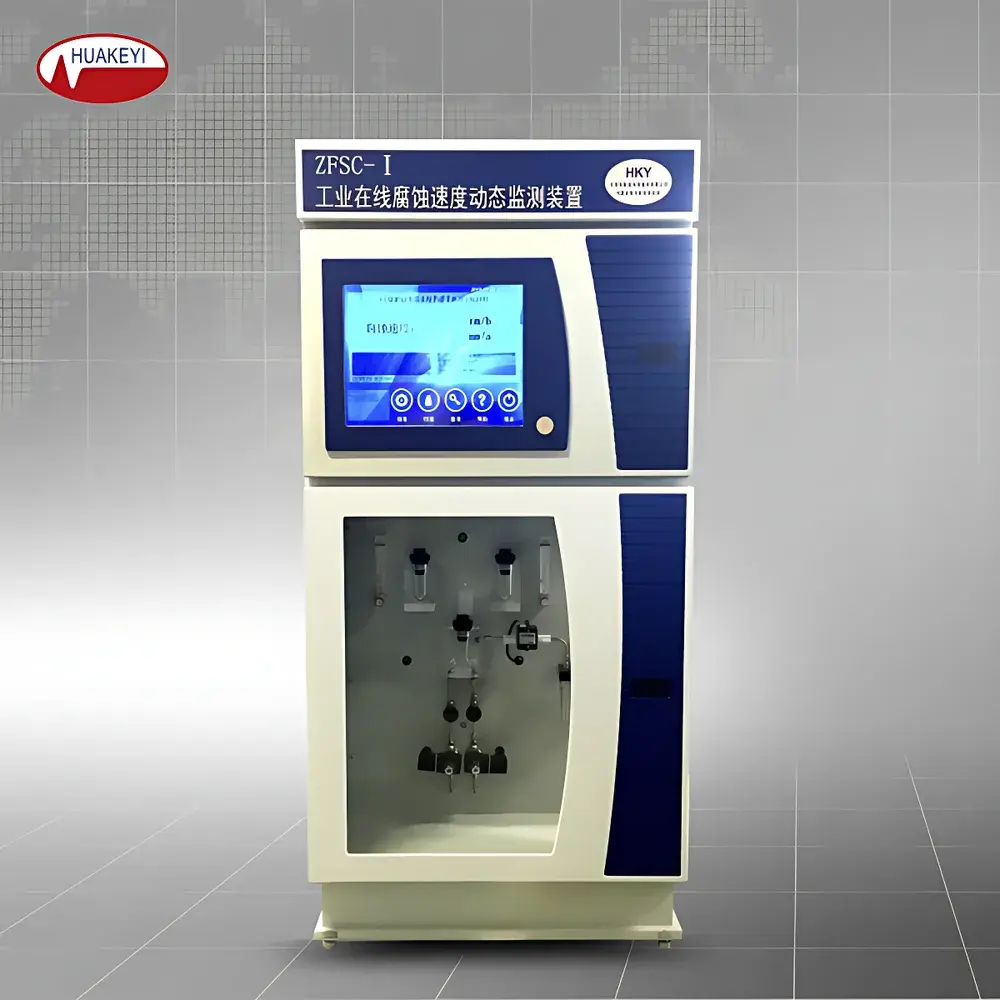
ZFSC-I Industrial Online Corrosion Rate Dynamic Monitoring System
| Brand | Huake Instrument |
|---|---|
| Origin | Beijing, China |
| Manufacturer Type | Authorized Distributor |
| Country of Origin | China |
| Model | ZFSC-I |
| Price Range | USD 70,000–100,000 (FOB) |
| Instrument Type | Online Water Quality Analyzer |
| Measured Parameter | Dissolved Hydrogen |
| Display Resolution | 0.01 µg/L |
| Measurement Range | 0–10 µg/L and 0–100 µg/L |
| Accuracy | ±3% FS or ±0.5 µg/L (whichever is greater) |
| Response Time (T90) | 5 s |
| Temperature Compensation Range | 5.0–45.0 °C (manual/automatic) |
| Sample Temp. Range | 5.0–45.0 °C |
| Flow Rate | 50–350 mL/min |
| Max. Suspended Particle Size | ≤5 µm (no colloids or oils) |
| Ambient Temp. | 5.0–45.0 °C |
| Humidity | ≤90% RH (non-condensing) |
| Power Supply | AC 100–240 V, 50–60 Hz |
| Max. Power Consumption | ≤500 W |
| Insulation Strength | 1500 VAC for 1 min |
Overview
The ZFSC-I Industrial Online Corrosion Rate Dynamic Monitoring System is an engineered solution for real-time, in-situ assessment of corrosion kinetics in high-parameter thermal power plant water-steam cycles. It operates on the electrochemical principle that dissolved hydrogen (H₂(aq)) concentration serves as a sensitive, quantitative indicator of ongoing hydrogen evolution reactions occurring at metal surfaces—particularly carbon steel and low-alloy boiler tubing under reducing, high-purity water conditions. By continuously measuring dissolved hydrogen at sub-ppb resolution and applying empirically validated temperature-normalized conversion algorithms, the system calculates instantaneous corrosion rate (typically expressed in mm/year or mpy), enabling predictive maintenance and early detection of localized corrosion mechanisms such as flow-accelerated corrosion (FAC) and hydrogen-induced cracking (HIC). Designed for integration into ASME Section I-compliant feedwater and boiler circulation loops, the ZFSC-I meets functional safety requirements for continuous monitoring in Class I, Division 1 hazardous locations when installed with appropriate enclosures.
Key Features
- Industrial-grade embedded PC with 12.1-inch resistive touch panel (1280 × 768 resolution), supporting full Chinese UI and configurable alarm thresholds;
- Dual-channel sampling architecture with alternating measurement mode to ensure redundancy and minimize downtime during calibration or sensor maintenance;
- Integrated thermal protection circuitry: automatically isolates sample lines and triggers bypass flow if inlet water temperature exceeds 45.0 °C, preventing membrane damage to the amperometric H₂ sensor;
- Multi-mode calibration support—including standard addition, span calibration with certified NIST-traceable H₂ standards, and zero-point verification using nitrogen-purged deionized water;
- Automatic temperature normalization: all dissolved H₂ readings and derived corrosion rates are mathematically corrected to 25 °C reference conditions per ASTM D867-22 Annex A1 guidelines;
- Comprehensive environmental compensation: simultaneous measurement of sample temperature (±0.5 °C), ambient pressure (0–115 kPa, ±1.5% FS), and relative humidity ensures metrological traceability across seasonal operational shifts.
Sample Compatibility & Compliance
The ZFSC-I is qualified for use with ultra-pure water streams meeting ASTM D1193 Type I specifications. Sample acceptance criteria include: suspended solids ≤5 µm (measured by laser diffraction per ISO 13320), absence of colloidal silica or organic emulsions, and free of hydrocarbon contamination—conditions routinely verified during pre-installation commissioning per IAPWS TR-02. The system complies with electromagnetic compatibility requirements per IEC 61326-1 (industrial environment), electrical safety per IEC 61010-1, and supports audit-ready data integrity through configurable event logging. While not inherently 21 CFR Part 11 compliant, its RS485/RS232 and 4–20 mA outputs integrate seamlessly with DCS platforms operating under GAMP 5-aligned validation protocols for power generation QA/QC systems.
Software & Data Management
Built-in firmware enables local data storage (≥30 days at 1-min intervals) with timestamped records of dissolved H₂, calculated corrosion rate, temperature, pressure, and system status flags. All analog and digital outputs (four programmable 4–20 mA channels, four 0–10 V outputs, dual serial ports) support Modbus RTU and ASCII protocols for interoperability with Siemens Desigo, Honeywell Experion PKS, and Emerson DeltaV control systems. Optional cloud gateway module provides TLS 1.2-encrypted MQTT transmission to secure enterprise SCADA dashboards, with configurable retention policies aligned with ISO/IEC 27001 information security controls. Audit trails record all configuration changes, calibration events, and user logins—supporting GLP-aligned documentation for regulatory inspections.
Applications
- Real-time FAC monitoring in economizer, drum, and superheater feedwater circuits of subcritical and supercritical coal-fired units;
- Early-stage detection of steam generator tube degradation in nuclear PWR secondary loops;
- Corrosion performance benchmarking during chemistry optimization trials (e.g., AVT(R) vs. OT treatment regimes);
- Validation of passivation effectiveness following acid cleaning or online chelant treatments;
- Integration into plant-wide corrosion management systems (CMS) per EPRI TR-102543 recommendations;
- Supporting root cause analysis during post-event forensic investigations of tube leaks or burst failures.
FAQ
How does the ZFSC-I convert dissolved hydrogen concentration to corrosion rate?
It applies a physics-based empirical correlation derived from Faraday’s law and electrode kinetic models, calibrated against weight-loss coupons and electrochemical noise measurements under representative flow and temperature conditions. Conversion assumes uniform dissolution of Fe → Fe²⁺ + 2e⁻ with concurrent 2H⁺ + 2e⁻ → H₂(g), adjusted for local pH and oxygen fugacity.
Is the system suitable for seawater-cooled condensate systems?
No. The ZFSC-I is designed exclusively for high-purity, low-conductivity (<0.2 µS/cm) boiler feedwater and steam condensate. Chloride interference and electrode poisoning render it unsuitable for marine or industrial cooling water applications.
What maintenance intervals are recommended for the H₂ sensor?
Electrode membrane replacement every 12 months; electrolyte refill every 6 months; quarterly zero/span verification using certified standards; annual full system metrological verification per ISO/IEC 17025-accredited lab procedures.
Can the ZFSC-I interface with existing DCS historian databases?
Yes—via native Modbus RTU over RS485 or OPC UA via optional gateway. Tag mapping, polling intervals, and data formatting are fully configurable through the onboard engineering menu.
Does the instrument meet ASME PTC 19.11 requirements for online corrosion monitoring?
While ASME PTC 19.11 does not certify individual instruments, the ZFSC-I satisfies all referenced metrological, installation, and data reporting criteria for “continuous corrosion rate indicators” defined in Clause 5.3.2 and Annex B of the latest revision (2022).







