
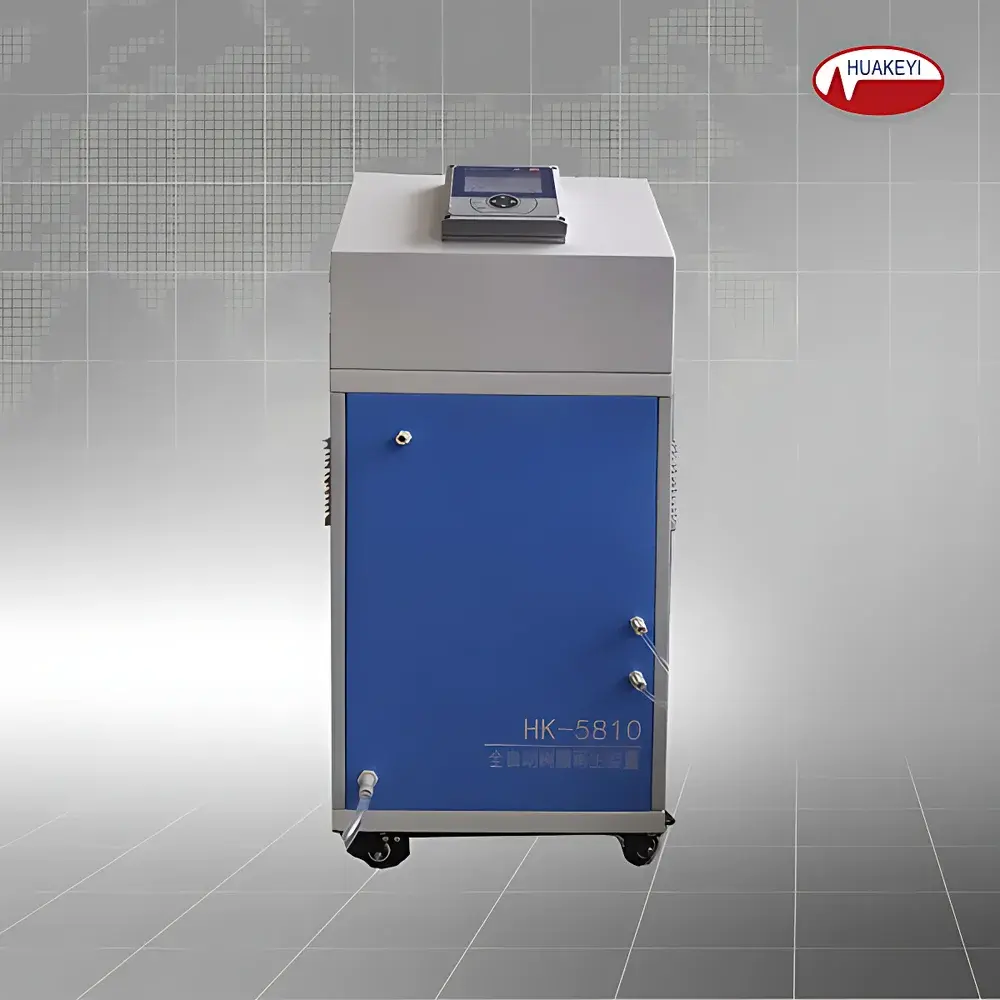
Huakeyi HK-5810 Fully Automated Cation Exchange Resin Regeneration System
| Brand | Huakeyi |
|---|---|
| Origin | Beijing, China |
| Manufacturer Type | Authorized Distributor |
| Origin Category | Domestic (China) |
| Model | HK-5810 |
| Price Range | USD 14,000 – 70,000 |
| Sample Processing | Waste Water Treatment |
| Regeneration Capacity | 8–20 L per cycle |
| Regeneration Efficiency | ≥98% for virgin cation resin |
| Acid Consumption (5% HCl) | ≤60 L/cycle |
| Rinse Water Consumption | ≤120 L/cycle |
| Cycle Time | ~3 hours |
| Construction Materials | Stainless steel frame, transparent organic glass columns, PVC piping |
| Operating Temperature | 5–40 °C |
| Power Supply | AC 200–220 V |
| Dimensions (L×W×H) | 660 × 570 × 1480 mm |
| Weight | 100 kg |
Overview
The Huakeyi HK-5810 Fully Automated Cation Exchange Resin Regeneration System is an engineered solution designed specifically for the restoration of exhausted strong-acid cation exchange resins used in high-purity water monitoring applications—particularly in power generation facilities where hydrogen conductivity measurement demands ultra-low ionic contamination. Based on counter-current regeneration principles, the system implements a precisely sequenced chemical regeneration process using hydrochloric acid (5% w/w), followed by thorough displacement rinsing and neutralization of residual effluent. Its architecture integrates flow-controlled reagent delivery, real-time conductivity and pH monitoring, and fail-safe electromagnetic valve actuation to ensure reproducible regeneration outcomes aligned with industry requirements for analytical-grade water quality assurance.
Key Features
- Counter-current regeneration design achieves ≥98% regeneration efficiency for virgin or moderately exhausted cation resins, significantly extending resin service life and maintaining consistent ion exchange capacity.
- Programmable logic controller (PLC)-based automation governs all operational phases—including acid dosing, slow rinse, fast rinse, and neutralization—with adjustable timing and flow parameters to accommodate varying resin bed volumes (8–20 L per cycle).
- Integrated online instrumentation—conductivity and pH sensors—provides continuous feedback during regeneration, enabling endpoint detection and verification of rinse completion prior to resin reuse.
- All fluid-contact components—including regeneration columns, metering tanks, and waste collection vessels—are constructed from corrosion-resistant materials: transparent organic glass (PMMA) for visual process monitoring, PVC for tubing, and stainless steel (304 grade) for structural framing and mounting hardware.
- Acid dosing accuracy is maintained via calibrated diaphragm metering pumps with ±2% volumetric repeatability; rinse distribution ensures zero dead-leg zones, eliminating channeling and incomplete resin bed flushing.
- Neutralized effluent discharge complies with local environmental regulations for acidic wastewater; integrated pH adjustment loop uses NaOH solution to bring final waste stream pH to 6.5–8.5 before release.
- Compact, wheeled mobile chassis allows deployment in laboratory, chemistry shop, or on-site turbine hall environments without permanent installation.
Sample Compatibility & Compliance
The HK-5810 is validated for use with standard gel-type and macroporous sulfonated polystyrene-based strong-acid cation exchange resins (e.g., Dowex HCR-S, Amberlite IR-120, Purolite C100). It supports both single-bed and mixed-bed resin configurations when regeneration is performed ex-situ. The system adheres to general safety standards for low-pressure chemical handling equipment (IEC 61000-6-2/6-4 for EMC; GB/T 3797–2016 for industrial control cabinets). While not certified to ISO/IEC 17025 or ASTM D4582 (Standard Practice for Regeneration of Ion Exchange Resins), its operational protocol aligns with best practices referenced in EPRI TR-102513 and IEEE Std 117–2022 for power plant water chemistry management. All electrical components meet IP54 ingress protection rating for indoor industrial use.
Software & Data Management
The onboard PLC records timestamped event logs—including acid injection volume, rinse durations, conductivity/pH trends, and valve actuation sequences—for each regeneration cycle. Data export is supported via USB interface in CSV format for offline analysis. Audit trail functionality includes operator ID entry (via keypad), cycle start/stop confirmation, and error code logging—meeting basic GLP documentation expectations. Optional RS-485 Modbus RTU output enables integration into central SCADA or CMMS platforms for fleet-level maintenance tracking. No cloud connectivity or FDA 21 CFR Part 11-compliant electronic signature module is included in the base configuration.
Applications
- Regeneration of cation exchange cartridges used in online hydrogen conductivity analyzers (e.g., in main steam, condensate, and feedwater circuits of fossil and nuclear power plants).
- Restoration of laboratory-scale ion exchange columns employed in ultrapure water (UPW) qualification testing per ASTM D5127 and IEC 60404-8-15.
- Supporting routine QA/QC workflows in thermal power station chemistry labs where daily resin turnover is required to maintain measurement integrity.
- Field-service deployment for emergency resin recovery during unplanned outage scenarios, minimizing downtime of critical water purity monitoring systems.
- Educational use in university chemical engineering laboratories to demonstrate ion exchange kinetics, mass transfer limitations, and regeneration stoichiometry under controlled conditions.
FAQ
What types of cation resins are compatible with the HK-5810?
The system is optimized for strong-acid gel and macroreticular sulfonic acid resins with standard crosslinking (8–12% DVB); it is not intended for weak-acid or chelating resins.
Can the HK-5810 regenerate mixed-bed resins?
No—mixed-bed resins require separation prior to cation regeneration; the HK-5810 is designed exclusively for cation-only beds.
Is remote monitoring or Ethernet connectivity available?
Standard configuration includes only local HMI and USB data export; optional RS-485 Modbus RTU interface supports third-party SCADA integration.
What maintenance intervals are recommended for the metering pump and valves?
Diaphragm pumps require diaphragm replacement every 12 months under typical usage; solenoid valves should be inspected quarterly for seal integrity and response time.
Does the system include acid concentration verification capability?
No built-in titration or density measurement is provided; users must pre-prepare and verify 5% HCl solutions prior to loading into the metering tank.



