
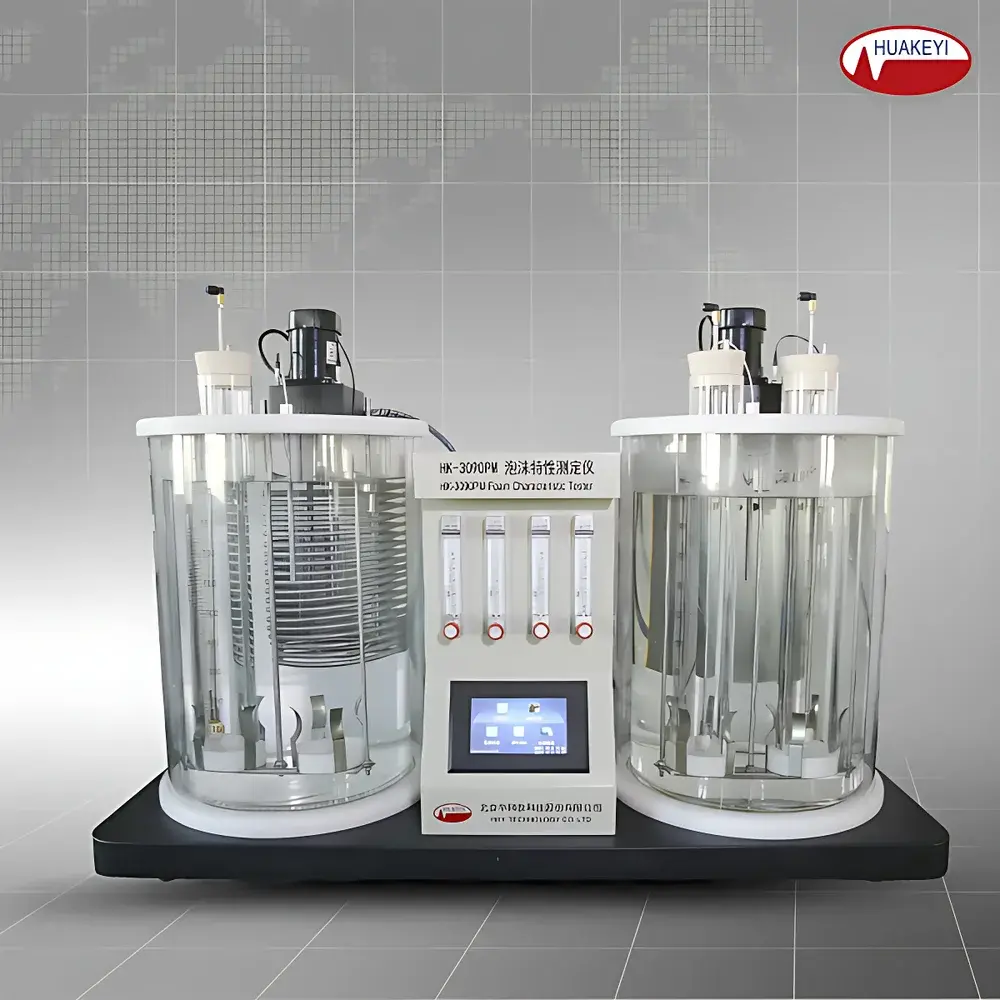
Huake Instrument HK-3090PM Foam Characterization Analyzer
| Brand | Huake Instrument |
|---|---|
| Origin | Beijing, China |
| Manufacturer Type | Authorized Distributor |
| Origin Category | Domestic (China) |
| Model | HK-3090PM |
| Price Range | USD 2,800 – 7,000 |
| Display | 800×480 Color TFT Touchscreen (Bilingual: Chinese/English) |
| Sample Positions | 4 |
| Temperature Control Range | Ambient to 100 °C |
| Temperature Stability | ±0.5 °C |
| Built-in Air Source | ≥400 mL/min |
| Gas Diffuser Permeability | 3000–6000 mL/min at 2.4 kPa (250 mmH₂O) |
| Heating Power | ≤2500 W |
| Cylinder Specification | 1000 mL (Dedicated Calibration Cylinder) |
| Power Supply Options | AC 220 V / 50–60 Hz |
| Dimensions (L×W×H) | 991 mm × 422 mm × 710 mm |
| Net Weight | ≤50 kg (dry) |
| Operating Environment | 10–35 °C, ≤93% RH (non-condensing), vibration-free, non-corrosive atmosphere, minimal electromagnetic interference |
Overview
The Huake Instrument HK-3090PM Foam Characterization Analyzer is a precision-engineered instrument designed in strict accordance with GB/T 12579–2002, the Chinese national standard equivalent to ASTM D892 and ISO 6295 for determining foam characteristics of lubricating oils. It quantifies two critical parameters: foam tendency (FT) — the volume of foam generated under standardized aeration conditions — and foam stability (FS) — the residual foam volume after a defined drainage period. The system operates on the principle of controlled air sparging through a calibrated gas diffuser into a precisely temperature-regulated oil sample within a 1000 mL graduated cylinder. Foam height is measured visually or via optional optical sensors, while thermal management ensures repeatability across test cycles. This methodology is essential for evaluating the performance of engine oils, gear oils, hydraulic fluids, and turbine oils where excessive foaming compromises hydrodynamic film formation, promotes oxidation, induces cavitation in pumps, and risks overflow from reservoirs — all leading to accelerated wear and system failure.
Key Features
- Four independent sample positions enable parallel testing of up to four lubricants or replicates per run, significantly improving laboratory throughput and statistical robustness.
- High-resolution 800×480 color TFT touchscreen with bilingual (Chinese/English) interface supports intuitive navigation, real-time parameter monitoring, and direct access to calibration menus and test protocols.
- PID-based intelligent temperature control delivers rapid thermal equilibration and maintains setpoint stability within ±0.5 °C across the full 0–100 °C operating range — critical for simulating service conditions in engines and gearboxes.
- Integrated digital electronic timer provides millisecond-accurate aeration and drainage timing, synchronized with visual observation or automated image capture systems.
- Auto-level detection with dry-run protection and audible/visual alarms prevents heater damage and ensures operator safety during low-fluid conditions.
- Built-in air supply (>400 mL/min) eliminates dependency on external compressors; gas diffuser meets permeability specifications (3000–6000 mL/min at 2.4 kPa), ensuring consistent bubble size distribution and interfacial energy input.
- USB port enables firmware updates, data export, and integration with LIMS or lab-wide QA/QC documentation workflows.
Sample Compatibility & Compliance
The HK-3090PM is validated for use with mineral-, synthetic-, and semi-synthetic-based lubricants, including API SP, CK-4, and ISO VG 32–460 grades. It supports routine QC testing in refinery labs, OEM lubricant development facilities, and third-party certification bodies. Its design complies with the procedural requirements of GB/T 12579–2002, ASTM D892 (Method A), and ISO 6295, and its temperature control architecture satisfies the thermal accuracy stipulations of ISO/IEC 17025:2017 Clause 6.4.1 for equipment used in accredited testing. When operated under documented SOPs with traceable calibration records (e.g., NIST-traceable RTDs), data generated are admissible for GLP-compliant reporting and internal GMP audits.
Software & Data Management
While the HK-3090PM operates as a standalone instrument with embedded firmware, its USB interface facilitates structured export of test logs (CSV format) containing timestamp, set temperature, actual temperature, FT/FS values, operator ID, and cylinder identification. Exported files retain metadata required for 21 CFR Part 11–aligned environments when paired with validated laboratory software (e.g., LabWare LIMS or custom Python-based QA dashboards). Firmware versioning, audit trails for parameter changes, and password-protected configuration modes support regulatory readiness. Optional RS-232 or Ethernet modules (available upon request) extend compatibility with centralized instrument management platforms.
Applications
- Evaluation of antifoam additive efficacy in formulated engine oils under elevated temperature conditions.
- Comparative assessment of foam behavior between conventional and bio-based hydraulic fluids in wind turbine gearboxes.
- Quality release testing of turbine oils prior to commissioning in power generation units.
- Root-cause analysis of field-reported lubrication failures linked to foaming-induced loss of oil film integrity.
- Research into surfactant–oil interactions affecting interfacial rheology and lamella drainage kinetics.
- Validation of re-refined base oil compatibility with commercial additive packages.
FAQ
What standards does the HK-3090PM comply with?
It conforms to GB/T 12579–2002, and its operational methodology aligns with ASTM D892 (Method A) and ISO 6295 for foam tendency and stability measurement.
Can the instrument operate at 120 V / 60 Hz?
Yes — power supply configuration is selected at time of order; options include AC 120 V / 60 Hz, AC 220 V / 50–60 Hz, or AC 240 V / 50 Hz.
Is the 1000 mL cylinder included and calibrated?
Four dedicated 1000 mL graduated cylinders are supplied as standard; they are manufactured to Class B volumetric tolerance per ISO 4787 and marked with individual serial numbers for traceability.
Does the system support automated foam height measurement?
The base configuration relies on manual visual reading per standard; however, optical sensor retrofit kits and image-analysis software modules are available as factory-installed options.
What maintenance is required for the gas diffuser?
Diffusers should be cleaned ultrasonically in solvent (e.g., n-hexane) after every 20 tests or when airflow deviation exceeds ±5% of nominal value; replacement diffusers are supplied with certified permeability certificates.



