
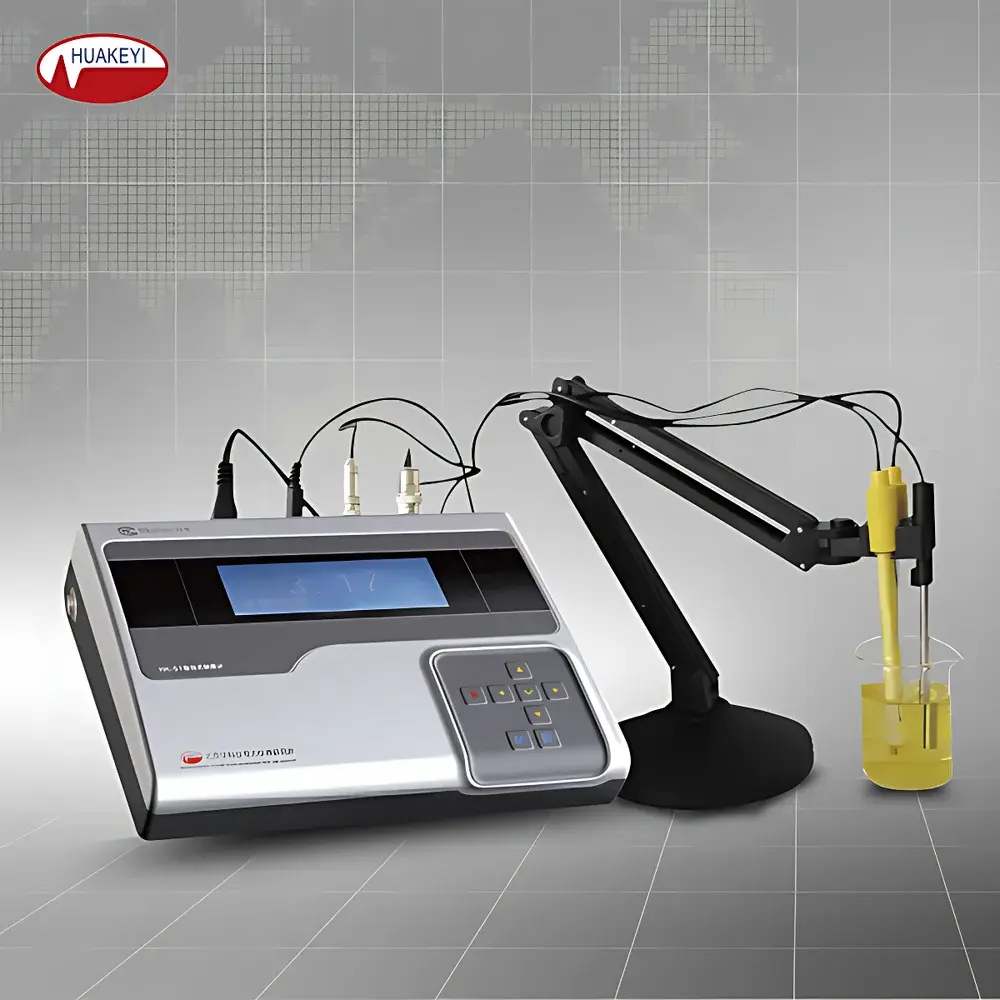
HK-51 Desktop Sodium Ion Analyzer
| Brand | Huake Instrument |
|---|---|
| Origin | Beijing, China |
| Manufacturer Type | Authorized Distributor |
| Product Category | Domestic |
| Model | HK-51 |
| Price Range | USD 700–1,400 (FOB) |
| Instrument Type | Sodium Ion-Specific Analyzer |
| Form Factor | Benchtop |
| Measurement Range | (1.00–8.00) pNa, equivalent to 0.23 µg/L–2.30 g/L Na⁺ |
| Detection Limit | ±0.03 pNa or ±5 µg/L (whichever is greater) |
| Response Time (T₉₀) | 2 min at 25 °C |
| Temperature Compensation | Automatic or Manual (0.1–60.0 °C) |
| Temperature Measurement Range | (0.0–99.9) °C |
| Temperature Accuracy | ±0.5 °C |
| Display | 192×64 dot-matrix LCD (English/Chinese selectable) |
| Resolution | 0.01 pNa / 0.01 µg/L |
| Electronic Unit Error | ±0.01 pNa or ±1 digit |
| Stability | ±0.01 pNa / 4 h |
| Input Impedance | ≥1×10¹² Ω |
| Power Supply | AC 100–240 V, 50–60 Hz |
| Power Consumption | 3 W |
| Dimensions | 270 × 200 × 65 mm (L×W×H) |
| Weight | 2 kg |
Overview
The HK-51 Desktop Sodium Ion Analyzer is a precision benchtop instrument engineered for trace-level sodium ion (Na⁺) quantification in ultra-pure and low-conductivity water matrices. It operates on the potentiometric principle using a selective sodium ion electrode coupled with a reference electrode and integrated Pt1000 temperature sensor. The system employs a high-input-impedance amplifier (>1×10¹² Ω) to ensure stable signal acquisition from the ion-selective membrane, minimizing polarization errors and drift—critical for measuring sub-ppb sodium concentrations in power plant steam condensate, boiler feedwater, and nuclear-grade demineralized water. Designed for compliance with ASTM D4582–21 (Standard Practice for Determination of Sodium in High-Purity Water) and aligned with IEC 62304 software lifecycle requirements for medical and industrial analyzers, the HK-51 delivers reproducible pNa measurements across its full operational range of 1.00–8.00 pNa (0.23 µg/L–2.30 g/L), with T₉₀ response ≤2 minutes at 25 °C.
Key Features
- 32-bit embedded microcontroller architecture with real-time auto-stabilization algorithm for endpoint detection during calibration and measurement
- Integrated dual-mode temperature compensation (automatic Pt1000 sensing or manual input) across 0.1–60.0 °C, supporting accurate conversion of millivolt readings to pNa values per Nernst equation
- Sealed, IP65-rated reinforced plastic housing with full silicone membrane keypad—designed for humid laboratory and control room environments
- Dual-display mode: English or Chinese interface selectable via firmware; simultaneous presentation of pNa, µg/L, temperature, and electrode status
- Intelligent electrode diagnostics including impedance monitoring and slope validation during calibration (single-point or two-point)
- Low-power design (3 W typical) compliant with IEC 62368-1 safety standards for laboratory equipment
Sample Compatibility & Compliance
The HK-51 is optimized for aqueous samples with conductivity <1 µS/cm and total dissolved solids <10 ppb—typical of turbine condensate, deaerator outlet water, and semiconductor rinse water. It accommodates sample temperatures between 5–60 °C and requires no chemical conditioning (e.g., alkalizing agents) for routine operation. Electrode configuration includes a solid-state sodium-selective electrode, double-junction Ag/AgCl reference electrode with KNO₃ filling solution, and integrated Pt1000 thermistor. The analyzer meets functional requirements outlined in ISO 17025 for calibration traceability when used with certified pNa standard solutions (e.g., NIST-traceable Na⁺ standards). Its measurement uncertainty budget conforms to GUM (JCGM 100:2008) guidelines, with combined standard uncertainty ≤±0.03 pNa under controlled lab conditions.
Software & Data Management
The HK-51 features embedded firmware with non-volatile memory storing up to 200 measurement records, including timestamp, pNa value, temperature, electrode slope (%), and calibration history. Data export is supported via USB interface (no proprietary drivers required) in CSV format for integration into LIMS or QA/QC reporting systems. Calibration logs include audit trail metadata (operator ID, date/time, standard lot number), satisfying basic GLP documentation needs. While not FDA 21 CFR Part 11-compliant out-of-the-box, the device supports manual record verification protocols compatible with ISO/IEC 17025-accredited laboratories conducting internal quality audits.
Applications
- Power generation: Continuous monitoring of sodium breakthrough in mixed-bed ion exchange effluent and turbine cycle chemistry control
- Semiconductor manufacturing: Verification of sodium contamination in ultrapure water (UPW) distribution loops per SEMI F63 standards
- Pharmaceutical water systems: Support for purified water (PW) and water for injection (WFI) sodium specification checks per USP
- Research laboratories: Kinetic studies of sodium leaching from glassware or membrane materials in low-ionic-strength media
- Environmental testing labs: Quantification of Na⁺ in rainwater, snowmelt, and groundwater where chloride interference is minimized via electrode selectivity
FAQ
What is the minimum detectable sodium concentration for the HK-51?
The instrument achieves a practical lower limit of quantitation (LLOQ) of 0.23 µg/L (1.00 pNa) under optimal conditions—requiring clean electrodes, temperature-stabilized samples, and use of low-sodium rinse water (≤0.1 µg/L background).
Can the HK-51 measure sodium in seawater or brine?
No. The sodium-selective electrode exhibits significant interference from high concentrations of K⁺, Ca²⁺, and Mg²⁺, and the measurement range is intentionally limited to support ultra-trace analysis—not high-ionic-strength matrices.
Is electrode calibration traceable to national standards?
Yes. When calibrated using NIST-traceable pNa standard solutions (e.g., 2.00 pNa and 5.00 pNa), measurement results maintain metrological traceability to SI units through documented chain-of-custody and certificate of analysis.
Does the HK-51 support automatic data logging to a network server?
No. It provides local storage and USB dump functionality only. For networked deployment, integration requires external data acquisition hardware or middleware-compatible SCADA interfaces.
What maintenance is required for long-term stability?
Monthly electrode reconditioning using provided activation solution, quarterly verification of temperature sensor accuracy against a calibrated thermometer, and annual firmware update (if released) are recommended to sustain ±0.03 pNa performance specification.







