
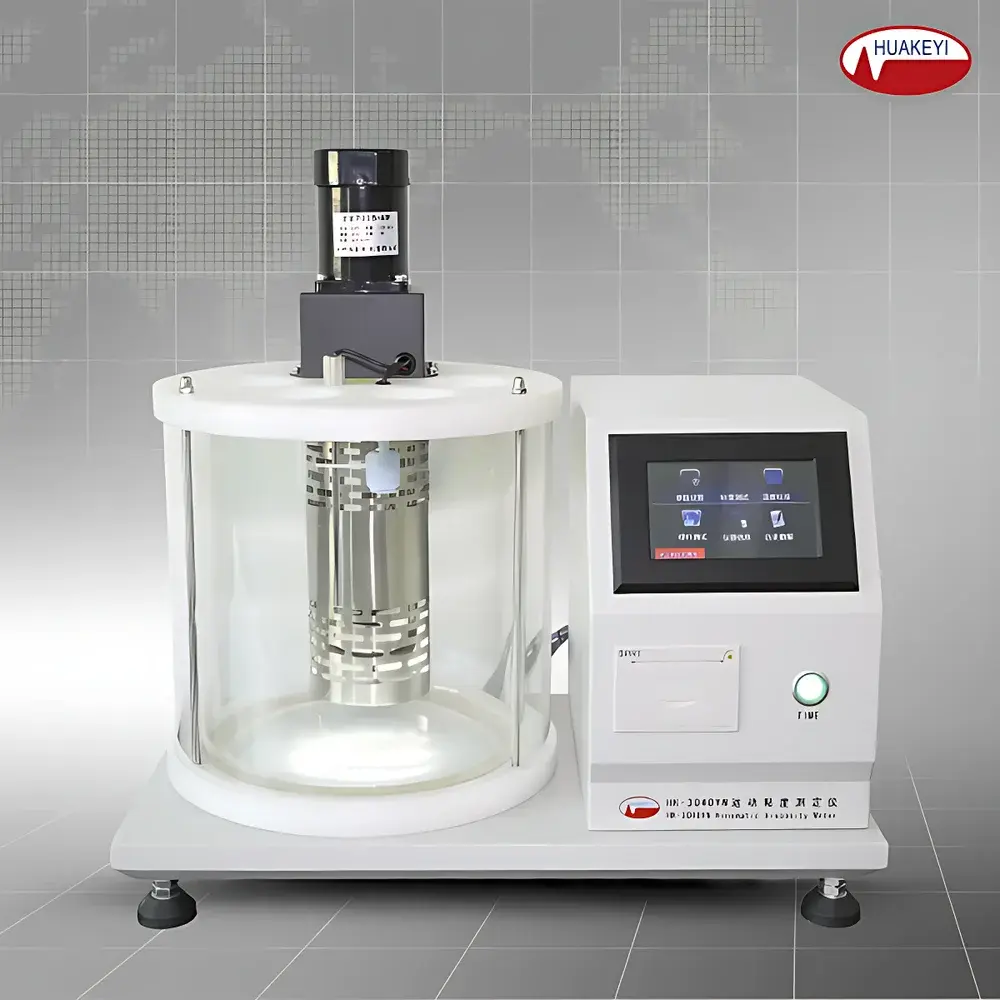
Huake Instrument HK-3040YN Kinematic Viscosity Tester
| Brand | Huake Instrument |
|---|---|
| Origin | Beijing, China |
| Manufacturer Type | Authorized Distributor |
| Country of Origin | China |
| Model | HK-3040YN |
| Price Range | USD 1,400 – 4,200 |
| Temperature Control Range | Ambient to 100 °C |
| Temperature Stability | ±0.1 °C |
| Bath Configuration | Dual-layer cylindrical stainless-steel bath |
| Number of Test Positions | 4 |
| Stirring Speed | 1250 rpm |
| Heating Power | Main heater 800 W + Auxiliary heater 300 W |
| Capillary Mounting Capacity | 2 capillaries simultaneously |
| Capillary Sizes Supplied | 0.8 mm, 1.0 mm, 1.2 mm, and 1.5 mm nominal bore |
| Data Storage | Up to 1000 test records with date/time stamping |
| Interface Options | Ethernet and USB 2.0 |
| Display | Color LCD touchscreen with bilingual (Chinese/English) UI |
| Built-in Thermal Printer | Yes, auto/manual print mode |
| Power Supply | AC 198–242 V, 50–60 Hz or AC 120 V ±10%, 60 Hz ±1 Hz (configurable at order) |
| Dimensions (W×D×H) | 400 × 450 × 650 mm |
| Net Weight | 25 kg |
| Operating Environment | 0–40 °C, RH ≤85%, non-corrosive, low-vibration, EMI/EMF-shielded ambient |
Overview
The Huake Instrument HK-3040YN Kinematic Viscosity Tester is a precision-engineered instrument designed for the standardized determination of kinematic viscosity in Newtonian liquid petroleum products, in strict compliance with GB/T 265–1988 — the Chinese national standard equivalent to ASTM D445 and ISO 3104. It operates on the capillary viscometer principle: a fixed-volume sample is drawn into a calibrated glass capillary tube under gravity, and the efflux time is measured as the fluid flows between two marked points. Kinematic viscosity (ν, in mm²/s or cSt) is calculated using the formula ν = C × t, where C is the capillary constant (determined via calibration with certified reference oils) and t is the measured flow time. The instrument integrates a thermostatically controlled dual-layer stainless-steel bath, high-stability temperature regulation via PWM-driven SSR (solid-state relay) control, and real-time liquid-level sensing to prevent dry-burn operation — ensuring repeatability and long-term reliability in routine QC laboratories.
Key Features
- Dual-layer cylindrical bath with uniform axial/radial temperature distribution, engineered for minimal thermal gradient (<±0.05 °C across 4 test positions)
- Intelligent dual-heater architecture: primary 800 W heater for rapid ramp-up; auxiliary 300 W heater for fine-tuning and drift compensation
- Non-contact liquid-level detection with audible/visual alarm — performed automatically at power-on and before each test cycle
- Stainless-steel internal components including heating elements, baffle sleeve, and impeller assembly — resistant to hydrocarbon degradation and thermal oxidation
- High-luminance LED bottom illumination (6500 K CCT) enabling clear visual observation of meniscus transit without UV exposure or heat emission
- 7-inch color TFT-LCD touchscreen with intuitive menu navigation, bilingual (English/Chinese) interface, and context-sensitive prompts
- Integrated thermal printer supporting automatic result output per test or batch summary reports; configurable print format includes sample ID, capillary ID, efflux time, bath temperature, and calculated ν value
- Dual communication interfaces: isolated Ethernet port (supporting Modbus TCP and HTTP-based remote status polling) and USB 2.0 host/device mode for firmware updates and data export
Sample Compatibility & Compliance
The HK-3040YN accommodates standard Ubbelohde-type capillaries (including sizes 0.8, 1.0, 1.2, and 1.5 mm nominal bore), allowing viscosity measurement across a broad dynamic range — from light naphthas (~0.2 cSt) to heavy fuel oils (~150 cSt) — provided samples remain Newtonian under test conditions. Each test position supports independent timing with microsecond-resolution quartz timers. The system meets mechanical and thermal requirements stipulated in GB/T 265–1988, ASTM D445–22, and ISO 3104:2022. Its hardware architecture and embedded firmware support audit-ready operation: all test records are timestamped, immutable upon storage, and include operator ID (if configured), environmental temperature/humidity logs (via optional external sensor input), and full traceability of calibration constants. For regulated environments, the instrument can be validated per IQ/OQ protocols and operated under GLP-compliant workflows with user-access controls and electronic signature capability (enabled via optional software license).
Software & Data Management
Data handling is implemented through an embedded Linux-based RTOS with deterministic I/O scheduling. Up to 1000 test records are retained in non-volatile flash memory, indexed by ISO 8601 timestamp and searchable by date range, capillary ID, or operator tag. Export options include CSV over USB mass-storage mode or Ethernet FTP/SFTP — compatible with LIMS integration (e.g., Thermo Fisher SampleManager, LabVantage). Audit trails log all critical events: power cycles, parameter changes, calibration updates, and print actions. Firmware supports secure remote diagnostics via SSH (disabled by default); all network services adhere to IEC 62443-3-3 SL2 baseline security requirements. Optional PC software (HK-DataLink v3.x) provides graphical trend analysis, statistical process control (SPC) charts (X̄/R, Cpk), and automated report generation compliant with ISO/IEC 17025 documentation standards.
Applications
- Quality control of lubricating oils, transformer oils, hydraulic fluids, and jet fuels in refinery and power-generation facilities
- Batch release testing of base oils and finished formulations per ASTM D445 and GB/T 265 specifications
- Routine monitoring of used oil analysis (UOA) programs to detect thermal degradation or contamination-induced viscosity shifts
- Research and development of novel synthetic esters and polyalphaolefins (PAOs) requiring high-precision kinematic viscosity profiling
- Third-party certification laboratories performing accredited testing to CNAS-CL01 (equivalent to ISO/IEC 17025)
- Academic teaching labs demonstrating fundamental rheological principles and standardization methodology
FAQ
What capillary viscometers are compatible with the HK-3040YN?
The instrument accepts standard Ubbelohde-type capillaries with nominal bore diameters of 0.8 mm, 1.0 mm, 1.2 mm, and 1.5 mm — all included in the standard configuration. Custom capillaries may be mounted using the supplied adjustable holders, provided outer dimensions conform to ISO 3105 mechanical tolerances.
Does the system support calibration traceability to NIST or other national metrology institutes?
Yes — users must perform periodic calibration using certified reference oils (e.g., Cannon NIST-traceable standards). The instrument stores calibration constants per capillary ID, and all calibration events are logged with date, reference oil lot number, and technician ID.
Can test data be exported directly to Excel or LIMS without proprietary software?
Yes — CSV files generated via USB or Ethernet are plain-text, tab-delimited, and require no additional parsing tools. Column headers follow ASTM E1382 conventions for interoperability.
Is the HK-3040YN suitable for use in hazardous areas (e.g., Zone 1 or Class I Div 1)?
No — it is rated for general laboratory use only (IEC 61010-1:2010, Pollution Degree 2). Installation in classified locations requires third-party explosion-proof enclosures and associated safety certifications.
What maintenance intervals are recommended for long-term accuracy?
Daily: visual inspection of capillary cleanliness and bath fluid level. Quarterly: verification of temperature sensor accuracy using a calibrated PRT. Annually: full performance qualification (PQ) including timing accuracy, thermal stability, and printer functionality — documented per ISO/IEC 17025 Annex A.3.





