
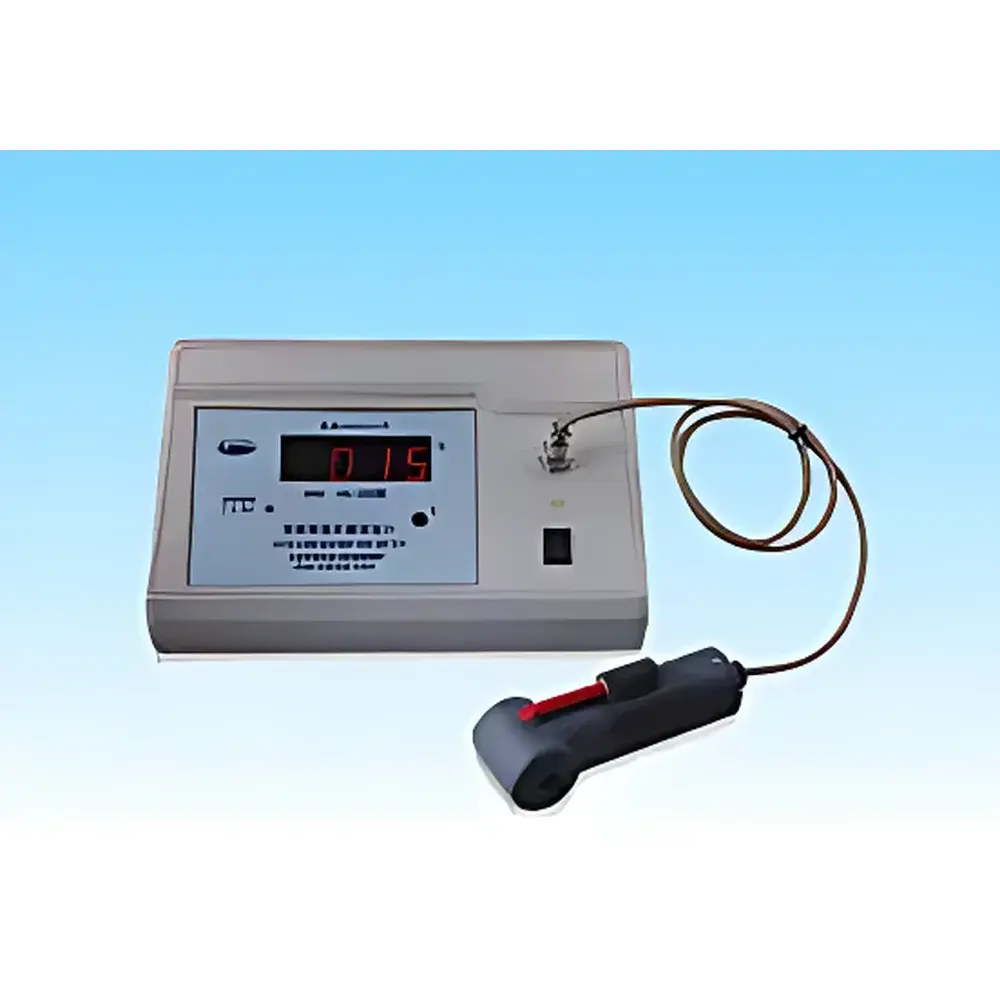
HK-268 Electromagnetic Induction Acid-Base Concentration Meter
| Brand | Huake Instrument |
|---|---|
| Origin | Beijing, China |
| Manufacturer Type | Authorized Distributor |
| Country of Origin | China |
| Model | HK-268 |
| Pricing | Available Upon Request |
| Measurement Range | NaOH: (0–5.00) wt% |
| H₂SO₄ | (0–5.00) wt% |
| HCl | (0–10.00) wt% |
| NaCl | (0–5.00) wt% or (0–10.00) wt% (custom ranges available upon request) |
| Accuracy | ±1.5% of Full Scale (F.S.) |
| Measured Media | Aqueous solutions of HCl, NaOH, H₂SO₄, NaCl (specified at order) |
| Temperature Compensation Range | 0–55 °C |
| Display | 4-digit, 0.8-inch LED |
| Power Supply | 220 V AC via external power adapter (~5 W) |
| Dimensions (L×W×H) | 350×230×120 mm |
| Weight | 1.5 kg |
| Sensor Probe | Ø39×100 mm |
| cable length | 1 m |
Overview
The HK-268 Electromagnetic Induction Acid-Base Concentration Meter is a dedicated process analytical instrument engineered for real-time, non-contact measurement of strong electrolyte concentrations in industrial water treatment and chemical manufacturing environments. Unlike conventional potentiometric or conductometric analyzers that rely on electrode-based sensing—prone to fouling, drift, and corrosion in aggressive media—the HK-268 employs Faraday’s law of electromagnetic induction to determine solution conductivity, which correlates directly with the mass concentration of ionized species (e.g., H⁺, OH⁻, Cl⁻, SO₄²⁻, Na⁺). This principle eliminates physical contact between the sensor and process fluid, thereby removing electrode polarization, chemical passivation, and surface contamination risks. The device is specifically optimized for monitoring regeneration solutions in ion exchange systems, where precise control of acid (HCl, H₂SO₄) and alkali (NaOH) dosing is critical to prevent scaling (e.g., CaSO₄ precipitation in cation exchangers) or colloidal silica deposition (e.g., SiO₂ gel formation in anion exchangers), both of which compromise resin bed integrity and cycle efficiency.
Key Features
- Non-invasive electromagnetic induction sensing technology ensures long-term stability and zero electrode maintenance in highly corrosive environments
- Dual-range NaCl measurement capability (0–5.00% and 0–10.00% w/w) supports flexible deployment across desalination, brine recovery, and rinse water monitoring applications
- Integrated temperature compensation (0–55 °C) using a built-in Pt100 RTD sensor enables accurate concentration readings across variable process temperatures
- Rugged, compact housing (350×230×120 mm; 1.5 kg) with IP65-rated front panel and chemically resistant probe body (316 stainless steel + PTFE insulation)
- High-visibility 4-digit LED display (0.8-inch digit height) with automatic backlighting for low-light control room or field installation
- Flexible power architecture: standard 220 V AC input via external switching power supply (~5 W), plus optional internal Li-ion battery for portable or backup operation (up to 3 hours)
Sample Compatibility & Compliance
The HK-268 is validated for continuous online measurement of aqueous solutions containing hydrochloric acid (HCl), sulfuric acid (H₂SO₄), sodium hydroxide (NaOH), and sodium chloride (NaCl) within specified concentration bands. It is not intended for organic solvents, non-electrolytes, or suspensions. While no formal ISO/IEC 17025 calibration certificate is included as standard, the instrument complies with general functional safety requirements for fixed industrial analyzers per IEC 61000-6-2 (EMC immunity) and IEC 61000-6-4 (EMC emissions). Its design aligns with Good Manufacturing Practice (GMP) principles for critical utility monitoring—particularly in pharmaceutical purified water (PW) and water-for-injection (WFI) loop regeneration stages—as referenced in USP and EP 2.2.38. Traceability of factory calibration is documented per internal QA procedure HK-QA-268-Rev.3.
Software & Data Management
The HK-268 operates as a standalone analog transmitter with 4–20 mA current loop output (HART-enabled option available), supporting integration into DCS, PLC, or SCADA systems without proprietary software dependencies. For data logging and trending, optional USB-to-RS485 converter kits enable connection to PC-based platforms such as LabVIEW, MATLAB, or custom CSV-export utilities. All configuration parameters—including range selection, temperature coefficient, damping time (0.1–10 s), and linearization mode—are set via front-panel keypad navigation. Audit trail functionality is not embedded; however, configuration changes are timestamped and logged externally when interfaced with HART-compatible asset management tools compliant with FDA 21 CFR Part 11 requirements.
Applications
- Regeneration solution concentration monitoring in mixed-bed and dual-bed ion exchange systems for power plant boiler feedwater purification
- In-line verification of acid/alkali dosing during resin regeneration cycles in pharmaceutical water systems (PW, WFI, pure steam condensate)
- Process control of pickling bath concentration in steel cold-rolling mills (HCl/H₂SO₄)
- Brine saturation monitoring in chlor-alkali membrane cell feed preparation
- Quality assurance of caustic soda dilution batches in chemical synthesis units
- Continuous NaCl concentration tracking in food-grade cleaning-in-place (CIP) return streams
FAQ
Does the HK-268 require periodic recalibration?
Yes—annual verification against NIST-traceable standard solutions (e.g., certified KCl conductivity standards) is recommended. Field calibration can be performed using two-point span adjustment with known concentration references.
Can the probe be inserted directly into pressurized pipelines?
No. The standard probe is designed for insertion into open tanks, overflow weirs, or low-pressure bypass streams (<0.3 MPa). High-pressure variants with ANSI flange mounting and reinforced housings are available under custom order (HK-268-HP).
Is the instrument compatible with hazardous area installations?
The base model is rated for Class I, Division 2 / Zone 2 environments when installed with appropriate barrier systems. A certified intrinsically safe version (HK-268-IS) meeting ATEX II 2G Ex ib IIB T4 Gb is available upon request.
What materials are in contact with the process fluid?
The wetted parts consist of 316 stainless steel sensor coil housing, PTFE-insulated excitation/detection windings, and a fused silica viewing window (for optional visual alignment aid). No elastomers or adhesives contact the medium.
How does temperature compensation affect accuracy?
The built-in Pt100 RTD provides real-time correction using solution-specific temperature-conductivity coefficients stored in firmware. Deviations exceeding ±1.5% F.S. may occur if the actual solution composition differs significantly from calibration matrix assumptions (e.g., mixed-acid streams without prior characterization).




