
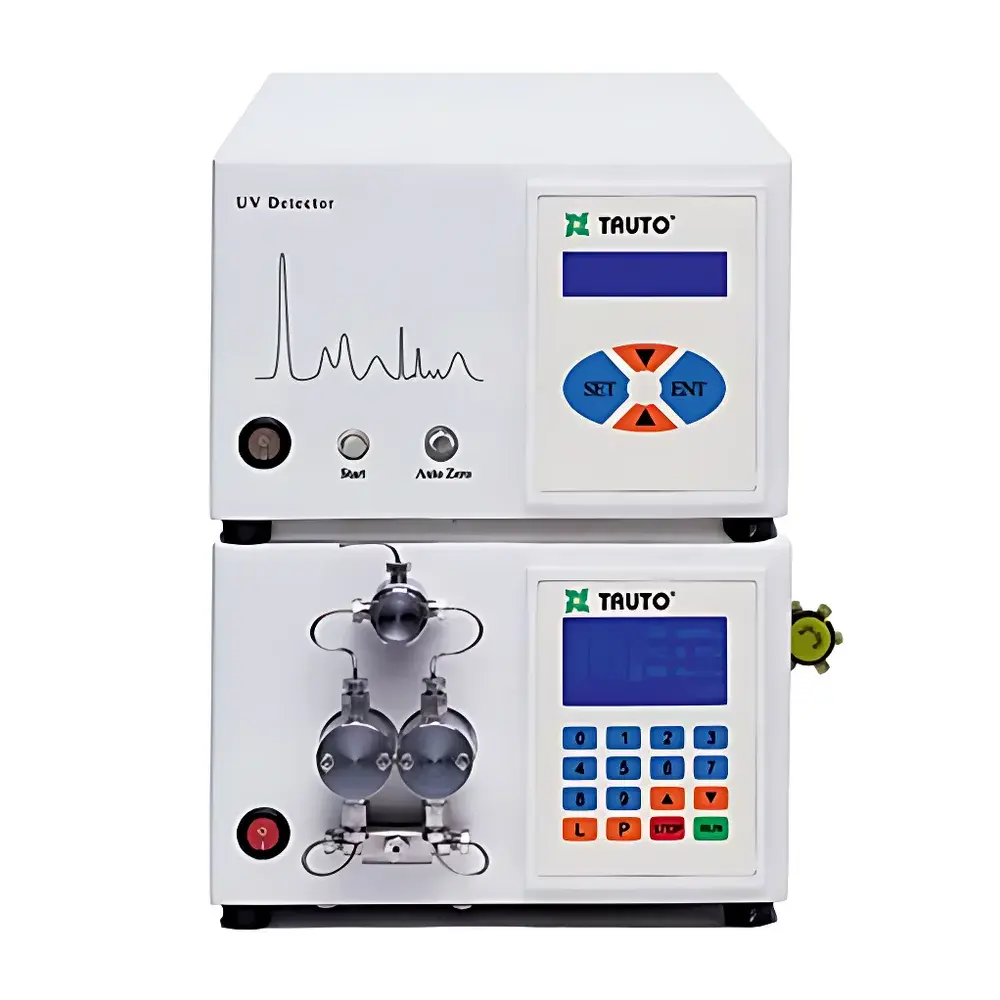
Tongtian S501 Six-Wavelength Medium-Pressure Preparative Liquid Chromatography System
| Brand | Tongtian |
|---|---|
| Origin | Shanghai, China |
| Model | S501 |
| Application Level | Laboratory Grade |
| Instrument Type | Medium-Low Pressure Preparative LC System |
| Flow Rate Range | 1–200 mL/min |
| Flow Accuracy | ≤2% |
| Flow Precision (RSD) | ≤1% |
| Maximum Operating Pressure | 20 MPa |
| Wavelength Range | ±1 nm |
| Wavelength Repeatability | 0.2 nm |
| Baseline Noise | 1 × 10⁻⁵ AU |
| Data Acquisition Frequency | 20 Hz |
Overview
The Tongtian S501 Six-Wavelength Medium-Pressure Preparative Liquid Chromatography System is an engineered solution for scalable purification of natural products, peptides, oligonucleotides, and bioactive small molecules in academic, pharmaceutical, and biotechnology laboratories. Built upon a dual-plunger reciprocating pump architecture, the system operates within a regulated pressure envelope of up to 20 MPa—enabling robust medium-pressure chromatographic separations without requiring high-end HPLC infrastructure. Its core separation principle relies on differential partitioning of analytes between a stationary phase (e.g., silica, C18, or specialty resins) and a mobile phase under controlled flow and gradient elution conditions. Unlike analytical-scale systems, the S501 prioritizes throughput and loading capacity while maintaining sufficient resolution for fraction collection and downstream characterization. The inclusion of six discrete UV wavelengths—programmable across 254 nm, 280 nm, 313 nm, 365 nm, and two user-defined positions—supports simultaneous monitoring of diverse chromophores, including aromatic amino acids, nucleic acid bases, and conjugated plant metabolites.
Key Features
- Dual-head constant-flow piston pump delivering stable, pulse-dampened solvent delivery across 1–200 mL/min with ≤1% RSD flow precision and ≤2% absolute accuracy
- Six-wavelength UV-Vis detector featuring deuterium lamp source, thermally stabilized optical path, and 70 µL flow cell with 3 mm pathlength for high-sensitivity absorbance detection
- Integrated medium-pressure injection valve (V-541 type) with standardized conversion interfaces for seamless coupling to preparative columns (ID 10–50 mm, length up to 500 mm)
- Real-time digital flow rate display and manual/gradient mode selection via front-panel interface; no external PC required for basic operation
- Modular design supporting column switching, fraction collection integration, and optional backpressure regulation for viscous mobile phases
- Stainless-steel fluidic path compliant with common organic solvents (acetonitrile, methanol, THF, ethyl acetate) and aqueous buffers (pH 2–9)
Sample Compatibility & Compliance
The S501 accommodates a broad range of sample matrices—including crude plant extracts, fermentation broths, enzymatic digests, and synthetic reaction mixtures—with minimal prefiltration (0.45 µm recommended). Its 20 MPa maximum pressure rating permits use of sub-20 µm spherical media at elevated flow rates, improving resolution over conventional flash systems. Column compatibility extends to reversed-phase (C4, C8, C18), normal-phase (silica, diol), ion-exchange (SAX, SCX), and size-exclusion resins. From a regulatory standpoint, the system supports GLP-aligned workflows: all detector signals are timestamped and logged with metadata (wavelength, flow, pressure); audit trails can be exported in CSV or ASCII format for internal review. While not pre-certified for FDA 21 CFR Part 11, its data acquisition architecture allows integration with validated third-party chromatography data systems (CDS) meeting GMP documentation requirements per ICH Q5, Q7, and USP .
Software & Data Management
The embedded chromatography workstation provides real-time chromatogram visualization, peak integration (tangent skim, valley-to-valley), retention time alignment, and customizable fraction triggering based on UV threshold or time window. Raw data files (.chd or .txt) store absorbance vs. time at all six wavelengths, enabling retrospective spectral analysis. Export formats include CSV, Excel-compatible XML, and AIA-standard .cdf for cross-platform compatibility with OpenLab CDS, Chromeleon, or Empower. All method parameters—including gradient table, flow program, wavelength schedule, and fraction collection logic—are saved as encrypted binary files with version stamping. System logs record operational events (pump start/stop, pressure excursions >18 MPa, lamp on/off cycles) with UTC timestamps, supporting root-cause analysis during method transfer or troubleshooting.
Applications
- Purification of alkaloids, flavonoids, terpenoids, and polyphenols from botanical extracts under isocratic or linear gradient conditions
- Desalting and buffer exchange of monoclonal antibody fragments following enzymatic cleavage
- Removal of residual catalysts and ligands from transition-metal-mediated synthesis intermediates
- Fractionation of oligosaccharide libraries for structure–activity relationship studies
- Method development for subsequent scale-up to industrial continuous chromatography platforms
- QC release testing of herbal medicinal products per Chinese Pharmacopoeia (ChP) monographs requiring UV detection at multiple wavelengths
FAQ
What column dimensions are supported by the S501 system?
Standard configurations accommodate columns with internal diameters from 10 mm to 50 mm and lengths up to 500 mm. Custom adapters are available for ID 6 mm and 80 mm columns.
Can the system perform gradient elution?
Yes—the onboard controller supports two-solvent binary gradients with programmable slope, hold, and re-equilibration steps. Gradient delay volume is <1.2 mL.
Is the UV detector compliant with pharmacopeial wavelength accuracy requirements?
Wavelength repeatability of ±0.2 nm meets USP and EP 2.2.25 specifications for photometric accuracy in quantitative analysis.
How is system suitability verified?
Users may run standard test mixtures (e.g., uracil/acetophenone/naphthalene) to assess resolution (Rs ≥ 1.5), tailing factor (Tf ≤ 2.0), and plate count (N ≥ 2000/m) per ICH Q2(R2) guidelines.
Does the system support remote monitoring or network connectivity?
The workstation includes Ethernet port and RS-232 interface; remote control and data export are possible via TCP/IP using provided SDK or Modbus RTU protocol.
Related Products






