
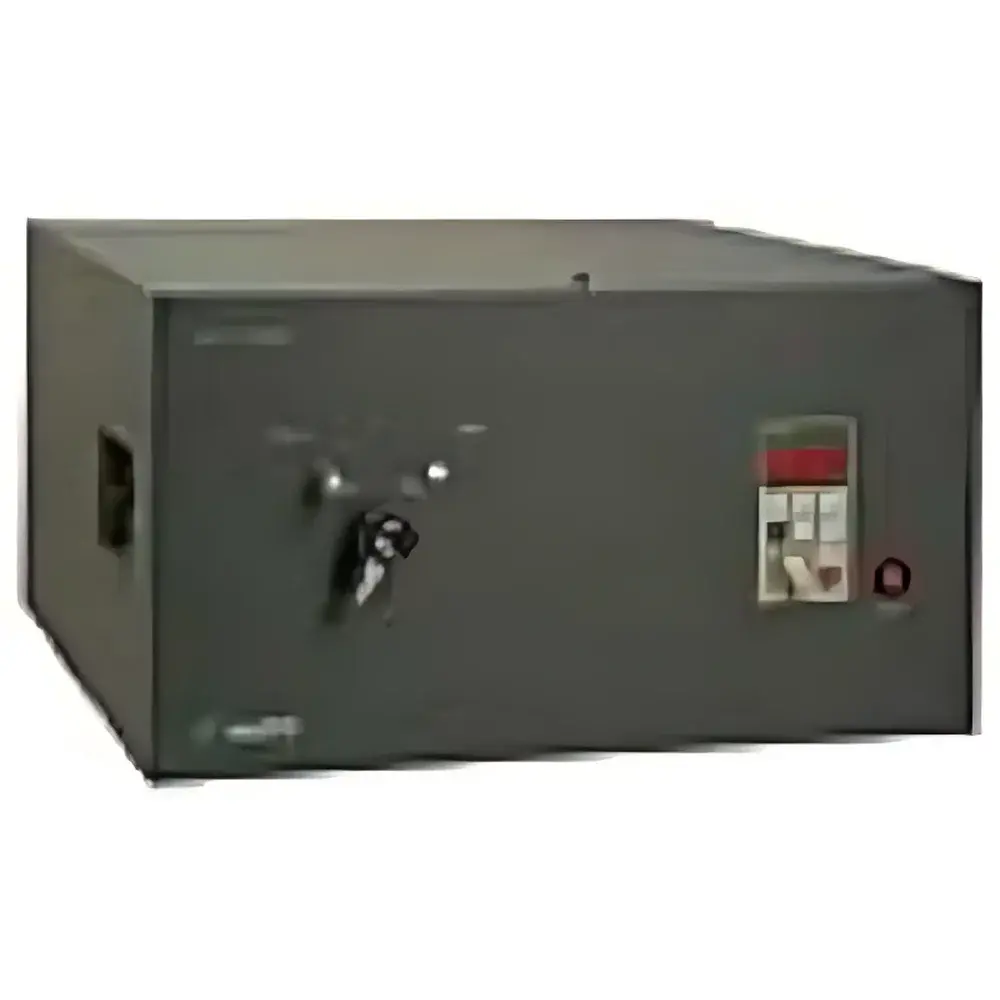
Tongtian TBE-300A High-Speed Counter-Current Chromatograph (HSCCC)
| Brand | Tongtian |
|---|---|
| Origin | Shanghai, China |
| Model | TBE-300A HSCCC |
| Power Supply | 220 V ± 20 V, 50 Hz ± 0.5 Hz |
| Motor Power | 200 W |
| Column Configuration | Triple-spiral coiled column assembly |
| Rotational Speed Range | 700–900 rpm (infinitely variable frequency control) |
| Flow Rate Range | 0.1–30 mL/min (adjustable in 0.1 mL/min increments) |
| Maximum System Pressure | 2 MPa |
| Tubing Volume | 260 mL |
| Injection Volume | 20 mL |
| UV Detector Wavelengths | 254 nm & 280 nm (dual fixed-wavelength) |
| Temperature Control Module | 15–40 °C (±0.5 °C accuracy), compatible with external recirculating chiller (flow rate: 1–10 L/min) |
| Dimensions (W×D×H) | 563 × 638 × 368 mm |
Overview
The Tongtian TBE-300A High-Speed Counter-Current Chromatograph (HSCCC) is a preparative-scale liquid–liquid partition chromatography system engineered for high-resolution, carrier-free separation of thermolabile and structurally complex compounds. Unlike conventional solid-phase chromatographic methods, HSCCC operates on the principle of partition equilibrium between two immiscible liquid phases—one stationary (retained by centrifugal force in coiled tubing) and one mobile (pumped through the column). This eliminates irreversible adsorption, sample degradation, and column fouling associated with solid supports. The TBE-300A implements a patented triple-spiral coiled column architecture, where three identical helical separation columns are connected in series within a single rotor. This design ensures mechanical balance at rotational speeds up to 900 rpm, minimizing vibration, acoustic noise, and baseline drift—critical for reproducible peak integration and long-duration fraction collection. The instrument is purpose-built for natural product isolation, pharmaceutical process development, and analytical method scouting where recovery yield, structural fidelity, and solvent system flexibility are paramount.
Key Features
- Triple-spiral coiled column assembly: Patented mechanical configuration ensures dynamic balance during high-speed rotation (700–900 rpm), delivering stable retention time reproducibility and low operational noise (<55 dB(A) at 1 m).
- Carrier-free liquid–liquid partitioning: Eliminates silica- or polymer-based stationary phases—no sample adsorption, no active site deactivation, and no risk of analyte denaturation or racemization.
- Full solvent system versatility: Compatible with a broad range of biphasic solvent systems (e.g., hexane/ethyl acetate/methanol/water, chloroform/methanol/water), enabling optimization of selectivity without hardware modification.
- Infinitely variable speed & bidirectional rotation: Frequency-controlled motor allows precise adjustment of centrifugal field strength and phase retention ratio (Sf), supporting both normal- and reversed-phase partition modes.
- Integrated temperature control module: External recirculating chiller interface maintains column temperature between 15–40 °C (±0.5 °C), critical for stabilizing partition coefficients of temperature-sensitive biomolecules and improving resolution in viscous solvent systems.
- Dual fixed-wavelength UV detection: Simultaneous monitoring at 254 nm and 280 nm supports real-time tracking of aromatic compounds, nucleic acids, and proteins without spectral scanning delays.
- Modular valve architecture: Dual six-port switching valves enable online fraction collection, system flushing, and mobile phase recycling—reducing solvent consumption and enabling multi-step sequential elution protocols.
Sample Compatibility & Compliance
The TBE-300A is routinely applied to samples incompatible with solid-phase media—including alkaloids, glycosides, polyphenols, marine toxins, peptides, and labile secondary metabolites. Its absence of surface interactions ensures quantitative recovery (>95% typical) and preserves stereochemical integrity—making it suitable for chiral separations and preparative isolation prior to NMR or X-ray crystallography. The system complies with fundamental requirements for GLP-compliant laboratories: full traceability of operational parameters (speed, flow, temperature, UV response), manual audit trail documentation, and compatibility with 21 CFR Part 11–ready data acquisition software (when paired with validated third-party platforms). While not certified as GMP-grade out-of-the-box, its mechanical robustness, pressure-rated fluidics (up to 2 MPa), and stainless-steel wetted path support qualification under ICH Q5, Q7, and USP guidelines for purification process validation.
Software & Data Management
The TBE-300A operates via front-panel controls with real-time digital displays for rotational speed, flow rate, UV absorbance, and temperature setpoint. For integrated data handling, the system provides analog (0–10 V) and digital (RS-232) outputs compatible with industry-standard chromatography data systems (CDS), including Chromeleon™, Empower™, and OpenLab CDS. Time-stamped parameter logs (rpm, mL/min, °C, mAU) can be exported in CSV format for post-run correlation analysis. When deployed in regulated environments, users may implement electronic signatures, user access levels, and audit trails using validated third-party software—ensuring alignment with FDA expectations for analytical instrument qualification (AIQ) and computerized system validation (CSV). The absence of embedded firmware-based data storage simplifies 21 CFR Part 11 compliance by decoupling raw signal acquisition from interpretation logic.
Applications
- Preparative isolation of bioactive constituents from plant extracts, fungal cultures, and marine organisms
- Purification of synthetic intermediates and reaction mixtures without silica-induced decomposition
- Development of reference standards for herbal monographs (e.g., WHO, EP, ChP)
- Fingerprint profiling of traditional Chinese medicine formulations under standardized solvent conditions
- Separation of enantiomers using chiral solvent systems (e.g., D-limonene/chiral alcohol/aqueous buffer)
- Recovery of heat-sensitive antibiotics (e.g., macrolides, β-lactams) and peptide antibiotics
- Isolation of radiolabeled tracers for pharmacokinetic studies—without quenching or sorbent interference
- Downstream processing of monoclonal antibody fragments and disulfide-rich mini-proteins
FAQ
How does HSCCC differ fundamentally from conventional column chromatography?
HSCCC uses two immiscible liquid phases—one stationary (centrifugally retained) and one mobile—eliminating solid supports entirely. This prevents irreversible adsorption, sample degradation, and column clogging.
What is the maximum sample loading capacity for preparative runs?
Typical injection volume is 20 mL; actual loadable mass depends on solubility in the selected solvent system and partition coefficient (K), but scales linearly with column volume (260 mL total tubing capacity).
Can the TBE-300A be interfaced with mass spectrometry?
Yes—via post-column flow splitting and make-up solvent addition, the UV detector output stream can be directed to ESI-MS or APCI sources for real-time structural confirmation.
Is method transfer between TBE-300A and analytical-scale HSCCC systems feasible?
Yes—scaling follows linear velocity and phase ratio principles; retention time and selectivity are preserved when Sf (stationary phase retention) and Δφ (mobile phase composition gradient) are matched.
Does the instrument require specialized training for routine operation?
Basic operation requires <4 hours of hands-on instruction; advanced method development (solvent system screening, K-value prediction, temperature optimization) benefits from foundational knowledge in liquid–liquid partition theory and phase diagram interpretation.





