
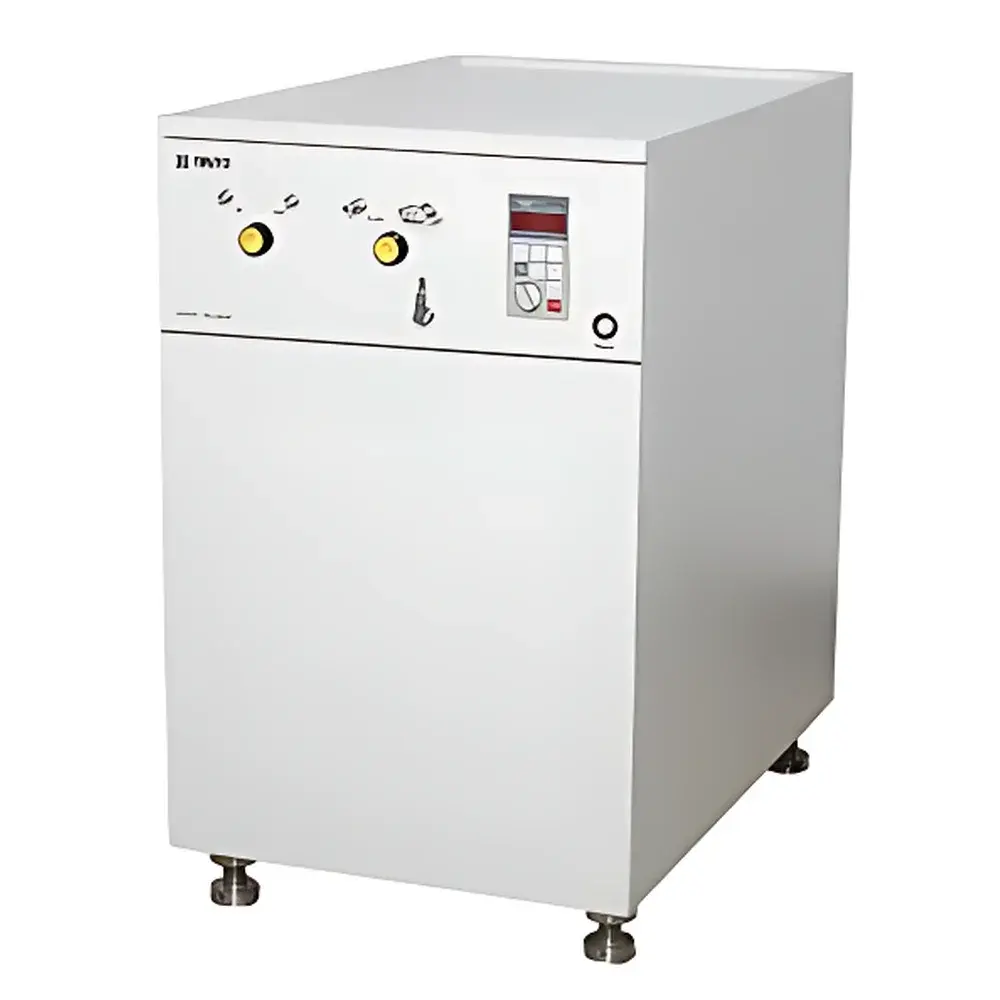
Tongtian TBE-300V High-Speed Counter-Current Chromatography System
| Brand | Tongtian |
|---|---|
| Origin | Shanghai, China |
| Model | TBE-300V |
| Column Capacity | 300 mL |
| Sample Injection Volume | 20 mL |
| Dimensions (W×D×H) | 330 × 600 × 550 mm |
| Rotation Speed Range | 0–1000 rpm |
| Separation Speed Range | 700–900 rpm (stepless frequency-controlled) |
| Flow Rate Range | 0.1–30 mL/min |
| Separation Flow Rate | 0.5–4.0 mL/min |
| Maximum System Pressure | 2 MPa |
| UV Detection Wavelengths | 214, 254, 280, 340, 365, 405 nm (optional full-spectrum detector available) |
| Temperature Control Range | 15–40 °C (±0.5 °C accuracy |
Overview
The Tongtian TBE-300V High-Speed Counter-Current Chromatography (HSCCC) System is a vertically oriented, multi-column preparative separation platform engineered for high-resolution, solvent-based partition chromatography without solid stationary-phase adsorption. Based on the principle of liquid–liquid partitioning in a rotating coil column under centrifugal force—governed by the hydrodynamic equilibrium of two immiscible phases—the TBE-300V enables reproducible, scalable isolation of thermolabile and structurally complex biomolecules. Unlike conventional HPLC or flash chromatography systems, HSCCC eliminates irreversible adsorption, peak tailing, and sample degradation, making it especially suitable for natural product purification, pharmaceutical intermediate isolation, and biopolymer fractionation where structural integrity and recovery yield are critical.
Key Features
- Triple-Column Architecture: Integrated three-coil separation columns with synchronized rotation enhance phase retention, improve resolution, and increase loading capacity—enabling parallel or sequential elution strategies for complex mixtures.
- Dual Six-Port Switching Valves: Facilitate automated solvent system priming, sample injection, column reconfiguration, and fraction collection without manual intervention—supporting method robustness and operator safety.
- Real-Time Online UV Detection: Equipped with fixed-wavelength photodiode array detection at six standard wavelengths (214, 254, 280, 340, 365, 405 nm), with optional full-spectrum scanning capability for spectral confirmation during elution profiling.
- Precision Temperature Control Interface: Compatible with external recirculating chillers to maintain column temperature between 15–40 °C (±0.5 °C), ensuring consistent partition coefficient (K) values across runs—critical for method transfer and regulatory compliance.
- Stepless Frequency-Controlled Drive: Variable-speed motor delivers stable rotational speeds from 0–1000 rpm, with optimized separation range 700–900 rpm for high-efficiency retention of upper or lower phase depending on solvent system polarity.
- Modular Fluidic Design: All wetted parts constructed from chemically inert PTFE, stainless steel (316L), and sapphire—compatible with chloroform-, hexane-, ethyl acetate-, and methanol-based biphasic systems per ICH Q5A and USP <621> guidelines.
Sample Compatibility & Compliance
The TBE-300V demonstrates broad applicability across polar and non-polar analytes—including polysaccharides, glycosides, alkaloids, flavonoids, peptides, and low-molecular-weight proteins—with demonstrated recovery >95% and purity >99% for over 100 isolated natural compounds. Its solvent-based mechanism avoids silica-related artifacts, aligning with GLP-compliant workflows for botanical drug development (FDA Botanical Guidance, 2022). The system conforms to ISO 9001:2015 quality management requirements and carries CE marking per Directive 2014/30/EU (EMC) and 2014/35/EU (LVD). While not inherently 21 CFR Part 11 compliant, audit trails, electronic signatures, and data integrity controls can be implemented via validated third-party chromatography data systems (CDS) interfaced through analog/digital I/O ports.
Software & Data Management
The TBE-300V operates via an embedded industrial controller with intuitive touchscreen interface for parameter setup (rotation speed, flow rate, temperature setpoint, valve sequencing). Raw UV signal output is provided as analog voltage (0–10 V) or RS-485 digital stream, enabling integration with commercial CDS platforms such as Empower, Chromeleon, or OpenLab for peak integration, calibration curve generation, and report export in PDF/CSV formats. All acquisition parameters—including timestamped method files, instrument logs, and detector response—are stored locally on removable SD card with write-protection option. For regulated environments, users may deploy supplementary validation packages covering IQ/OQ/PQ protocols aligned with ASTM E2500 and ISO/IEC 17025 standards.
Applications
- Purification of bioactive constituents from Ginkgo biloba, Soybean, and Huperzia serrata extracts—validated in Shanghai High-Tech Industrialization Projects for Huperzine A production.
- Isolation of oligosaccharide fractions from medicinal herbs for structure–activity relationship (SAR) studies under Chinese Pharmacopoeia monographs.
- Preparative-scale separation of monoclonal antibody fragments and peptide libraries in early-stage biopharmaceutical development.
- Method development for QC release testing of herbal active pharmaceutical ingredients (APIs), supporting registration dossiers under EU Traditional Herbal Medicinal Products Directive (THMPD) and NMPA Technical Guidelines.
- Academic research in phytochemistry, marine natural products, and metabolomics—deployed at Shanghai Jiao Tong University, Second Military Medical University, and Institute of Process Engineering, CAS.
FAQ
What solvent systems are compatible with the TBE-300V?
The system supports all common biphasic solvent systems used in HSCCC, including but not limited to n-hexane–ethyl acetate–methanol–water (HEMWat), chloroform–methanol–water, and tert-butyl methyl ether–acetonitrile–water. Selection depends on target compound log P and solubility profile.
Can the TBE-300V be operated under GMP conditions?
Yes—when integrated with validated CDS, documented SOPs, and periodic performance qualification (PQ) per ASTM E2500, the system meets baseline requirements for GMP-compliant purification of botanical APIs and intermediates.
Is column cleaning and regeneration required between runs?
No solid-phase matrix is present; columns are flushed with miscible solvents (e.g., methanol followed by water) to remove residual phases. No equilibration time is needed between injections.
What is the typical resolution achievable for closely eluting flavonoid glycosides?
Under optimized conditions (e.g., 750 rpm, 1.5 mL/min, n-BuOH–AcOH–water, 4:1:5 v/v/v), baseline resolution (Rs ≥ 1.5) has been reported for quercetin-3-O-rutinoside and kaempferol-3-O-rutinoside in crude Rhododendron extract.
Does Tongtian provide application support for method development?
Yes—application scientists offer remote and on-site assistance for solvent system selection, column configuration, and gradient optimization, backed by an internal library of >200 published HSCCC methods for natural products and pharmaceuticals.
Related Products



