
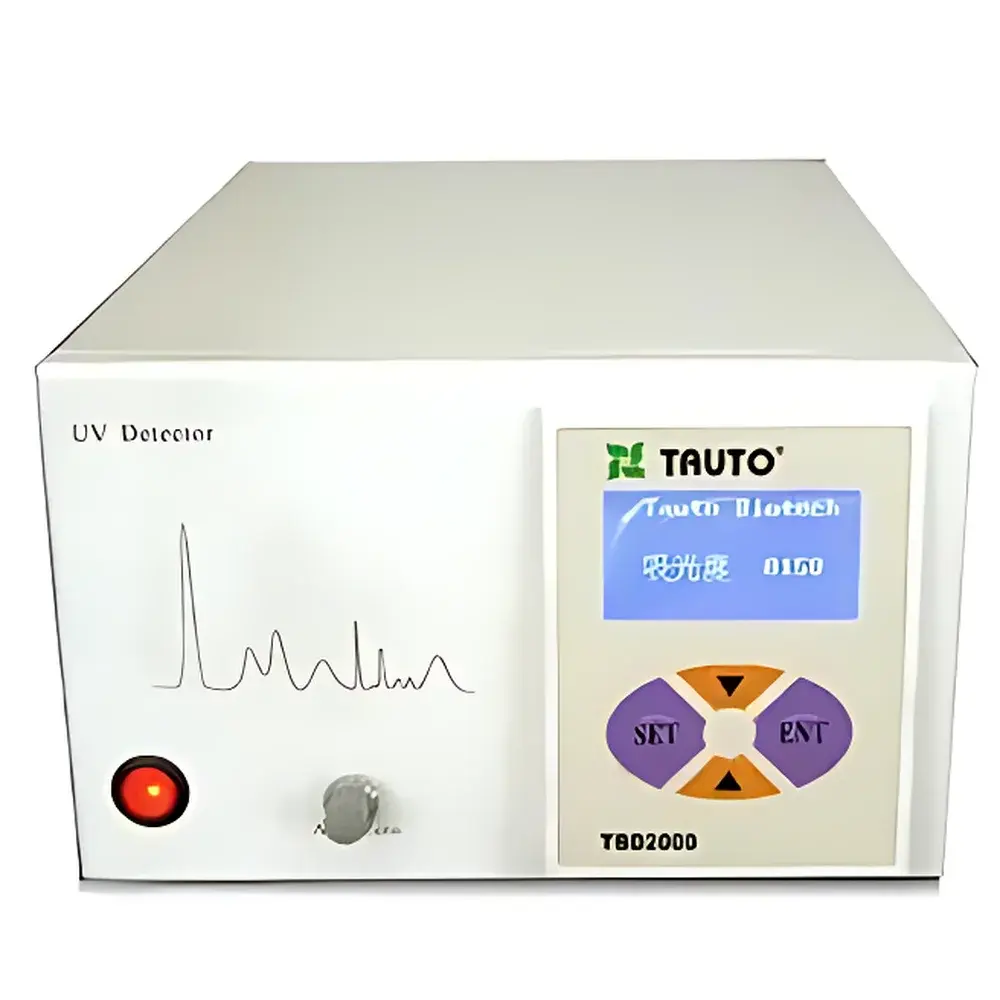
Tongtian TBD-3000 Dual-Beam UV Absorbance Detector for Nucleic Acid and Protein Detection
| Brand | Tongtian |
|---|---|
| Model | TBD-3000 |
| Detection Wavelengths | 214, 230, 260, 280 nm (customizable) |
| Noise Level | ≤ 0.0004 A |
| Drift | ≤ 0.002 A/h (at constant ambient temperature) |
| Optical Path Length | 3 mm |
| Flow Cell Volume | 212 µL |
| Display | 128 × 32 LCD |
| Power Consumption | ≤ 25 W |
| Input Voltage | 220 V ± 10%, 50 Hz |
| Operating Temperature | 0–40 °C |
| Relative Humidity | ≤ 70 % RH |
| Dimensions (W × H × D) | 360 × 160 × 255 mm |
| Weight | 4 kg |
| Beam Configuration | Dual-beam optical design |
| Compliance | Designed for integration into GMP/GLP-compliant chromatography workflows |
Overview
The Tongtian TBD-3000 Dual-Beam UV Absorbance Detector is a precision optical instrument engineered for real-time, quantitative detection of biomolecules—including nucleic acids, proteins, peptides, and nucleotides—during liquid chromatography (LC), fast protein liquid chromatography (FPLC), or gravity-fed column elution. It operates on the fundamental principle of ultraviolet absorbance spectroscopy, leveraging the intrinsic electronic transitions of aromatic amino acid residues (e.g., tryptophan, tyrosine at 280 nm) and nucleic acid bases (e.g., purines and pyrimidines at 260 nm). The detector employs a dual-beam optical architecture: one beam passes through the sample flow cell while the reference beam traverses an identical path in solvent-only mode. This configuration actively compensates for lamp intensity fluctuations, solvent baseline drift, and minor thermal variations—enabling high reproducibility and long-term signal stability without manual zeroing. Its fixed-wavelength design supports four standard UV bands (214 nm for peptide backbone detection, 230 nm for certain co-factors, 260 nm for DNA/RNA quantification, and 280 nm for protein estimation), with optional wavelength customization available upon request to meet application-specific spectral requirements.
Key Features
- Dual-beam optical system minimizing baseline drift and enhancing measurement robustness under variable ambient conditions
- Low-noise analog signal processing with ≤ 0.0004 A RMS noise level, supporting detection of dilute biomolecular fractions
- Stable photometric response (≤ 0.002 A/h drift at constant temperature), critical for extended gradient runs and preparative-scale separations
- 3 mm pathlength flow cell optimized for compatibility with standard FPLC and analytical LC systems; 212 µL internal volume ensures minimal band broadening and rapid equilibration
- Integrated 128 × 32 character LCD display providing real-time absorbance readout (0–2.0 A full scale), eliminating dependency on external data acquisition hardware for basic monitoring
- Compact footprint (360 × 160 × 255 mm) and low power draw (≤ 25 W), suitable for benchtop deployment in shared core facilities or mobile laboratory environments
- Designed for seamless integration with peristaltic pumps, fraction collectors, and strip-chart recorders via analog output (0–1 V or 0–10 V DC, switchable)
Sample Compatibility & Compliance
The TBD-3000 is compatible with aqueous and water-miscible mobile phases commonly used in ion-exchange, size-exclusion, and hydrophobic interaction chromatography—including Tris-HCl, phosphate buffers, ammonium acetate, and low-concentration organic modifiers (e.g., ≤ 20 % acetonitrile or methanol). Its stainless-steel and quartz flow cell construction resists corrosion from mildly acidic or basic eluents. While not certified to IEC 61010-1 or CE for standalone medical device use, the detector conforms to general electrical safety and electromagnetic compatibility (EMC) expectations for laboratory instrumentation operating in ISO/IEC 17025-accredited testing laboratories. When deployed within validated chromatographic workflows—such as those supporting USP , EP 2.2.46, or FDA 21 CFR Part 11–aligned data integrity protocols—the TBD-3000 serves as a compliant absorbance endpoint sensor, provided that system-level audit trails, user access controls, and electronic signature capabilities are implemented at the data acquisition layer.
Software & Data Management
The TBD-3000 operates as an analog-output detector and does not include embedded firmware or proprietary software. It delivers continuous voltage signals proportional to absorbance, fully compatible with third-party data acquisition systems—including ChromaLink, Unicorn (Cytiva), LabChart (ADInstruments), and custom Python- or LabVIEW-based DAQ platforms. For GLP/GMP applications, users are advised to route its analog output through validated ADC modules with time-stamped logging, electronic signature support, and secure audit trail generation. Optional TTL-compatible trigger outputs enable synchronized fraction collection events. No cloud connectivity, remote control, or firmware updates are supported—ensuring deterministic behavior and reducing cybersecurity surface area in regulated environments.
Applications
- Real-time monitoring of protein elution profiles during affinity or ion-exchange purification (e.g., His-tagged protein capture, antibody purification)
- Quantitative assessment of nucleic acid yield and purity (A260/A280 ratio) in plasmid prep or oligonucleotide synthesis workflows
- Enzyme activity assays involving chromogenic or UV-absorbing substrates (e.g., NADH oxidation at 340 nm via optional filter retrofit)
- Quality control of biopharmaceutical intermediates, including monoclonal antibody fragments and recombinant growth factors
- Educational demonstrations of Beer–Lambert law principles, chromatographic resolution, and biomolecular extinction coefficients
- Field-deployable analysis in agricultural biotech labs for rapid screening of transgenic crop extracts or fermentation broths
FAQ
Is the TBD-3000 compatible with HPLC systems?
Yes—when interfaced via appropriate pressure-rated flow cells and backpressure regulators, though it is primarily optimized for low-pressure FPLC and gravity-fed applications.
Can detection wavelengths be changed in real time?
No—the TBD-3000 uses fixed-bandpass filters; wavelength selection requires manual filter replacement or factory modification.
Does the detector support digital communication protocols (e.g., RS-232, USB)?
No—it provides only analog voltage output and TTL trigger signals; digital interface requires external ADC hardware.
What is the minimum detectable concentration for BSA at 280 nm?
Under standard 3 mm pathlength and noise-limited conditions, the theoretical LOD is approximately 0.02 mg/mL (based on S/N = 3 and ε280 = 43,824 M⁻¹cm⁻¹).
Is validation documentation (IQ/OQ/PQ) provided?
Tongtian supplies basic operational specifications and calibration certificate templates; site-specific qualification must be performed by the end user per ISO/IEC 17025 or ASTM E2500 guidelines.




