WinRHIZO Root System Analysis System
| Origin | Canada |
|---|---|
| Manufacturer Type | Authorized Distributor |
| Origin Category | Imported |
| Model | WinRHIZO |
| Pricing | Available Upon Request |
Overview
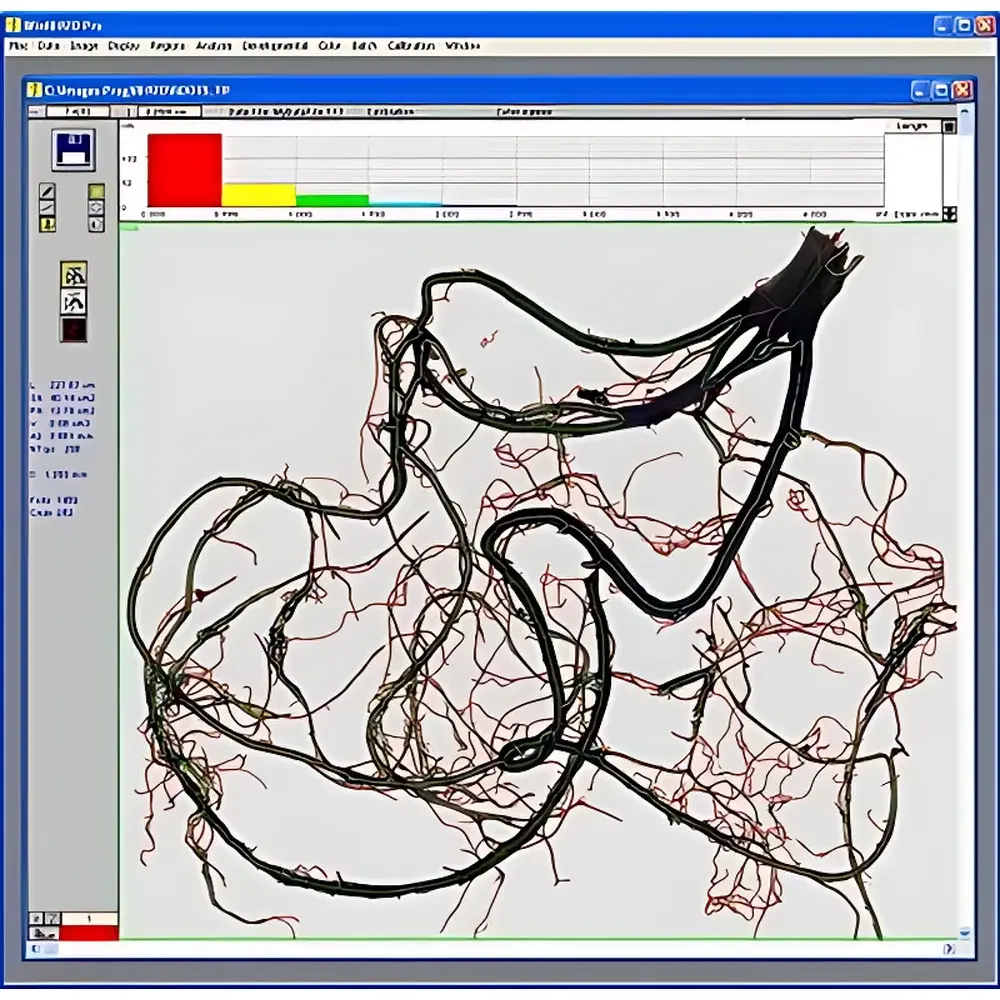
The WinRHIZO Root System Analysis System is a high-precision, non-destructive digital image analysis platform engineered for quantitative morphological characterization of excised root systems. Designed specifically for post-washing root samples, it employs calibrated flatbed scanning combined with dual-source illumination to eliminate shadow artifacts and optical non-uniformity—ensuring consistent grayscale or color fidelity across the entire imaging field. Unlike statistical sampling or manual tracing methods, WinRHIZO implements deterministic pixel-based segmentation and topological reconstruction algorithms to resolve overlapping root segments, enabling accurate measurement of total length, diameter distribution, surface area, volume, and branching architecture without reliance on probabilistic estimation. Its core measurement principle integrates geometric modeling with binary thresholding, edge detection, and skeletonization techniques compliant with ISO 11277 (soil description) and ASTM D6913 (particle size analysis by image processing) foundational methodologies.
Key Features
- Calibrated high-resolution flatbed scanner with integrated dual-LED illumination system optimized for root transparency and contrast enhancement
- Deterministic image analysis engine resolving overlapping roots via multi-scale skeleton pruning and branch-point identification
- Three-tiered software architecture: Basic, Standard, and Professional editions—each expanding analytical depth while maintaining backward compatibility with TIFF and JPEG input formats
- Sub-pixel diameter estimation using local intensity gradient analysis and circular Hough transform validation
- Topological graph generation for connectivity mapping, path-length calculation, and hierarchical branching order assignment (Professional Edition only)
- Color-space decomposition module (CIELAB) for viability assessment based on chromatic shift in root tissue pigmentation (Professional Edition only)
- GLP-compliant audit trail logging for all parameter adjustments, threshold selections, and batch processing events
Sample Compatibility & Compliance
WinRHIZO accepts washed root samples from herbaceous and woody species—including Arabidopsis, maize, wheat, rice, poplar, and perennial grasses—mounted on transparent acrylic trays with standardized background reflectance (90% ±2% diffuse white). The system supports root diameters ranging from 0.05 mm to 5 mm, with optimal resolution at ≥4800 dpi optical capture. All measurement outputs comply with FAO Soil Guidelines for Root Architecture Documentation and are traceable to NIST-traceable calibration targets included with each hardware shipment. Software validation packages support FDA 21 CFR Part 11 requirements for electronic records and signatures when deployed in regulated agricultural research environments.
Software & Data Management
WinRHIZO software operates on Windows 10/11 (64-bit) platforms and features a modular GUI with real-time preview, batch processing queue, and export-ready reporting templates. Measurement data exports to CSV, Excel (.xlsx), and XML formats with embedded metadata including scanner model, illumination settings, user ID, timestamp, and version-controlled algorithm flags. The Professional Edition includes an SQLite-based project database supporting relational queries across multiple experiments, automated QC flagging for outlier root density values (>3 SD from cohort mean), and integration with R and Python via COM automation interfaces. All software updates undergo internal verification against ISO/IEC 17025-accredited reference datasets prior to release.
Applications
- Phenotypic screening of root architecture traits in breeding programs targeting drought tolerance and nutrient use efficiency
- Longitudinal studies of root developmental plasticity under controlled abiotic stress (e.g., phosphorus limitation, salinity gradients)
- Validation of computational root growth models (e.g., CRootBox, SimRoot) using empirically derived topological constraints
- Soil–root interface characterization in rhizosphere microbiome studies requiring precise root surface area normalization
- Regulatory submission support for biopesticide and biostimulant efficacy trials where root morphology endpoints are specified in OECD TG 208 or EPPO PP 1/262 protocols
- Academic research in plant functional ecology, including allometric scaling relationships between shoot biomass and root system complexity
FAQ
What image formats does WinRHIZO support?
WinRHIZO natively imports uncompressed TIFF (8- or 16-bit grayscale/color) and JPEG (baseline, RGB) files. Lossless compression is strongly recommended; JPEG quantization artifacts may impair segmentation accuracy.
Is hardware calibration required before each scan session?
Yes—a daily calibration using the supplied NIST-traceable gray scale target and spatial reference grid is mandatory for ISO 17025-aligned workflows. Calibration parameters are stored per-scanner ID and automatically applied during image ingestion.
Can WinRHIZO analyze intact soil cores or rhizobox images?
No. WinRHIZO is validated exclusively for washed, two-dimensional root arrays on uniform backgrounds. For in situ root imaging, complementary platforms such as RhizoVision Explorer or minirhizotron-based systems are recommended.
Does the Professional Edition support batch processing across multiple experimental replicates?
Yes. The Professional Edition includes a scriptable batch processor with conditional logic for folder-based auto-import, parameter inheritance, and error-resilient resume functionality after interruption.
How is measurement uncertainty quantified in WinRHIZO reports?
Each exported dataset includes coefficient of variation (CV%) calculated across three independent scans of the same sample, plus inter-operator repeatability metrics derived from blinded duplicate analyses performed by two certified technicians.