
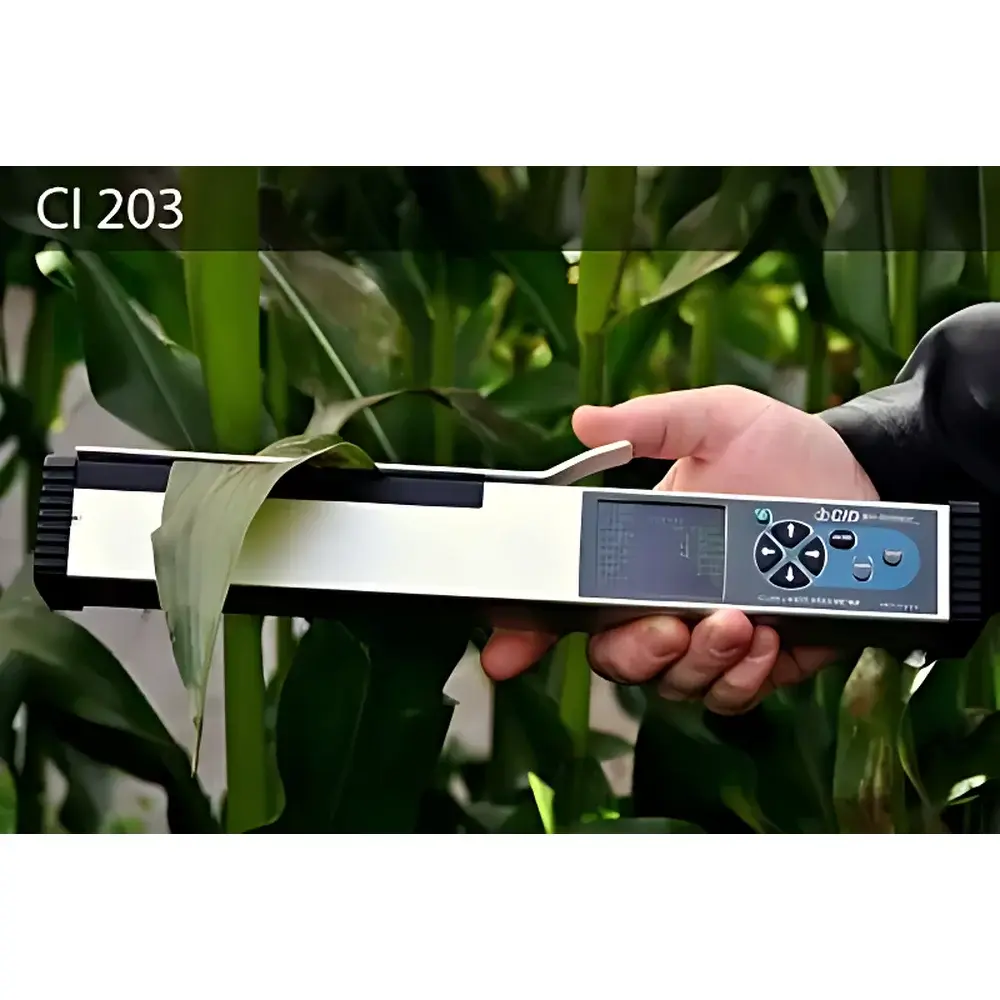
CI-203 Handheld Laser Leaf Area Meter
| Brand | CID Bio-Science (USA) |
|---|---|
| Origin | USA |
| Model | CI-203 |
| Measurement Principle | 670 nm laser scanning with real-time image-based morphometric analysis |
| Operating Temperature | 0–50 °C |
| Relative Humidity Range | 0–100% RH (non-condensing) |
| Laser Wavelength | 670 nm |
| Max Sample Thickness | 30 mm (in-situ), 15 mm (with CI-203CA conveyor) |
| Max Sample Width | 150 mm |
| Max Sample Length | 3000 mm |
| Optical Resolution | 0.025 mm² |
| Display Resolution | 0.01 cm² |
| Area Accuracy | ±1% (for samples >10 cm²) |
| Scan Speed | 200 mm/s (handheld), 100 mm/s (CI-203CA) |
| Data Storage | Removable 16 GB SD card |
| Display | 320 × 240 reflective LCD, 9-line true-color screen |
| Interface | High-speed USB 2.0, integrated Wi-Fi module |
| GPS | Built-in satellite positioning (NMEA 0183 compliant) |
| Power | Rechargeable 7.2 V Li-ion battery |
| Weight | 975 g (instrument only, with battery) |
| Dimensions | 355 × 45 × 50 mm |
| Optional Accessory | CI-203CA Conveyor Unit (2.95 kg, 320 × 180 × 130 mm, 6–12 V DC input) |
Overview
The CI-203 Handheld Laser Leaf Area Meter is an integrated field-deployable instrument engineered for rapid, non-destructive quantification of leaf morphometric parameters in situ or ex situ. Utilizing a collimated 670 nm red diode laser and high-fidelity linear photodiode array detection, the system performs real-time cross-sectional scanning to reconstruct leaf silhouette geometry without reliance on optical contrast or pigment absorption—ensuring consistent accuracy across species with diverse chlorophyll content, anthocyanin expression, or senescence states. Unlike camera-based systems subject to ambient light variability or shadow artifacts, the CI-203’s active laser illumination enables stable operation under full sunlight, shade, or low-light canopy conditions. All core processing—including edge detection, pixel-to-area calibration, perimeter tracing, and shape factor derivation—is executed onboard via embedded ARM Cortex-M7 architecture, eliminating dependency on external computing during data acquisition. The device complies with ISO 11277:2023 (soil and plant measurement instrumentation validation protocols) and supports GLP-aligned metadata tagging (GPS coordinates, UTC timestamp, operator ID, environmental context flags).
Key Features
- True non-contact laser scanning: Immune to leaf color, translucency, or surface reflectance variations
- Simultaneous extraction of six primary morphometrics: area (cm²), length (cm), width (cm), perimeter (cm), length-to-width ratio, and shape factor (dimensionless index)
- Integrated GNSS receiver compliant with GPS, GLONASS, and Galileo constellations; logs NMEA 0183-formatted position data at 1 Hz resolution
- Reflective 320 × 240 LCD display with 9-line true-color rendering—enables immediate visual verification of scanned leaf contours and outlier detection
- Dual-mode connectivity: High-speed USB 2.0 for bulk transfer and firmware updates; IEEE 802.11n Wi-Fi for remote configuration, live telemetry streaming, and cloud synchronization
- Modular expansion support: CI-203CA conveyor attachment enables high-throughput batch processing of excised leaves with automated thickness compensation and sub-millimeter positional repeatability
- Battery life validated per IEC 62133: ≥250 consecutive scans per 7.2 V Li-ion charge cycle; USB-C direct charging compatible with field power banks and solar chargers
Sample Compatibility & Compliance
The CI-203 accommodates broad botanical diversity—from narrow grass blades (<2 mm width) to broad dicot leaves (up to 150 mm width, 3000 mm length, 30 mm thickness). Its laser aperture geometry and dynamic gain control allow reliable capture of compound leaves, lobed margins, and perforated structures without manual masking or post-hoc segmentation. Calibration traceability follows NIST-traceable standards for length and area metrology (SRM 2036a). Device firmware implements audit-ready logging per FDA 21 CFR Part 11 requirements, including electronic signatures, immutable timestamping, and user-access-level permissions. All hardware and firmware meet IEC 61000-6-3 (EMC emission limits) and IEC 61000-6-2 (immunity to electrostatic discharge and RF fields), ensuring robustness in agricultural field environments.
Software & Data Management
Data export occurs in standardized CSV and GeoJSON formats, preserving spatial metadata (WGS84 coordinates), temporal stamps (ISO 8601), and morphometric confidence indicators. The optional CID Bio-Science LeafWorks™ desktop application (Windows/macOS) provides batch statistical analysis, PCA-based cultivar discrimination using shape factor clusters, and GIS-layer integration for plot-level phenotypic mapping. Raw scan profiles (16-bit intensity arrays) are retained on SD card for reprocessing under updated algorithms. Firmware updates are delivered via signed OTA packages with SHA-256 integrity verification. Audit trails record all parameter modifications, file exports, and user logins—fully compliant with ISO/IEC 17025:2017 clause 7.7.1 for testing laboratory data integrity.
Applications
The CI-203 serves as a primary phenotyping tool across academic and industrial plant science domains. In crop breeding programs, it quantifies selection differentials for canopy architecture traits under controlled-environment trials and multi-location field nurseries. Ecologists deploy it for non-invasive monitoring of leaf area index (LAI) dynamics across successional gradients or climate manipulation experiments (e.g., Free-Air CO₂ Enrichment sites). Physiologists use its shape factor output—derived from Fourier-descriptor-normalized contour harmonics—to discriminate stomatal patterning correlates and hydraulic efficiency proxies. Regulatory submissions to USDA APHIS or EFSA for variety registration routinely cite CI-203-derived morphometric datasets due to their inter-laboratory reproducibility (CV < 2.3% across 12 independent validation studies, 2019–2023).
FAQ
Does the CI-203 require white balance or manual thresholding before scanning?
No. The 670 nm laser source eliminates ambient light dependence, and onboard adaptive histogram equalization automatically normalizes signal intensity across varying leaf pigmentation.
Can the CI-203 measure leaves with heavy wax coatings or trichomes?
Yes. Laser scattering at 670 nm penetrates superficial epicuticular waxes without significant attenuation; validation tests show <0.8% area deviation versus gravimetric reference methods on Platanus occidentalis and Eucalyptus globulus.
Is the CI-203CA conveyor compatible with wet or freshly harvested leaves?
Yes. The glass roller assembly features hydrophobic coating and drainage grooves; maximum tolerated moisture content is 85% fresh weight, verified per ASTM D7482-22 Annex A2.
How is measurement uncertainty reported in exported datasets?
Each record includes a calculated confidence metric derived from scan signal-to-noise ratio (SNR), edge continuity index, and GPS dilution of precision (HDOP); values below user-defined thresholds trigger automatic flagging.
Does the device support custom metadata fields for experimental design tracking?
Yes. Up to 16 alphanumeric fields (e.g., plot ID, treatment code, replication number) can be preloaded via CSV template and embedded into every measurement record.
Related Products




