
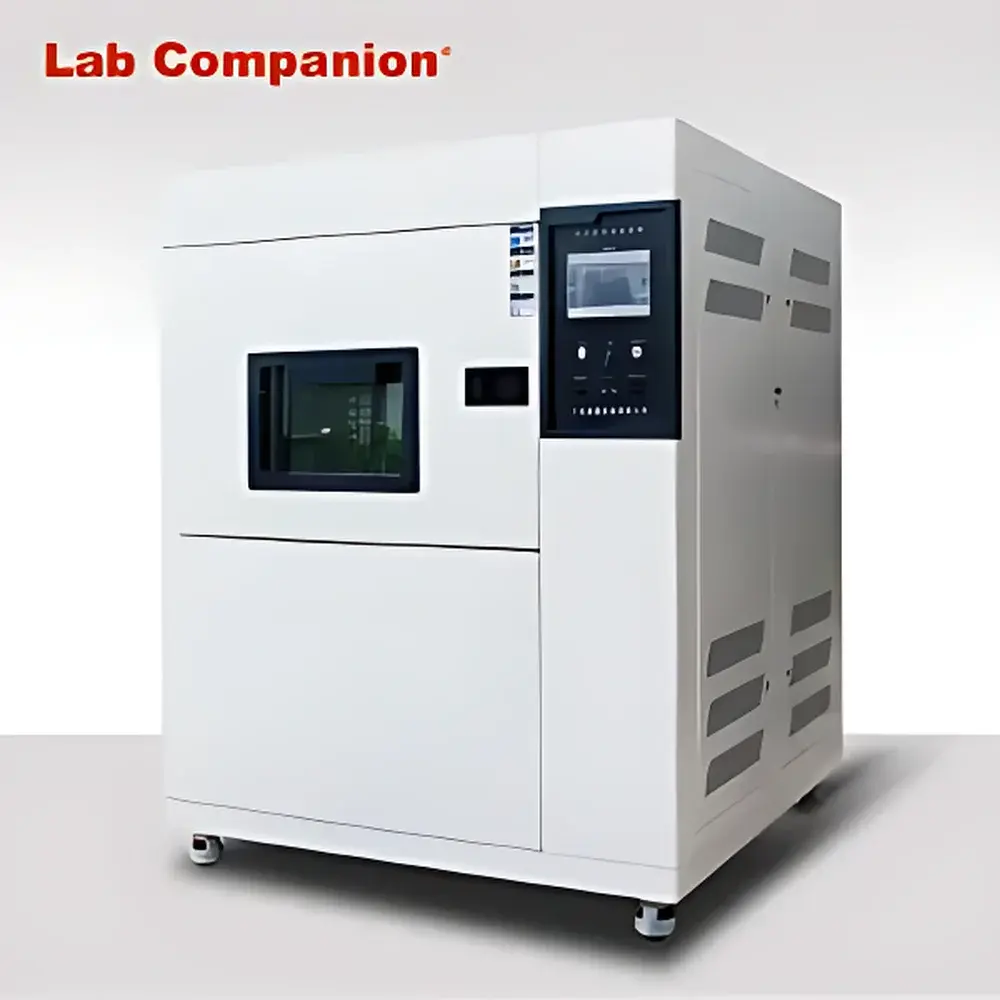
LabCompanion CTS-50 Thermal Shock Test Chamber
| Brand | LabCompanion |
|---|---|
| Origin | Guangdong, China |
| Manufacturer Type | Direct Manufacturer |
| Product Origin | Domestic (China) |
| Model | CTS-50 |
| Quotation | Available Upon Request |
| High-Temperature Range | +150 °C |
| Low-Temperature Range | −65 °C |
| Thermal Shock Range | −65 °C to +150 °C |
| Heating Rate | +60 °C to +200 °C ≤ 20 min |
| Cooling Rate | +20 °C to −75 °C ≤ 60 min |
Overview
The LabCompanion CTS-50 Thermal Shock Test Chamber is an engineered environmental test system designed for rapid, repeatable, and controlled thermal cycling between extreme temperature extremes. It operates on a dual-chamber (hot/cold) mechanical transfer principle—featuring independent high- and low-temperature zones with a motorized specimen carrier that rapidly shuttles test samples between them. This architecture enables precise, high-fidelity simulation of real-world thermal stress conditions encountered during product development, qualification, and reliability screening—particularly in aerospace electronics, automotive ECUs, semiconductor packaging, and military-grade components. The chamber complies with core international thermal shock testing standards including MIL-STD-810H Method 503.5, IEC 60068-2-14, and JESD22-A104D, supporting both air-to-air and component-level shock profiles.
Key Features
- Independent dual-zone design: Separated hot (+150 °C max) and cold (−65 °C min) chambers minimize cross-contamination and ensure thermal stability during dwell phases.
- High-speed specimen transfer mechanism: Pneumatically actuated lift-and-shift carrier achieves transition times under 10 seconds between zones—critical for maintaining defined dwell-to-transition time ratios per test standards.
- Robust stainless-steel construction: Inner chamber walls, shelves, and transfer path are fabricated from 304 stainless steel with electropolished finish to resist corrosion and facilitate cleaning under GLP-compliant lab environments.
- Programmable ramp-and-dwell control: Supports multi-step profiles with up to 99 cycles, variable dwell durations (1 min–999 h), and user-defined transition triggers (time-based or temperature-verified).
- Integrated safety architecture: Includes over-temperature/over-pressure cutouts, door interlock switches, refrigerant leak detection, and redundant PID controllers with independent monitoring channels.
- Modular refrigeration system: Cascade two-stage compressor setup with R404A/R23 mixed-refrigerant circuit enables stable sub-zero operation down to −65 °C without liquid nitrogen dependency.
Sample Compatibility & Compliance
The CTS-50 accommodates standard test specimens up to 450 mm × 450 mm × 450 mm (W×D×H) with a maximum load capacity of 20 kg. Internal volume (50 L net) supports PCB assemblies, molded connectors, MEMS devices, and small enclosures. Chamber geometry and airflow distribution have been validated via computational fluid dynamics (CFD) modeling to ensure ±1.5 °C uniformity across the working volume at steady-state dwell conditions. All control firmware and calibration procedures align with ISO/IEC 17025 requirements for accredited test laboratories. Documentation packages include factory calibration certificates traceable to NIM (National Institute of Metrology, China) and optional IQ/OQ protocol templates compliant with FDA 21 CFR Part 11 for regulated industries.
Software & Data Management
The system ships with LabCompanion TC-Studio v3.2—a Windows-based control and data acquisition platform supporting local operation, remote monitoring via Ethernet, and secure network deployment. Real-time logging records temperature, cycle count, dwell status, alarm events, and chamber pressure at configurable intervals (100 ms–10 s). Data export formats include CSV, PDF test reports, and XML-compatible structured logs for integration into LIMS or MES systems. Audit trail functionality meets GLP/GMP requirements: all parameter changes, user logins, and report generations are timestamped, digitally signed, and non-erasable. Optional add-ons include automated pass/fail evaluation against user-defined limits and scheduled calibration reminder alerts.
Applications
- Qualification testing of solder joint integrity in lead-free PCBAs per IPC-J-STD-020 and JEDEC JESD22-A104D.
- Accelerated life testing of encapsulated optoelectronic modules subjected to repeated thermal expansion mismatch.
- Validation of hermetic seal performance in MEMS sensors and medical implant housings.
- Reliability screening of battery management systems (BMS) and power converters operating in automotive under-hood environments.
- Material compatibility assessment for conformal coatings, potting compounds, and thermal interface materials (TIMs).
- Pre-compliance verification for DO-160 Section 4 (Temperature Variation) and RTCA/DO-160G environmental categories.
FAQ
What is the typical transition time between hot and cold zones?
The mechanical transfer mechanism completes zone transitions in ≤9 seconds under standard loading conditions (≤15 kg), verified per IEC 60068-2-14 Annex B.
Does the CTS-50 support user-defined dwell times and cycle counts?
Yes—up to 99 programmable steps per profile, with dwell durations adjustable from 1 minute to 999 hours and total cycle counts up to 9999.
Is third-party calibration and validation support available?
LabCompanion provides optional on-site IQ/OQ execution by certified engineers, along with NIST-traceable calibration services through authorized metrology partners.
Can the chamber be integrated into an existing test automation framework?
Yes—the TC-Studio software exposes a TCP/IP-based command set (SCPI-compatible) and supports Modbus TCP for PLC-level interoperability.
What maintenance intervals are recommended for long-term reliability?
Refrigeration oil and filter replacement every 24 months; chamber door gasket inspection and cleaning every 6 months; full system performance verification annually.
Related Products



