
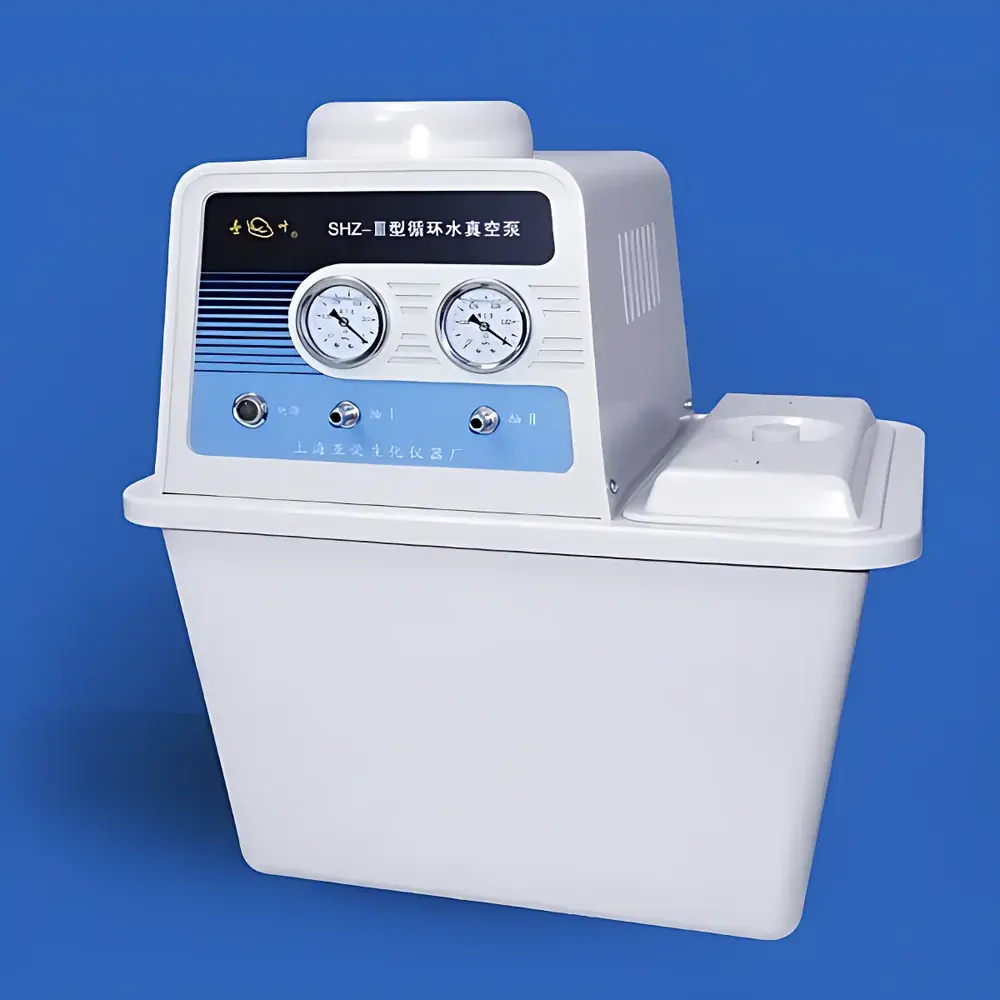
Jinye SHZ-III Dual-Head Circulating Water Vacuum Pump
| Brand | Jinye |
|---|---|
| Origin | Shanghai, China |
| Manufacturer Type | Direct Manufacturer |
| Instrument Type | Circulating Water Vacuum Pump |
| Product Category | Oil-Free Vacuum Pump |
| Air Displacement (per port) | 10 L/min |
| Ultimate Vacuum | 0.098 MPa (735 Torr) |
| Dimensions (W×D×H) | 40 × 39 × 45 cm |
| Weight | 10.5 kg |
| Motor Power | 180 W |
| Rated Voltage/Frequency | 220 V AC / 50 Hz |
| Water Reservoir Capacity | 15 L |
| Total Flow Rate | 60 L/min |
| Maximum Head | 8 m |
| Pump Heads | 2 |
| Housing & Impeller Material | Corrosion-Resistant Polypropylene (PP) |
Overview
The Jinye SHZ-III Dual-Head Circulating Water Vacuum Pump is an oil-free, water-sealed vacuum generation system engineered for stable, low-maintenance operation in academic laboratories, chemical synthesis setups, and routine analytical sample preparation workflows. Operating on the principle of water-ring vacuum generation, it utilizes a rotating impeller within a partially filled cylindrical chamber to create a sealed, variable-volume cavity—generating vacuum through centrifugal displacement of water and entrained air. Unlike mechanical or diaphragm pumps, this design eliminates lubrication requirements, avoids hydrocarbon contamination, and provides inherent thermal buffering during extended duty cycles. The SHZ-III delivers a consistent ultimate vacuum of 0.098 MPa (equivalent to ~735 Torr), suitable for rotary evaporation, vacuum filtration, vacuum drying ovens, and suction-based distillation under mild to moderate vacuum conditions. Its dual independent vacuum ports enable simultaneous operation of two instruments—such as a rotary evaporator and a filtration manifold—without cross-contamination or pressure coupling.
Key Features
- Dual independent vacuum outlets with individual flow control valves for parallel process support
- Corrosion-resistant polypropylene (PP) housing and impeller—resistant to dilute acids, alkalis, and organic solvents commonly encountered in chemistry labs
- Integrated 15 L water reservoir with transparent level indicator and overflow protection
- Thermally stable motor assembly rated for continuous operation at 180 W input power (220 V AC / 50 Hz)
- Self-cooling water circulation system minimizes heat buildup during prolonged use
- Compact footprint (40 × 39 × 45 cm) optimized for benchtop integration in space-constrained environments
- No oil, no grease, no particulate emission—ensuring clean vacuum for sensitive applications such as solvent recovery or inert atmosphere purging
Sample Compatibility & Compliance
The SHZ-III is compatible with standard laboratory glassware interfaces (e.g., 10/15/19 mm ground glass joints) via universal rubber tubing connections. Its PP-wetted path ensures compatibility with aqueous solutions, ethanol, acetone, ethyl acetate, and diluted HCl or NaOH up to pH 2–12. While not certified to ISO 8573 or FDA 21 CFR Part 11, the pump’s construction supports GLP-aligned documentation practices when used in non-regulated research settings. It meets general electrical safety requirements per GB 4706.1 (China National Standard) and conforms to IEC 61000-6-3 for electromagnetic compatibility in laboratory environments. For applications requiring trace-metal-free vacuum, users should pre-condition the water reservoir with deionized water and monitor conductivity periodically.
Software & Data Management
The SHZ-III operates as a standalone analog device without embedded firmware, digital interface, or data logging capability. All operational parameters—including inlet pressure, flow rate, and temperature—are manually monitored using external gauges or process instrumentation. This architecture aligns with cost-sensitive, high-reliability lab environments where deterministic mechanical behavior supersedes automated control. Users integrating the pump into validated systems (e.g., GMP-compliant rotary evaporation lines) may pair it with third-party pressure transducers and SCADA-compatible PLC modules for audit-ready vacuum profiling. No proprietary software, drivers, or cloud connectivity are provided or required.
Applications
- Routine rotary evaporation of heat-sensitive organic compounds under controlled vacuum
- Vacuum-assisted gravity filtration of crystalline precipitates or microbial biomass
- Supporting vacuum desiccators and low-temperature freeze-drying pre-chamber evacuation
- Providing aspiration for multi-well plate washers or benchtop tissue homogenizers
- Generating negative pressure for Schlenk line inert gas purging sequences (when paired with appropriate traps)
- Teaching laboratory demonstrations of fluid dynamics, vapor pressure, and phase equilibria
FAQ
What is the maximum permissible water temperature for continuous operation?
The pump is rated for inlet water temperatures ≤ 30 °C. Higher temperatures reduce vacuum stability and accelerate PP aging; recirculated water should be actively cooled or refreshed in ambient environments above 25 °C.
Can the SHZ-III be used with aggressive solvents like chloroform or concentrated nitric acid?
No. While PP resists many common reagents, chlorinated hydrocarbons and strong oxidizers (e.g., >30% HNO₃) cause stress cracking. Consult chemical compatibility charts before exposure.
Is the vacuum level adjustable per port?
Yes—each outlet features a dedicated needle valve enabling independent regulation of suction strength and flow distribution between connected apparatuses.
Does the pump require periodic maintenance beyond water replacement?
Routine maintenance includes biweekly inspection of impeller clearance, quarterly cleaning of the water chamber with mild detergent, and annual verification of motor insulation resistance per IEC 60034-1.
How does ambient humidity affect performance?
High humidity has negligible direct impact on vacuum generation, but condensation inside unheated vacuum lines may reduce effective flow—use insulated or heated transfer tubing in humid climates.



