
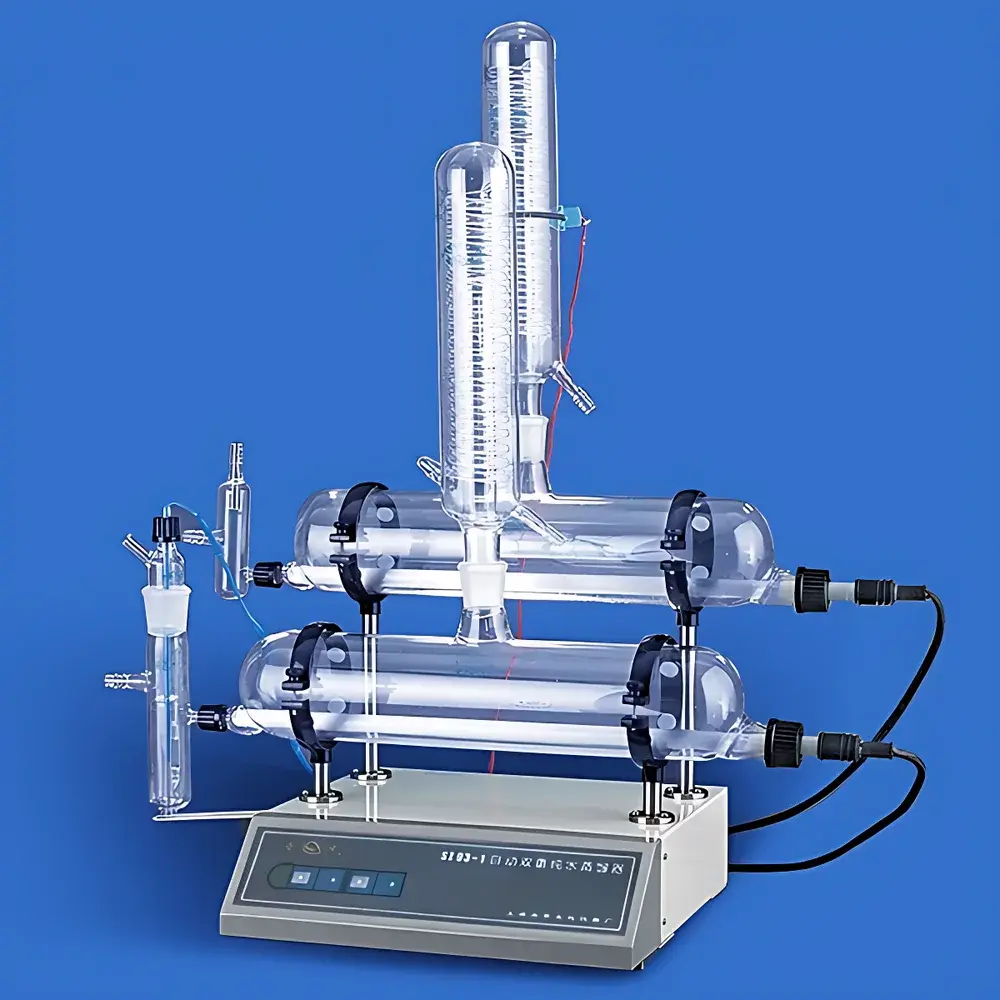
SZ-93-1 Automatic Dual-Stage Laboratory Water Distiller by Shanghai Yarong
| Brand | Jinye |
|---|---|
| Origin | Shanghai, China |
| Manufacturer Type | Direct Manufacturer |
| Country of Origin | China |
| Model | SZ-93-1 |
| Price | Upon Request |
| Output Rate | 1600 mL/h |
| Control Interface | Touchscreen |
| Distillation Stages | Two-Stage (Primary + Secondary) |
| Application | Production of Reagent-Grade Double-Distilled Water (Type I–II per ISO 3696 / ASTM D1193) |
Overview
The SZ-93-1 Automatic Dual-Stage Laboratory Water Distiller is an engineered solution for the reliable, continuous production of high-purity double-distilled water in research, quality control, and analytical laboratories. Designed and manufactured by Shanghai Yarong — a long-standing Chinese producer of laboratory purification equipment — this unit implements a sequential two-stage vapor-condensation cycle to remove non-volatile impurities, dissolved ions, organic contaminants, and microbial byproducts that persist after single-stage distillation. Unlike simple boiling-type stills, the SZ-93-1 incorporates an integrated reflux condenser between stages to enhance separation efficiency and thermal stability, yielding water with resistivity typically exceeding 1.0 MΩ·cm at 25 °C — consistent with Type II water specifications defined in ISO 3696:2011 and ASTM D1193-20. Its fully enclosed stainless-steel (304-grade) distillation chamber and borosilicate glass condensers ensure chemical inertness and minimize leaching, while the sealed vapor path prevents atmospheric recontamination during condensation.
Key Features
- Touchscreen human-machine interface (HMI) enabling intuitive operation, real-time status monitoring, and programmable start/stop cycles
- Dual-stage distillation architecture with primary evaporation and secondary re-distillation in a single integrated housing
- Stainless steel (AISI 304) boiling chamber and feed reservoir, corrosion-resistant and compliant with GLP cleaning protocols
- Automated water level sensing and low-water cutoff protection to prevent dry-heating and extend heating element service life
- Overtemperature and overpressure safety interlocks meeting IEC 61010-1 requirements for laboratory electrical equipment
- Consistent output rate of 1600 mL/h under standard operating conditions (tap water feed, ambient 20–25 °C, 45–65% RH)
- Modular design supporting benchtop installation; compact footprint (approx. 420 × 320 × 680 mm) suitable for ISO Class 5–7 lab environments
Sample Compatibility & Compliance
The SZ-93-1 accepts municipal tap water, deionized water, or pre-filtered feed sources as input. It is not intended for direct use with seawater, highly turbid, or chemically aggressive industrial effluents. Feed water hardness ≤ 200 ppm CaCO₃ equivalent is recommended to minimize scale accumulation. The distilled output meets the purity thresholds required for critical applications including buffer preparation, spectrophotometric standards, HPLC mobile phase make-up (where Type II water is acceptable), and microbiological media sterilization. While not certified to ISO/IEC 17025, the system’s operational repeatability and built-in safeguards support adherence to internal SOPs aligned with GLP and GMP documentation practices. Documentation packages include factory calibration records, material certifications for wetted parts, and CE-marked electrical compliance reports.
Software & Data Management
The SZ-93-1 operates via embedded firmware without external PC dependency. The touchscreen interface logs runtime hours, total volume dispensed (cumulative counter), and fault event timestamps (e.g., “Low Water Alert – 2024-06-12 14:32”). Data export is not supported via USB or network ports; however, manual logging is facilitated through on-screen readouts and audible alerts. For regulated environments requiring audit trails (e.g., FDA 21 CFR Part 11), users may integrate the unit into broader lab infrastructure using external PLC-based monitoring systems or environmental data loggers connected to its dry-contact alarm outputs. Firmware updates are performed locally via microSD card — revision history and update instructions are provided in the English-language technical manual shipped with each unit.
Applications
- Preparation of double-distilled water for trace-metal analysis (e.g., AAS, ICP-OES sample dilution)
- Formulation of calibration standards and reference solutions where residual sodium, chloride, or silica must be minimized
- Feedstock for ultrapure water systems (e.g., as pre-treatment for Type I water generation via EDI or polishing cartridges)
- Pharmaceutical QC labs performing dissolution testing or excipient compatibility studies per USP
- Educational laboratories requiring robust, low-maintenance distillation platforms for undergraduate chemistry curricula
- Environmental testing labs preparing blanks and reagents for EPA Method 200.7 or 200.8 analyses
FAQ
What feed water quality is recommended for optimal performance and reduced maintenance?
Tap water with total dissolved solids (TDS) below 300 ppm and hardness below 200 ppm CaCO₃ is advised. Pre-filtration via sediment and activated carbon filters extends service intervals between descaling.
Can the SZ-93-1 produce water compliant with CLSI EP28-A3c or ISO 15195 for clinical laboratory use?
No — it delivers Type II water per ISO 3696, not the higher-purity Type I required for clinical reference measurement procedures. It is not validated for diagnostic reagent preparation.
Is the unit compatible with continuous feed from a central water supply?
Yes, when equipped with an optional solenoid-controlled inlet valve kit (sold separately); manual fill mode remains standard.
What materials contact the water during distillation?
Boiling chamber and feed tank: AISI 304 stainless steel. Condensers and collection vessel: Borosilicate glass (Duran®-grade equivalent). Seals: Food-grade silicone.
Does the device include a built-in storage tank?
No — it is a continuous-output still. Distillate flows directly into an external container; a 2-L borosilicate receiver is supplied as standard.



