
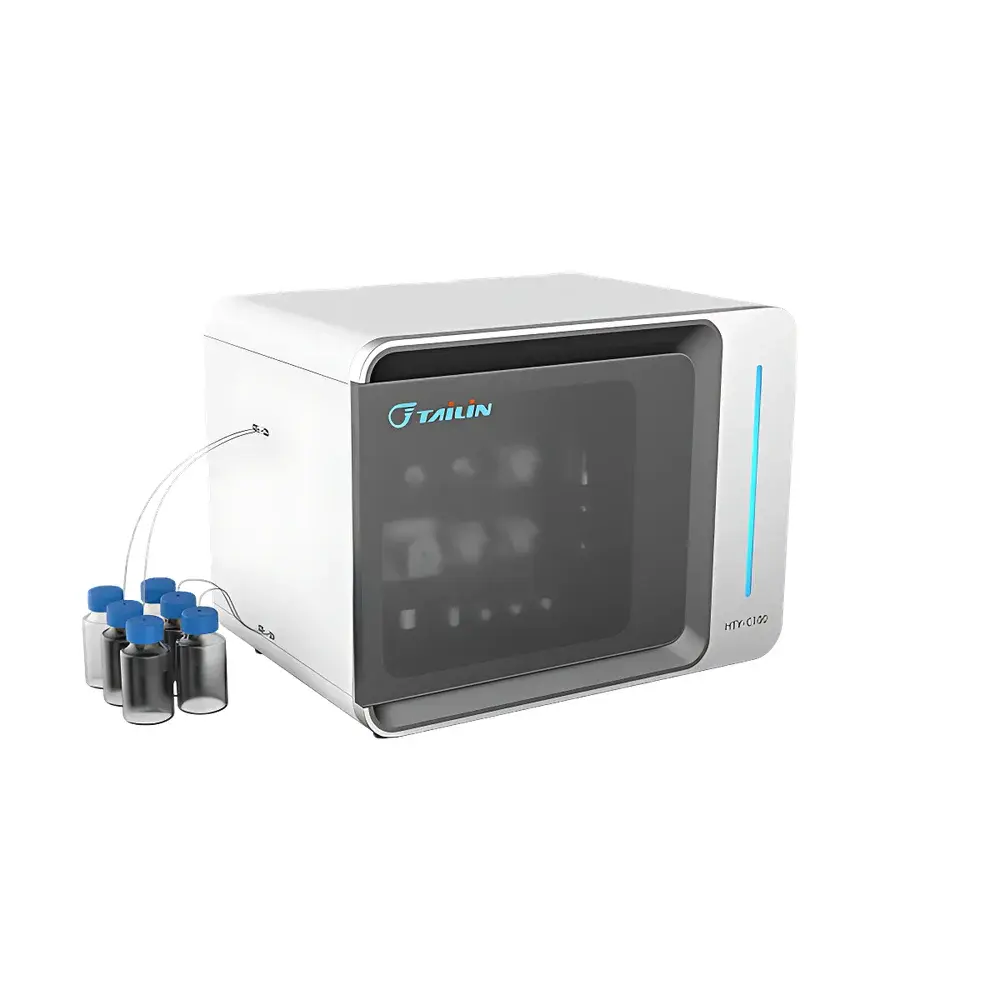
Tailin Biotech C100 Total Organic Carbon (TOC) Enrichment Analyzer
| Brand | Tailin Biotech |
|---|---|
| Origin | Zhejiang, China |
| Manufacturer Type | OEM/ODM Manufacturer |
| Country of Origin | China |
| Model | C100 |
| Oxidation Method | High-Temperature Catalytic Combustion |
| Sample Volume Range | 1–100 mL (customizable) |
| TOC Measurement Range | 0–1000 mg/L |
| Oxidation Efficiency | ≥99% |
| CO₂ Absorption Efficiency | ≥95% |
| Analysis Time | 2–60 min (programmable per sample volume) |
| Detection Limit | 0.1 µg C |
| Maximum Permissible Error | ±5% |
| Repeatability (RSD) | ≤5% |
| Dimensions | 700 × 500 × 500 mm |
Overview
The Tailin Biotech C100 Total Organic Carbon (TOC) Enrichment Analyzer is a benchtop, high-precision instrument engineered for reliable quantification of non-purgeable organic carbon in aqueous matrices using high-temperature catalytic combustion oxidation—fully compliant with ISO 8245, USP <643>, and ASTM D7573 methodologies. Unlike UV/persulfate-based systems, the C100 employs a dual-stage thermal oxidation process at 680 °C with platinum-coated catalyst support, ensuring complete mineralization of recalcitrant organics—including humic substances, surfactants, and pharmaceutical residues—into CO₂. The evolved CO₂ is then selectively absorbed in a proprietary amine-based capture reagent, followed by gravimetric or conductometric quantification. This architecture delivers robust performance across low-conductivity ultrapure water, high-salinity industrial effluents, and complex biological process streams—without matrix-induced suppression or memory effects.
Key Features
- Fully automated workflow: Integrated syringe-driven liquid handling enables unattended sample injection, acid spiking, purge gas control, reactor heating/cooling cycles, condensate drainage, and system rinsing—all governed by embedded real-time logic.
- High-capacity reaction chamber: Accommodates up to 100 mL single-sample volumes—optimized for regulatory compliance testing of wastewater discharge, bioreactor harvests, and environmental leachates where dilution would compromise detection integrity.
- Modular hardware architecture: Separable oxidation module, absorption cell, detector assembly, and fluidic manifold allow field-replaceable component servicing without full-system recalibration or downtime.
- Adaptive time-resolved analysis: User-defined analysis duration (2–60 min) dynamically synchronizes furnace ramp profiles, gas flow rates, and integration windows to match sample load and matrix complexity—maximizing throughput without sacrificing accuracy.
- Low-particulate fluid path: All wetted surfaces are constructed from PFA, quartz, and inert ceramics; no stainless-steel contact with sample or reagents minimizes metal-catalyzed side reactions and blank contributions.
Sample Compatibility & Compliance
The C100 accepts a broad spectrum of aqueous samples—including purified water (PW), water-for-injection (WFI), municipal wastewater, landfill leachate, cooling tower blowdown, and biopharmaceutical process intermediates—without pre-filtration when turbidity remains below 5 NTU. It meets the instrumental requirements outlined in FDA 21 CFR Part 11 for electronic records and signatures when operated with Tailin’s validated LIMS-integrated software suite. System validation documentation supports IQ/OQ/PQ protocols aligned with EU GMP Annex 15 and WHO TRS 992. All calibration standards (potassium hydrogen phthalate, sucrose) are traceable to NIST SRM 84d.
Software & Data Management
Tailin TOC Suite v3.2 provides audit-trail-enabled operation with role-based access control (RBAC), electronic signature capture, and automatic generation of 21 CFR Part 11-compliant PDF reports—including raw chromatograms, calibration curves, system suitability summaries, and uncertainty budgets. Data export supports CSV, XML, and ASTM E1384-compliant formats for seamless integration into enterprise quality management systems (QMS) such as TrackWise or Veeva Vault. Optional OPC UA server module enables real-time telemetry to SCADA or MES platforms for continuous environmental monitoring applications.
Applications
- Pharmaceutical water system validation and routine monitoring per USP <643> and EP 2.2.44
- Environmental compliance reporting under EPA Method 415.3 and ISO 14852 for industrial effluent discharge
- Biotechnology upstream/downstream process characterization—cell culture media, buffer solutions, and final product hold tanks
- Research-grade carbon budgeting in limnology, soil leaching studies, and microplastic degradation assays
- Power plant demineralizer outlet surveillance and steam cycle purity assurance
FAQ
What oxidation method does the C100 use, and why is it preferred for regulatory applications?
The C100 utilizes high-temperature (680 °C) catalytic combustion with Pt/Rh catalyst support—delivering >99% oxidation efficiency across diverse organic structures. This approach is mandated by USP <643> for WFI testing and avoids the incomplete oxidation risks associated with UV/persulfate methods.
Can the C100 analyze samples with high chloride content?
Yes—its closed-loop CO₂ absorption design and chloride-tolerant reagent formulation eliminate interference from Cl⁻ concentrations up to 10,000 mg/L without requiring post-oxidation scrubbing.
Is method transfer supported from legacy TOC platforms?
Tailin provides documented equivalency protocols—including spike recovery studies and inter-instrument RSD comparisons—for seamless migration from Shimadzu TOC-L, GE Sievers 900, or Elementar vario TOC select systems.
Does the system require daily maintenance or consumable replacement?
The modular design permits quarterly catalyst cartridge replacement and annual detector cell cleaning—no daily reagent refills or gas cylinder changes are required under standard operating conditions.
How is data integrity ensured during power interruption or network failure?
All measurement sequences execute locally on the embedded ARM Cortex-A9 controller; raw sensor data is buffered to non-volatile flash memory and auto-resumed upon recovery—zero data loss even during unscheduled shutdowns.







